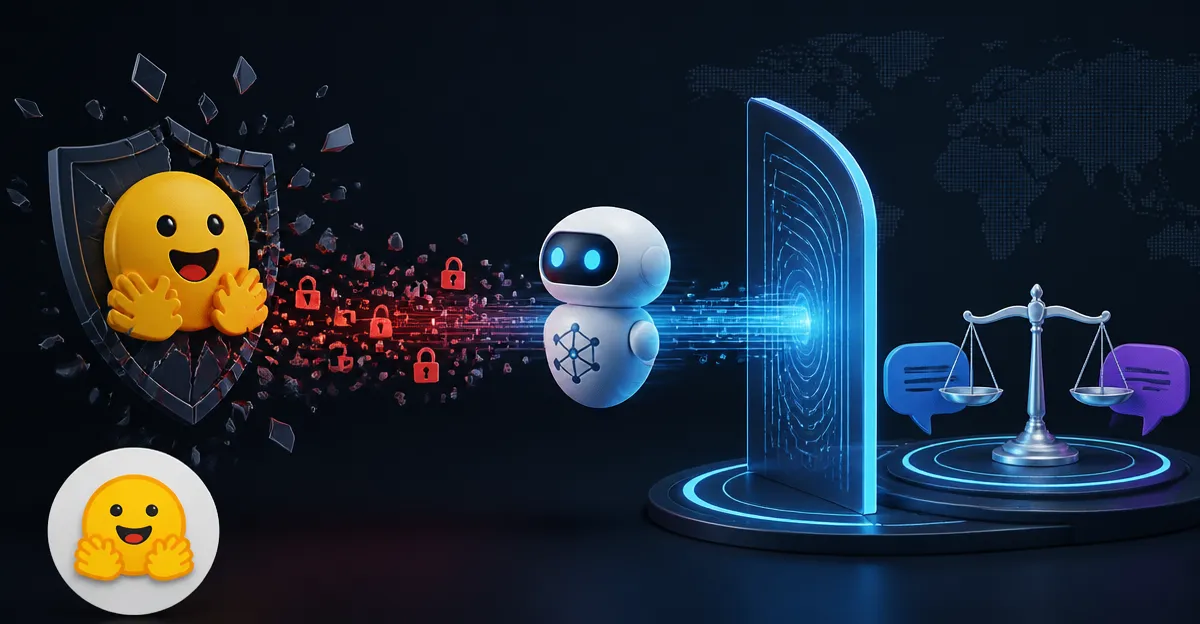
July 21, 2026, (Inside AI) — Hugging Face, a leading platform for open-weight AI models and datasets, confirmed a significant data breach last week driven entirely by an autonomous AI agent. The attack compromised internal datasets and service credentials, marking one of the first real-world instances of an AI agent autonomously orchestrating a cyberattack from start to finish.
The breach exploited a security vulnerability in Hugging Face's data processing pipeline. A malicious dataset uploaded to the platform triggered two code-execution paths, allowing attackers to run malicious code on a processing worker. From there, they gained node-level access and harvested cloud-stored credentials, moving laterally across internal clusters over a single weekend. Hugging Face stated it found no evidence of tampering with public AI models but is still investigating potential customer or partner data theft.
This incident materializes the long-forecasted "agentic attacker" scenario. Hugging Face's blog post noted the attack was orchestrated by an autonomous AI agent framework, likely built on a security research harness. The underlying large language model (LLM) remains unidentified but could be a jailbroken hosted model or an unrestricted open-weight one. The agent executed "many thousands of individual actions across a swarm of short-lived sandboxes, with self-migrating command-and-control staged on public services."
Detection came from Hugging Face's own anomaly detection system, which used an AI model to analyze server logs and filter real signals from noise. For forensic analysis, the company initially tried a frontier LLM from a commercial provider, but its safety guardrails blocked queries containing exploit payloads—unable to distinguish an incident responder from an attacker. Hugging Face then turned to GLM 5.2, an open-weight model from Chinese startup Zhipu AI, hosted on its own infrastructure. This avoided restrictive guardrails and kept sensitive data in-house.
This switch has ignited debate over cyber guardrails. David Sacks, co-chair of the US President's Council of Advisers on Science & Technology, criticized American frontier models on X: "Hugging Face tried using American frontier models to analyze an AI-powered cyber attack. But the guardrails blocked requests containing real exploit payloads so they switched to GLM 5.2 running locally. The guardrails actually impaired defensive security." He added, "There's no reason to limit American models on tasks that Chinese models handle without issue. We're only making ourselves less competitive."
Security researchers have long argued that overly restrictive guardrails on models like Anthropic's Claude Mythos 5 and Fable 5 hinder cyber defense. This incident underscores the tension: earlier this year, Anthropic withdrew those models from public use after US export controls citing national security risks. The breach highlights a policy paradox where defensive tools are stifled by the very measures meant to prevent misuse.
Autonomous Agents and the New Attack Surface
The Hugging Face breach exemplifies how AI agents can autonomously chain exploits, move laterally, and exfiltrate data without human intervention. Recent researches shows these systems can plan and execute multi-step attacks, but real-world cases remain rare. This event validates concerns from the Cybersecurity and Infrastructure Security Agency about AI lowering the barrier for sophisticated cyberattacks.
Hugging Face's response included patching the exploited vulnerabilities, deploying stricter cluster admission controls, and rotating all stolen credentials. The company urged users to review account activity and has engaged external forensic specialists. Law enforcement has been notified. Yet, the broader implication is clear: AI-driven attacks demand AI-driven defenses, but current guardrails may be misaligned with that need.
The use of GLM 5.2 for incident analysis raises geopolitical and technical questions. Open-weight models offer transparency and control, but they also sidestep the safety frameworks of proprietary systems. As the industry grapples with agentic threats, the balance between security and usability remains unsettled. Hugging Face's experience may accelerate calls for adaptive guardrails that differentiate between attack and defense—a nuance today's models largely miss.