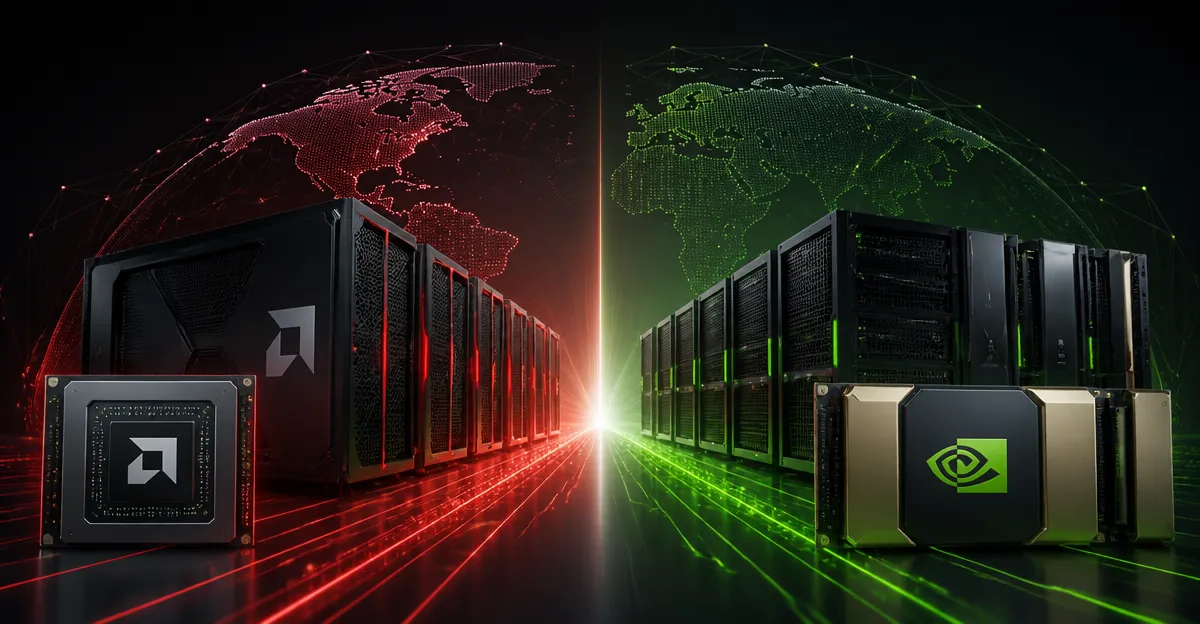
July 23, 2026, (Inside AI) — Advanced Micro Devices is set to unveil a next-generation AI infrastructure lineup Thursday in San Francisco, directly targeting Nvidia’s dominance in the data center chip market. The event at Moscone West will feature the formal launch of the Venice central processing unit and the first-generation Helios server rack, a design AMD is positioning as a rival to Nvidia’s second-generation rack offering.
The push comes at a critical moment. Nvidia this week disclosed technical details of its Vera CPU, claiming superior performance-per-watt for AI agent workloads when paired with its “Rubin” GPU. AMD’s countermove is not just about specs—it’s about ecosystem lock-in. By showcasing Helios alongside cloud providers Vultr and TensorWave, AMD signals that its hardware is ready for scaled inference deployments.
Inference, the computation behind every chatbot query, is where AMD sees its opening. Nvidia’s CUDA software moat is thinner here than in training. AMD’s ROCm open-source software stack has matured, and the company is betting that cloud operators want a second source to avoid vendor lock-in and negotiate pricing.
The stakes are enormous. AMD announced Wednesday a deal to sell up to two gigawatts of its Instinct MI450 chips to AI lab Anthropic, starting in the first half of 2027. The agreement includes an investment of as much as $5 billion in the Claude maker. That follows an October multiyear pact with OpenAI, which could bring in tens of billions in annual revenue and gives the ChatGPT creator an option to buy up to roughly 10% of AMD’s shares.
These deals aren’t just purchase orders. They’re strategic alliances that embed AMD into the fabric of frontier AI development. Anthropic’s commitment signals confidence that AMD’s roadmap can support large-scale inference for models like Claude. OpenAI’s equity option aligns its incentives with AMD’s long-term success.
Yet Nvidia isn’t standing still. Its Vera CPU and Rubin GPU are designed to maximize work per watt, a metric that hyperscalers obsess over. Nvidia’s integrated hardware-software stack still offers a cohesive experience that AMD must match. The Helios rack, while a first for AMD, enters a market where Nvidia’s second-generation rack is already shipping.
AMD’s event is as much about perception as product. Hundreds of executives and engineers gathered Wednesday for technical sessions, a Reuters witness reported. The showroom floor, with Helios at center stage, is a physical manifestation of AMD’s ambition to be seen as a peer, not a follower.
The data center CPU refresh with Venice adds another layer. CPUs remain critical for general-purpose compute in AI pipelines, and AMD’s EPYC line has gained share against Intel. A strong Venice launch could tighten AMD’s grip on the full-stack narrative from CPU to GPU to rack-scale systems.
Investors will watch for performance benchmarks, pricing, and partner commitments. But the deeper story is about the industry’s shift from a single-vendor GPU market to a more competitive landscape. As AI workloads diversify, the market may reward specialization and openness. AMD’s challenge is to prove that its open ecosystem can deliver the same ease of deployment as Nvidia’s integrated approach.
Anthropic’s two-gigawatt commitment is a tangible vote of confidence. In the rarefied world of AI infrastructure, power is the ultimate currency. Securing that much capacity suggests AMD’s MI450 is not just a contender. It’s a pillar of Anthropic’s scaling strategy. The deal’s timing, ahead of the Thursday launch, is a calculated leak that frames the event around customer validation, not just product specs.
AMD’s multiyear OpenAI deal, disclosed in October, added a financial dimension. The option for OpenAI to acquire up to 10% of AMD ties the chipmaker’s fortunes to the most visible AI company. It’s a symbiotic relationship: OpenAI gains supply chain diversity, AMD gains a flagship customer that can accelerate its software ecosystem.
Technical details on Venice remain sparse, but the CPU is expected to build on AMD’s chiplet architecture, offering high core counts and memory bandwidth. In AI servers, CPUs handle data preprocessing, orchestration, and inference for smaller models, tasks that demand strong single-thread performance and I/O. Venice will compete directly with Nvidia’s Vera and Intel’s upcoming Granite Rapids.
The Helios rack integrates AMD’s Instinct GPUs, EPYC CPUs, and networking into a validated, pre-configured system. This is a departure from AMD’s traditional component-sales model. By offering a rack-scale design, AMD mimics Nvidia’s DGX strategy, aiming to reduce integration complexity for cloud builders. The challenge will be matching Nvidia’s software-defined networking and management tools.
As the AI infrastructure race intensifies, the battle is shifting from raw teraflops to total cost of ownership. AMD’s open-source ROCm stack may appeal to hyperscalers that want to customize their software environment. But Nvidia’s CUDA remains the de facto standard, with a vast library of optimized libraries and developer mindshare. AMD’s success hinges on whether its hardware can attract enough software investment to create a self-sustaining ecosystem.