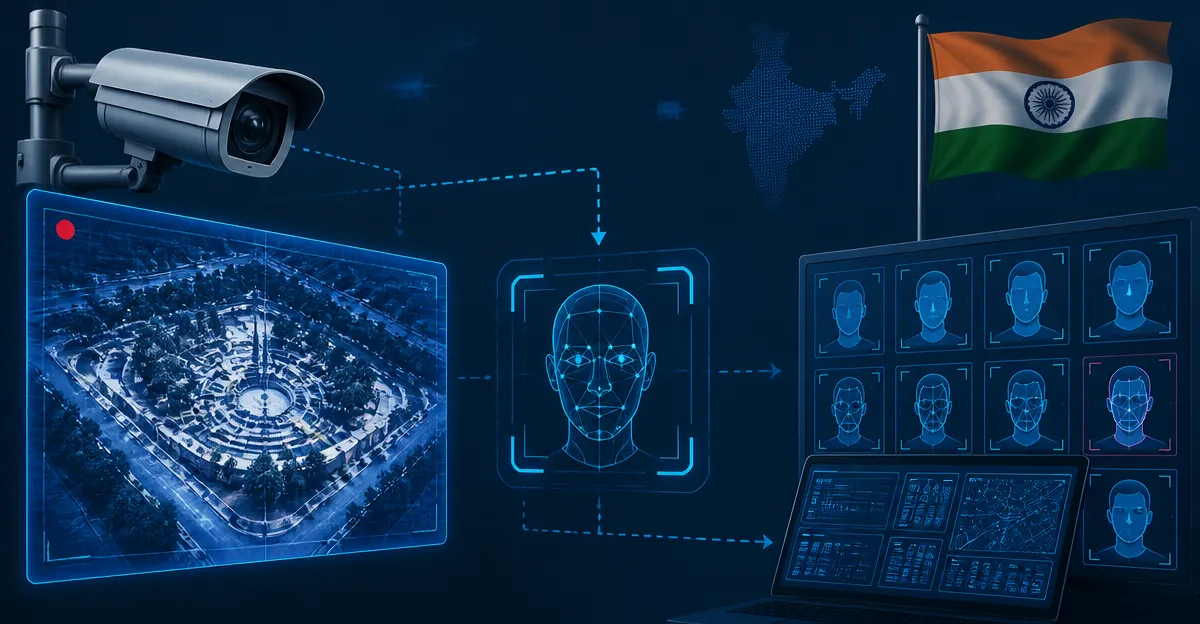
July 24, 2026, (Inside AI) — Delhi Police have deployed mobile surveillance vans equipped with AI-aided facial recognition at the Jantar Mantar student protest, scanning demonstrators against criminal databases through live video feeds. The operation, which began earlier this week, has drawn a legal challenge in the Delhi High Court, spotlighting the absence of a dedicated legal framework for such policing tools.
The deployment includes two specialized vehicles: a Mobile Command and Control Vehicle for monitoring live CCTV feeds, and Ikshana, a van first used during the 2023 G20 Summit. Ikshana carries eight fixed cameras providing 360-degree coverage and, according to technology partner CP Plus, supports face detection and recognition, number-plate recognition, and on-the-spot video analytics. At the protest site, the system places boxes around detected faces and compares them with police database images.
A senior Delhi Police officer told The Indian Express the aim is to flag anyone matching their criminal database. However, the force has not disclosed the database’s size, the software’s accuracy in the field, or the protocol after a potential match. In a 2022 RTI response, Delhi Police stated a match is considered “positive” at an 80% accuracy threshold—a figure that underscores the risk of false positives, especially given performance variations across demographics.
Facial recognition systems convert facial features into digital templates and compare them against watchlists. The technology’s reliability hinges on algorithm design, lighting, camera angles, and image quality. Without independent audits or clear human verification steps, errors can cascade.
Protesters say the constant recording has created a chilling effect. Several students covered their faces, fearing footage could reach families, schools, or employers. Former JNU Students’ Union president Aishe Ghosh has petitioned the Delhi High Court, alleging “continuous, indiscriminate and intrusive surveillance” that violates rights to privacy, dignity, free speech, and peaceful assembly.
During a July 20 hearing, Solicitor General Tushar Mehta, representing Delhi Police, argued the videography is solely for law and order, not snooping. The court asked whether police have a standard operating procedure aligned with Supreme Court directions on protest handling.
India’s Digital Personal Data Protection Act, 2023, defines facial images as personal data but exempts processing for crime prevention or investigation under Section 17. The law lacks specific rules on watchlist management, matching thresholds, retention periods, or independent audits. One officer admitted there are no fixed retention guidelines for protest footage, as it could be needed for future investigations.
The constitutional stakes are high. The Supreme Court’s 2017 right-to-privacy ruling requires any restriction to be legal, necessary, and proportionate. The core question is whether continuous identification at a peaceful protest is a narrowly tailored safety measure or a disproportionate intrusion treating all participants as suspects.
Beyond Jantar Mantar, Indian police are increasingly adopting AI-powered surveillance: CCTV networks, drone monitoring, and automated number plate recognition. Reports also mention Delhi Police using AI-enabled smart glasses from Indian firm AjnaLens during Republic Day celebrations, featuring integrated facial recognition and thermal imaging. These tools, while touted for efficiency, operate in a regulatory vacuum that civil liberties groups say threatens fundamental freedoms.