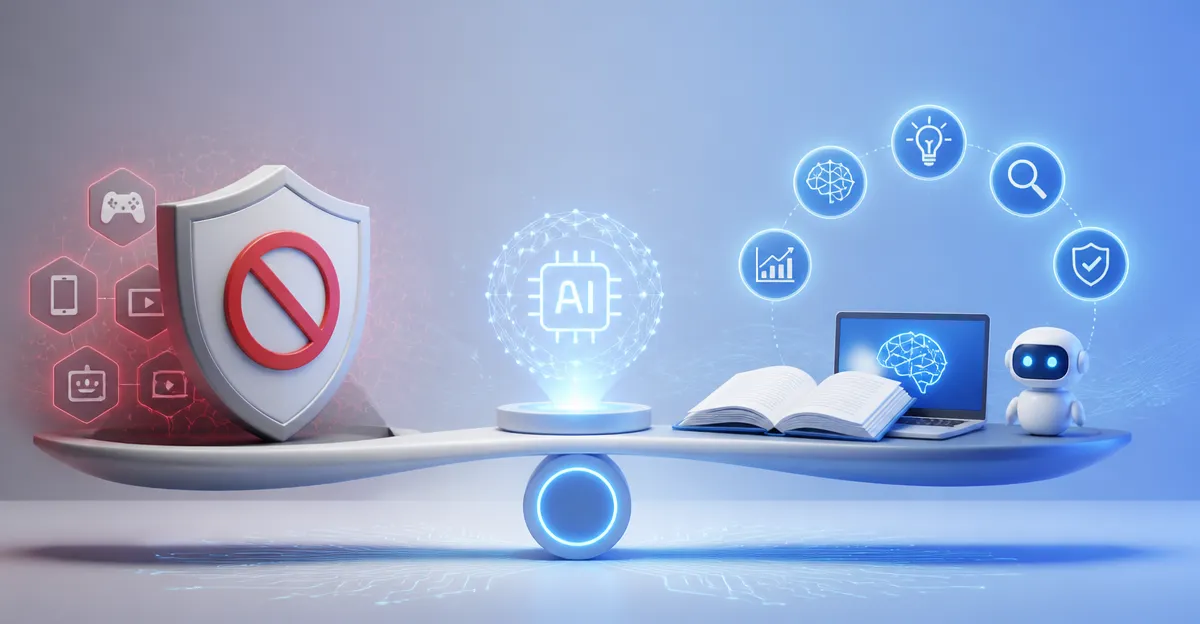
September 5, 2026, (Inside AI) — A divide is growing in how adults view children's technology use. New survey data shows overwhelming support for banning social media among young children, but strong opposition to banning AI tools like ChatGPT in schools.
The Ipsos Education Monitor 2026 found that 78% of Indian respondents support banning social media for children under 14, and 57% support banning smartphones in schools. Yet only 26% favor banning AI, including ChatGPT, from schools, while 61% oppose such a ban.
This split reflects a deeper psychological distinction. A child psychologist quoted in the report noted that children do not experience all technology the same way. A platform designed to keep a child scrolling, checking, comparing, and returning for social validation is fundamentally different from a tool that helps a student understand a difficult concept or explore an unfamiliar subject.
The screen is no longer the useful unit of measurement. Two hours watching curated videos and checking notifications is not equivalent to two hours creating something, researching a subject, or engaging with an AI tool under a teacher's guidance.
What Technology Does to a Developing Brain
Social media is particularly complicated because it can become part of a child's social identity. For adolescents, peer approval is developmentally significant. Social comparison is already heightened during these years. Add an environment where popularity is measured in likes, followers, and views, and the psychological stakes become considerably higher.
There is also the absence of a natural stopping point. A book ends. A television programme ends. A classroom ends. The social media feed does not. For a developing brain still acquiring impulse control, planning, and delayed gratification, an environment engineered around continuous engagement is a formidable opponent.
This is why the psychologist supports meaningful age-based restrictions on social media for younger children, alongside stronger protections around nighttime access. A child's bedroom should be allowed to remain a bedroom. Sleep should not have to compete with notifications, group chats, and the fear of missing out.
Childhood needs periods of psychological quiet time when a young person is not performing, comparing, or responding to an invisible audience.
AI Literacy as a Shield Against Cognitive Passivity
AI brings a very different question into the classroom. We cannot prepare children for the future while pretending the future will not arrive. AI is already changing how information is accessed, how work is produced, and how people solve problems. For today's children, learning how to engage with AI responsibly will eventually be as important as learning how to search for information online.
If a student uses ChatGPT to ask why they got a mathematics problem wrong, AI can potentially deepen learning. If a student asks it to explain a difficult scientific concept in three different ways, it can make learning more accessible. If a teacher gives students an AI-generated answer and asks them to identify its errors, the technology itself becomes an exercise in critical thinking.
The danger is cognitive passivity. There is developmental value in struggling with a difficult problem. There is value in writing an imperfect first draft, making an error, revising an argument, and discovering that you can eventually solve something that initially felt beyond you. If a child begins outsourcing every difficult cognitive task to a machine, we need to ask what happens to those capacities.
We could eventually have students who are exceptionally good at obtaining answers while becoming increasingly uncomfortable with uncertainty and intellectual struggle. It is an argument for AI literacy that includes psychological literacy. Children need to understand when technology is helping them think and when it is quietly doing the thinking for them.
The survey also identifies depression and anxiety among the significant challenges facing young people in India, with 30% of respondents identifying mental health challenges as a concern. The effects of social media and technology, including AI, were cited by 26%.
These findings deserve attention, but they also require nuance. A young person's mental health does not emerge from an app alone. Family relationships, academic pressure, loneliness, peer dynamics, socioeconomic circumstances, sleep, temperament, and access to psychological support all contribute. Social media can amplify vulnerability, but removing an app does not automatically create connection, confidence, or emotional security.
We cannot outsource the emotional development of children to legislation. Parents still have to create boundaries. Schools still have to teach emotional and digital literacy. Adults still have to notice when a child's behaviour changes. And parents need to examine their own behaviour. It is difficult to teach children that constant connectivity is unhealthy when the adults around them are checking their phones throughout dinner, conversations, and family time.
The Ipsos findings offer another striking insight. 72% of Indians surveyed believe young people in the country have a bright future, the highest figure among the 31 countries surveyed. Protecting children from harmful technology should not come from fear of the future. It should come from confidence that children deserve the time and developmental space to grow before being exposed to everything the adult digital world has to offer.
Age-appropriate boundaries are therefore essential. A 10-year-old does not need the same digital freedoms as a 16-year-old. A 16-year-old will eventually need more autonomy, along with the skills to exercise it responsibly. This progression is fundamental to child development.
At some point, every child has to move from external regulation to self-regulation. That is why a ban can be useful as a protective boundary, but it cannot be the entire solution. If we want children to navigate a world saturated with technology, we have to teach them how technology works on them. They should understand algorithms and attention. They should understand social comparison and digital footprints. They should understand misinformation, privacy, and persuasion. They should know that an algorithm is not a friend, a notification is not validation, and an AI-generated answer is not automatically the truth.
We need stronger protections around technologies that exploit immature attention systems. We need thoughtful regulation around children's access to social media. We need boundaries around sleep and smartphones. And we need schools that teach children how to use emerging technologies with judgement rather than simply banning them out of anxiety. Most importantly, we need adults who understand that technology policy cannot replace parenting, teaching, or relationships.
The real educational challenge of the AI era may therefore be remarkably simple to state: can we teach children to remain intellectually curious when a machine is always ready with an answer? If we can, then perhaps we will have achieved something more valuable than either a ban or unrestricted access. We will have raised a generation capable of using powerful technology without being controlled by it.