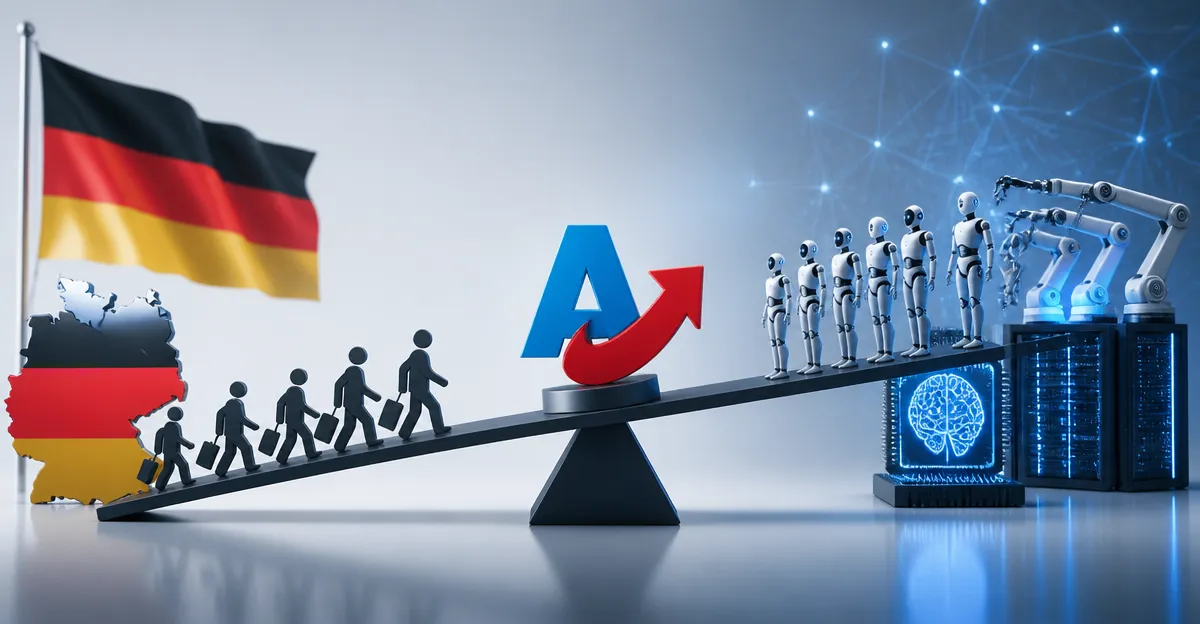
September 5, 2026, (Inside AI) — Germany’s far-right Alternative für Deutschland party is betting that artificial intelligence can replace migrant labor, a claim that is drawing scrutiny from economists and technology analysts ahead of a pivotal regional election in Saxony-Anhalt.
The party, known as AfD, has made immigration restriction a central plank of its platform. Now, some of its leaders argue that AI and automation could fill labor gaps in manufacturing, agriculture, and elder care, sectors that currently rely heavily on foreign workers.
This economic wager is the focus of a new episode of Econ World, where host Carmel Crimmins examines how similar promises have played out in other European countries.
The core question is whether AI can truly substitute for human labor at the scale and speed that AfD suggests. Germany’s economy is already facing a shortage of skilled workers, with official estimates pointing to a deficit of hundreds of thousands of positions in engineering, IT, and healthcare.
Automation has transformed some industries, but economists caution that AI is not a simple swap for migrant labor. Tasks requiring physical dexterity, emotional intelligence, or local cultural knowledge remain difficult to automate.
In agriculture, for instance, robotic harvesting has made progress but still struggles with delicate crops. In elder care, AI can assist with monitoring and documentation, yet human caregivers remain essential for patient interaction and trust.
AfD’s economic argument also ignores the demographic reality. Germany’s native-born workforce is aging and shrinking. Even with aggressive automation, many experts say the country will still need immigration to sustain its pension system and public services.
Historical examples from Europe offer cautionary tales. In the United Kingdom, post-Brexit labor shortages in hospitality and logistics were only partially offset by automation, leading to higher costs and reduced services in some regions.
In Italy, efforts to use robotics in small manufacturing firms have been slow, partly due to high upfront investment and the need for specialized maintenance skills.
AfD has not released a detailed cost analysis for its AI substitution plan. Critics say the party is using technology as a rhetorical device to soften the economic consequences of its anti-immigration stance.
The Saxony-Anhalt vote is being watched as a bellwether for national politics. If AfD performs strongly, it could embolden similar arguments across Europe, where far-right parties are increasingly pairing nativist rhetoric with tech-forward promises.
Yet the gap between political messaging and economic feasibility remains wide. AI can boost productivity, but it does not automatically create a self-sufficient labor force in a country with a declining birth rate.
Carmel Crimmins’ investigation highlights a deeper tension: voters may be attracted to the idea of technological self-reliance, but the practical costs and timelines are rarely spelled out in campaign speeches.
For now, the AfD’s bet remains untested. Germany’s industrial base, from automotive to chemicals, depends on complex supply chains and a flexible labor market. Replacing that with AI would require a level of investment and infrastructure that no major German party has seriously proposed.
The episode also touches on how automation could reshape political debates beyond Germany. If AI proves capable of filling labor shortages, it could reduce the economic pressure to accept migrants, but that scenario is still speculative.
As Saxony-Anhalt prepares to vote, the question is not just who wins, but whether a party can build a credible economic platform on a technology that is still evolving.