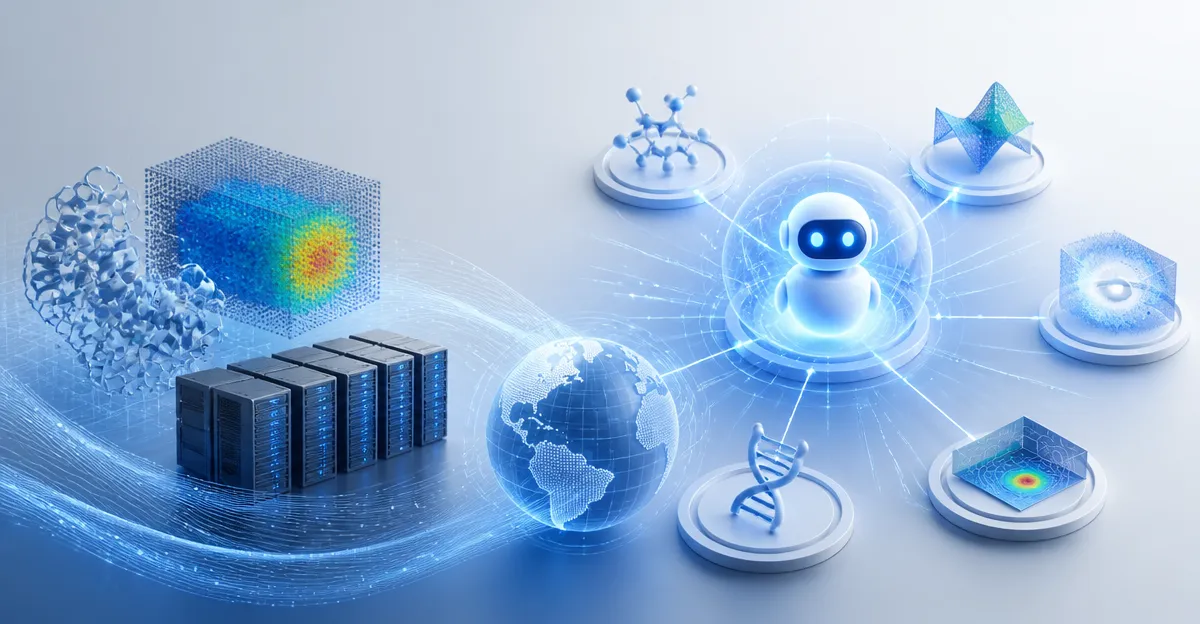
July 29, 2026, (Inside AI) — Scientific software is the invisible backbone of modern research, yet much of it is built on fragile foundations. A new field report from OpenAI reveals how coding agents are transforming this landscape, enabling small teams to modernize critical tools in genomics and beyond at unprecedented speed.
The report documents eight agent-assisted projects, primarily in the life sciences, where researchers used Codex alone or in combination with Claude Code to tackle tasks ranging from routine maintenance to full language migrations. The findings point to a fundamental shift: researchers are moving from implementation to orchestration, defining goals and verifying outputs while agents handle the heavy lifting.
Contributors consistently reported that agents significantly accelerated development, in some cases making feasible work that would have required far more time or specialized engineering support. However, the report also underscores a persistent challenge: establishing long-term responsibility and stewardship for the resulting tools.
The case studies span a wide scope. Five projects used Codex alone, while three combined Codex and Claude Code. One team modernized MHCflurry, a tool for predicting peptide-MHC binding, rewriting it in JAX to leverage GPU acceleration. Another migrated cyvcf2, a Python library for parsing genomic variant files, to a more maintainable codebase. A third project, rustar-aligner, involved rewriting an abandoned aligner in Rust, which then found new community stewardship.
These efforts highlight a recurring theme: agents excel at well-scoped, specific requests but cannot reliably judge scientific validity. As the report notes, agents often expressed confidence even when their work contained clear errors. This places a premium on human verification, with the strongest approaches using external references or measurable acceptance targets.
“Agents often produced initial implementations quickly, but resolving edge cases and subtle numerical differences took much longer,” the report states. “Completing the ‘last mile’ of an implementation often took the most work.”
The maintenance gap in research software has long slowed iteration and limited reproducibility. Published studies have found that many tools fail to install or run as documented, forcing researchers to spend substantial time on configuration and debugging. Even routine improvements can save time and reduce computing demands, while performance-based refactoring can deliver larger gains.
But lower implementation costs also make it easier to produce many similar rewrites, fragmenting users and spreading expert attention thin. The report emphasizes that mature scientific software carries undocumented conventions, compatibility requirements, and user trust that translating source code alone cannot reproduce. Long-term stewardship and attribution remain essential.
The case studies illustrate several possible paths forward. Changes to MHCflurry and cyvcf2 were incorporated into their original upstream projects, while rustar-aligner moved under new community stewardship because the original project had been abandoned. The report advises that coordination with existing maintainers should begin as early as possible, and when a separate implementation is necessary, it needs a clear owner and a credible maintenance plan.
“Without that, today’s modern rewrite can become tomorrow’s abandoned code rather than reliable scientific infrastructure,” the report warns.
This field report is retrospective and exploratory, but it points to a practical shift. Coding agents such as Codex can significantly lower the cost of maintenance, migration, optimization, and new implementations. Their long-term scientific value still depends on human decisions around what to build, how to verify it, and who will maintain it. The deeper change is not simply that researchers can produce more software, but that they can focus more of their effort on defining, validating, and stewarding the tools.
As coding agents improve, researchers will be able to spend less time keeping analysis pipelines running and more time advancing their fields. The bottleneck is no longer engineering labor; it is the human judgment needed to validate an AI agent’s output. In this emerging model, the researchers remain in control of the scientific direction and quality bar, but with a velocity uplift provided by agentic assistance.