July 29, 2026, (Inside AI) — Amazon Web Services has unveiled a new architecture that lets factory managers, line supervisors, and maintenance technicians ask natural language questions and receive personalized, cross-system insights without writing a single line of integration code. The system, built on Amazon Bedrock AgentCore and the open Model Context Protocol, was demonstrated at a precision manufacturing plant where Sarah Chen, who oversees 12 assembly lines and 2,000 machines, previously spent hours stitching together data from five disconnected systems to answer one question: which lines need attention this week?
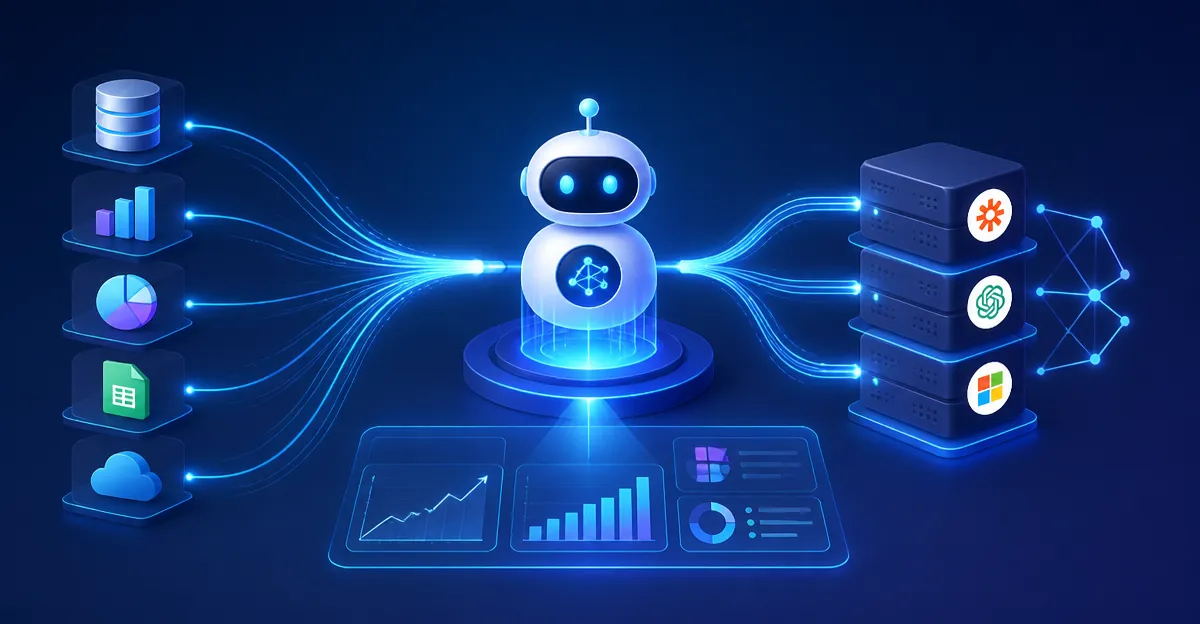
The new architecture replaces that manual integration with a configured stack of pre-built and custom MCP servers that expose tools for equipment status, IoT telemetry, supply chain, and quality analytics. Amazon Bedrock AgentCore orchestrates agent execution in isolated Firecracker microVMs, enforces fine-grained access policies written in plain English, and caches results to reduce latency. The result, AWS says, is a system where the same underlying data speaks in one voice to every user, but shows each only what they are authorized to see.
The core problem is familiar to large enterprises: data is abundant but fragmented across operational and analytical silos. Traditional BI dashboards show what happened yesterday, and single AI assistants answer isolated questions, but neither can autonomously coordinate across an entire technology stack. Custom multi-agent frameworks can theoretically span the full stack, but building one from scratch requires months of engineering for connectors, session isolation, memory, security, and orchestration logic. Amazon Bedrock AgentCore flips that model to configuration, not code.
“Businesses should not need an engineering team just to ask questions about their own data,” an AWS spokesperson said. “The real cost is not engineering time — it is the decisions made on stale, partial information while the right answer was sitting in a system nobody had time to check.”
Read: AWS Launches Claude Fable 5.1 with New Data Governance Controls
The architecture is organized into five layers: users at the top, Amazon Bedrock AgentCore as the orchestration center, MCP server connectors in the middle, a semantic layer for data discovery, and a unified data foundation built on Amazon SageMaker Lakehouse. The lakehouse is fully compatible with Apache Iceberg and unifies data across Amazon S3 data lakes, Amazon Redshift data warehouses, and operational stores connected through zero-ETL integrations. Pre-built MCP servers are available for Redshift, S3 Tables, and Amazon Aurora PostgreSQL. Custom MCP servers, built with the FastMCP framework, connect to Amazon Timestream for IoT telemetry and Amazon OpenSearch Serverless for quality analytics.
“Building a custom MCP server for a service like Timestream requires only defining the tool interface and delegating to the AWS SDK,” the company explained. Once registered, custom servers behave identically to pre-built ones, allowing enterprises to start with ready-made connectors and add specialized ones incrementally without changing the agent or orchestration logic.
Security is enforced at the infrastructure layer, not the application layer. The Amazon Bedrock AgentCore Gateway acts as a single entry point for all tool calls, performing protocol handshakes and indexing available tools. It implements a three-tier caching strategy: organization-scoped, user-scoped, and policy-driven. The Amazon Bedrock AgentCore Policy engine translates plain-English rules into Cedar policies that intercept every call. A rule like “Line supervisors can call only for lines within their assigned plant” is evaluated deterministically before any MCP server is contacted. If a request is denied, the agent receives a deny message and can suggest alternatives within the user’s scope.
“Cedar evaluation is pure logic — same input produces the same output. The LLM cannot influence the policy decision regardless of prompt injection,” AWS noted. Isolation is further hardened by running each user session in a dedicated Firecracker microVM with no shared filesystem, memory, or networking. When the session ends, the microVM is destroyed.
Amazon Bedrock AgentCore Memory provides short-term context within a session and long-term persistence across sessions, organized into user-scoped, team-scoped, and organization-scoped namespaces. For example, maintenance technician Priya Nair can ask “Has the vibration on Machine 42 gotten worse since last week?” and the agent retrieves last week’s baseline from memory without her repeating context. The Amazon Bedrock Agent Registry enables governed discovery and approval of new tools, so the system grows through configuration rather than code changes.
The demonstration showed three personas — plant manager Sarah Chen, line supervisor Raj Patel, and technician Priya Nair — using the same agent interface but receiving different answers based on their identity scopes. Sarah’s query about all lines returned a ranked list with root-cause context. Raj, scoped to Line 7 only, saw a precise status report with data from his assigned line. Priya got a trend comparison for Machine 42, with the system suggesting she check Machine 42 when she accidentally queried Machine 72. In all cases, unauthorized data was never retrieved, and the MCP servers were not contacted for denied requests.
The architecture also introduces a Semantic Layer MCP server that queries SageMaker Data Catalog metadata to help the agent discover relevant data sources before calling them. This decouples metadata discovery from data retrieval, so new sources can be onboarded by registering them in the catalog rather than writing custom integration code.
Read: AI Agents Break Down Corporate Silos to Execute CEO Directives Faster
Looking ahead, AWS plans to extend the system with the emerging Agent-to-Agent protocol for cross-organization collaboration, multimodal voice interfaces for hands-free factory floor use, and proactive agents that monitor IoT data continuously and surface alerts before scheduled reviews. As the Registry accumulates routing history, the agent can also learn to pre-fetch context for each user, further reducing time-to-insight.
For enterprises still stitching together insights from disconnected dashboards, the message is clear: the data existed, but it just couldn’t speak in one voice — until now.