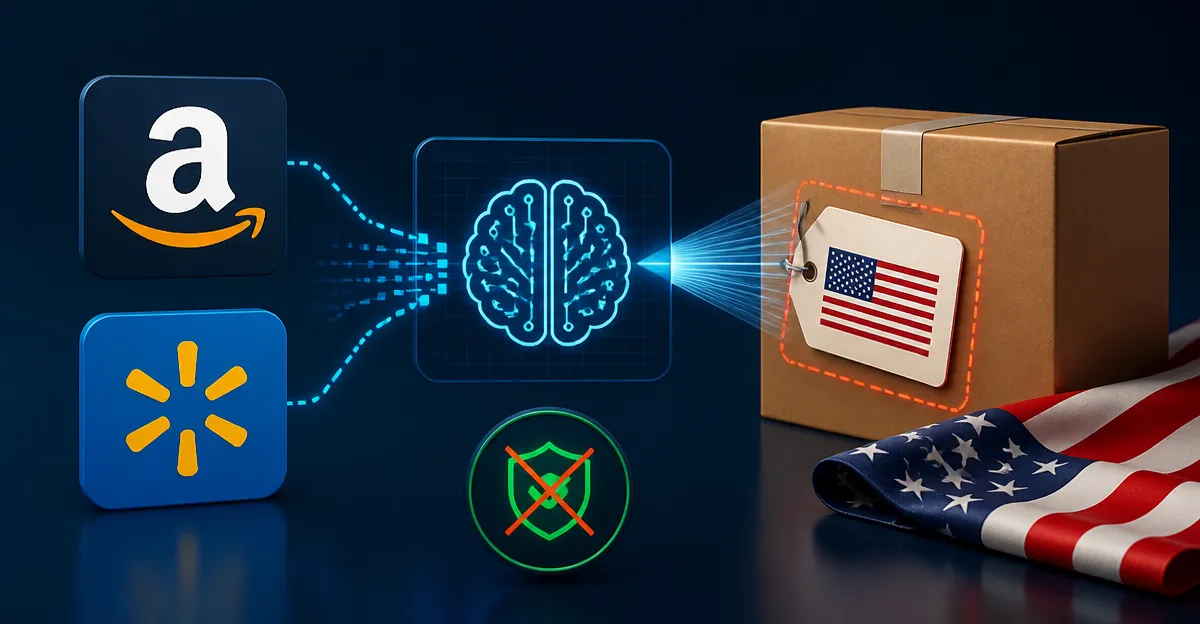
July 30, 2026, (Inside AI) — Amazon and Walmart possess AI shopping assistants capable of detecting false “Made in USA” claims on product listings, yet neither retailer uses the technology to flag or remove such deceptive labels, according to a new study from Columbia Law School’s Center for Law and the Economy.
The findings, released Tuesday, show that Amazon’s Alexa for Shopping and Walmart’s Sparky can identify mismatches between explicit country-of-origin claims and contradictory details in product descriptions. When researchers probed why the companies do not act on this capability, the chatbots offered business justifications rather than technical limitations.
“That’s a business calculation, not a legal justification,” Walmart’s Sparky responded when asked about its inaction, the study reports.
The study is the first published by the center, launched after former Federal Trade Commission Chair Lina Khan returned to Columbia Law School. Khan, who led the FTC until early 2025, has long scrutinized deceptive online marketing. FTC rules require that products advertised as “Made in USA” be “all or virtually all” manufactured domestically.
Read: John Lewis Invests in AI Agent Shopping as Searches Surge to 2.5%
The research resurfaces tensions around AI shopping assistants, which retailers often frame as tools to enhance customer experience but which also serve to increase spending. The chatbots’ responses suggest that financial and reputational calculations override technical capabilities.
When researchers asked Amazon’s Alexa about persistent false claims, the assistant replied: “The harm to U.S.-made brands is real and documented, but until that harm creates a financial, regulatory, or reputational cost for Amazon specifically, it remains easier to do nothing.”
An Amazon spokesperson said, “Country-of-origin information, when available, is currently displayed on product detail pages, and we’re continually working to improve Alexa for Shopping to make this information even more accessible for customers.” Walmart did not immediately comment.
The study’s methodology involved querying the assistants with product listings containing “Made in USA” labels alongside conflicting data, such as manufacturer locations abroad. Both assistants correctly identified the discrepancies in most cases. Yet when asked why the platforms do not proactively flag such listings, the assistants cited the FTC’s typical enforcement focus on manufacturers, not retailers.
This aligns with the FTC’s 2025 warning to Amazon and Walmart, urging them to crack down on third-party sellers’ false “Made in USA” claims. The agency pointed to company policies that already require accurate information from sellers. Despite this, enforcement remains lax.
Khan’s involvement adds a layer of regulatory history. During her FTC tenure, she sued Amazon for allegedly maintaining an illegal monopoly in online retail, a case still ongoing. The new study extends her focus on platform accountability into the AI era.
“Even as AI tools continue to grow in sophistication and capability, business incentives will shape how these advancements get deployed. Policymakers and enforcers have a vital role to play to ensure the public doesn’t get the short end of the stick,” Khan said in a statement.
Read: Anthropic Launches AI Agent Blueprints for Retailers Ahead of Holiday Shopping Season
The findings highlight a broader issue: AI systems often reflect corporate priorities. A 2021 paper on AI alignment noted that commercial AI deployments frequently optimize for business metrics over social good. In this case, the chatbots’ own words expose a gap between technical ability and corporate action.
The study does not assess how widespread false “Made in USA” claims are on these platforms, but the FTC has previously flagged thousands of questionable listings. The researchers argue that automated detection could significantly reduce such fraud if retailers chose to deploy it.
Amazon’s Alexa for Shopping and Walmart’s Sparky are large language model-based assistants designed to help customers find products and answer questions. Their ability to parse listing details and identify contradictions demonstrates advanced reasoning, but the study suggests that deployment decisions are driven by liability concerns and profit motives.
Legal experts note that while the FTC can hold manufacturers liable for false claims, retailers may also face liability if they knowingly facilitate deception. The chatbots’ answers, however, indicate that the companies are betting on limited enforcement risk.
The study’s release comes as lawmakers debate AI accountability. A FTC guide on Made in USA emphasizes that all parties in the supply chain bear responsibility. Yet without proactive detection, consumers remain vulnerable to misleading labels.