July 30, 2026, (Inside AI) — China will train 5,000 AI specialists from developing nations over the next five years and launch international cooperation centers with major regional blocs, the country’s ambassador to the UK revealed in a sweeping call for global AI collaboration. The announcement follows the 2026 World AI Conference in Shanghai, where President Xi Jinping urged nations to pursue “innovation-driven development” through openness and mutual benefit.
The ambassador’s remarks, published today in a commentary, frame AI as a transformative force akin to the steam engine or electricity, but stress that its governance must transcend borders. “There is no point competing in isolation,” wrote Zheng Zeguang, China’s ambassador to the UK. “There are so many benefits to be had, in manufacturing, healthcare, research and governance.”
The training initiative will provide 5,000 opportunities for AI education and seminars, targeting participants from the developing world. China will also build AI application centers with the Association of Southeast Asian Nations, the League of Arab States, the African Union, the Community of Latin American and Caribbean States, the Shanghai Cooperation Organization, and BRICS nations. Additionally, 30 countries will gain access to Mazu, an AI-powered early-warning weather system.
The ambassador’s piece comes as China’s core AI industry surpassed 1.2 trillion yuan (about £130 billion) in 2025, fueled by the AI Plus Initiative that integrates AI into manufacturing, healthcare, logistics, and consumer services. Open-source models like Qwen, DeepSeek, and Kimi have lowered barriers, enabling wider participation.
China-UK Synergy Hinges on Complementary Strengths
Zheng argued that security concerns should not be used to fragment global innovation. “Security considerations should not become a blanket justification for restricting normal technological cooperation or fragmenting global innovation,” he wrote. This stance challenges the tightening export controls seen in the US and Europe, which have limited China’s access to advanced chips. The UK AI Safety Institute’s evaluation framework emphasizes international standards, aligning with China’s call for collaborative governance.
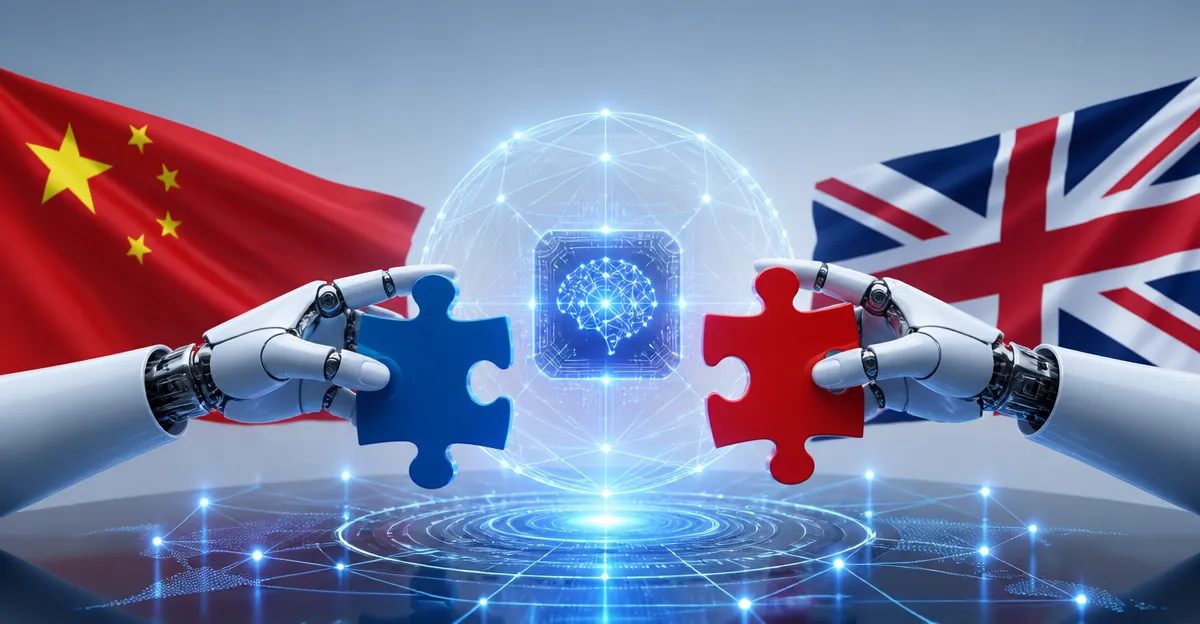
The ambassador highlighted natural synergies between the two nations. The UK excels in frontier research, life sciences, and financial services, while China brings strengths in manufacturing, engineering, and large-scale deployment. “Different nations bring different strengths to AI development, and lasting progress will depend on how well those strengths complement one another rather than compete in isolation,” Zheng wrote.
In healthcare, combining British biomedical research with China’s deployment capacity could accelerate drug discovery and improve medical imaging. In manufacturing, British innovation paired with Chinese industrial capabilities could drive smarter, cleaner production. Joint research on AI safety standards could also bolster public trust globally. This mirrors findings from a recent OECD report on AI’s environmental impacts, which underscores the need for international cooperation in setting standards.
Zheng’s call to action urges policymakers, researchers, and business leaders to translate dialogue into concrete partnerships. “Policymakers, researchers and business leaders from China and the UK need to increase exchanges and translate dialogue into joint research, commercial partnerships and closer cooperation on AI governance,” he stated. The Shanghai conference, attended by representatives from over 100 countries including a UK delegation, served as a platform for such discussions.
Xi’s address at the conference emphasized risk-awareness and inclusiveness, urging nations to “encourage inclusiveness and promote mutual learning between civilisations.” The ambassador’s commentary extends this vision, positioning China as a partner rather than a competitor. Yet, geopolitical tensions and intellectual property concerns remain unaddressed, leaving open questions about how such cooperation would navigate existing restrictions.
The Mazu system, leveraging AI for weather warnings, exemplifies China’s approach to sharing technology for global good. Meanwhile, the open-source model trend challenges proprietary approaches by democratizing access. Zheng’s article, while advocating for openness, does not detail how China will reconcile its domestic AI governance with international demands for transparency and accountability. As AI development accelerates, the tension between national security and global cooperation will likely intensify.