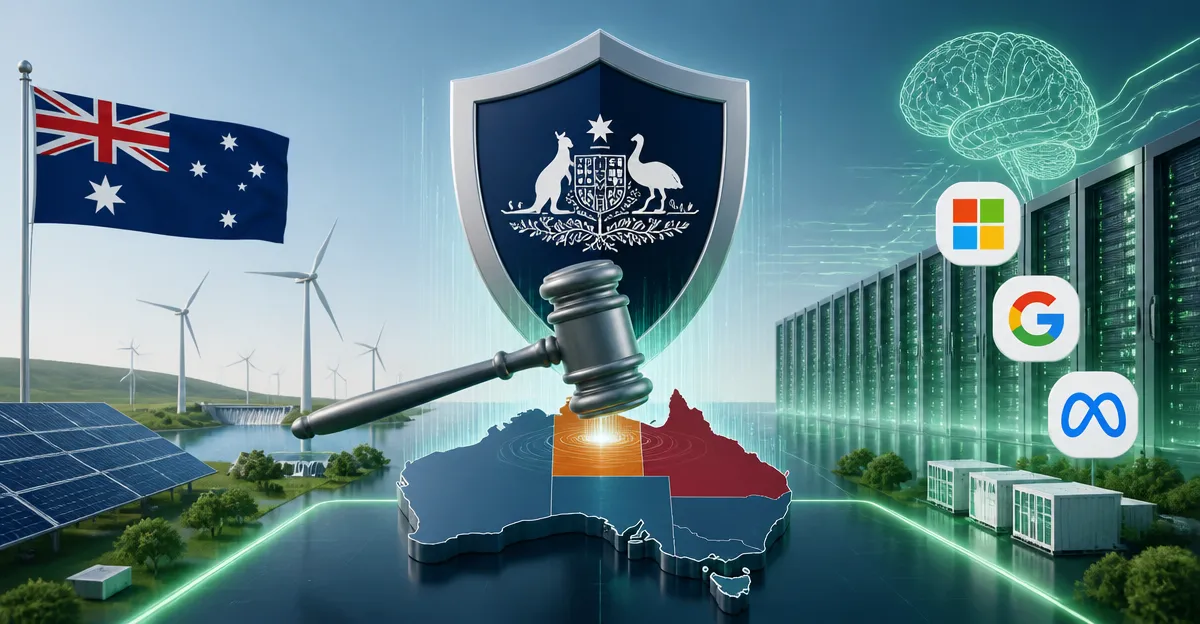
August 5, 2026, (Inside AI) — Federal Energy Minister Chris Bowen confirmed Wednesday that the Albanese government will legislate to force new AI datacentres to run on renewable energy, overriding opposition from Queensland and the Northern Territory. The move sets up a constitutional clash over energy policy, with Bowen insisting that commonwealth law will trump state resistance to protect household bills and grid reliability.
Speaking at the National Press Club, Bowen declared the government would not allow a “race to the bottom” among states competing to attract datacentres at the expense of consumers and emissions. The legislation will mandate that new AI datacentres rely on new renewable energy, minimize water use, maximize efficiency, pay their own grid connection costs, and put at least as much energy back into the grid as they consume. Datacentres powered solely by gas will be banned from registering and proceeding.
“We will legislate as a commonwealth. The constitution is clear about the power of commonwealth legislation. I respectfully disagree with Queensland and the Northern Territory,” Chris Bowen, Energy Minister, Australian Government
The policy follows Prime Minister Anthony Albanese’s pledge last month to set binding standards for AI datacentres, including location and energy use. While most states backed the plan at a recent energy ministers’ meeting, Queensland and the NT protested. Queensland’s David Janetzki dismissed the proposal as “underdeveloped ideas that hand increased power to Canberra,” while the NT has proposed a major gas-powered datacentre tied to the controversial Beetaloo basin development.
Bowen acknowledged gas may play a role in firming up intermittent renewables but stressed that gas-only datacentres would not meet the national minimum standards. He emphasized that the commonwealth would use all available powers to put Australian households and energy reliability first. The NT government declined to comment, but Janetzki said his state looks forward to discussing the issue at an upcoming national cabinet meeting on AI, adding that Queensland “will not force uneconomic investment into the system.”
Grid Costs at the Center of the Fight
The Australian Energy Market Commission (AEMC) warned Wednesday that without rule changes, the costs of connecting large datacentres would be borne partly by regular consumers rather than big tech companies. AEMC chair Anna Collyer underscored the need for proactive measures.
“Datacentre growth does not have to come at a cost to other consumers, but that depends on getting the settings right from the start. Our starting point is simple, this growth must not leave other consumers worse off,” Anna Collyer, Chair, Australian Energy Market Commission
The AEMC noted that power operator Transgrid has seen an unprecedented surge in connection requests in Western Sydney, with some 8 gigawatts about to connect, matching the entire average daily demand for New South Wales. The commission advised that datacentres should be required to show renewables certificates to ensure their connection does not tip the supply-demand balance and push up wholesale prices for everyone else.
Bowen said the federal legislation would require new datacentres to prove the source of their renewables, demonstrate how much power they offset, confirm backup power arrangements, and show flexibility during peak times to stabilize the grid. He disputed the characterization that Canberra would “force” states to comply but confirmed that federal laws would override state regulations. “We’ll engage in our levers. The clearest one is obviously commonwealth legislation. We’re going down that road,” he said.
Renewable Mandates Mirror Global Data Center Debates
The Australian push echoes international tensions over data center energy use. Ireland, for example, has imposed de facto moratoriums on new gas-powered data centers in Dublin due to grid constraints, while Singapore lifted a similar moratorium but with strict efficiency and renewable conditions. The AEMC’s advice aligns with a growing body of research on data center grid impacts, that found unmanaged data center growth can increase wholesale electricity prices by up to 15% in constrained grids.
The NT’s gas-powered datacentre proposal highlights a broader debate: whether natural gas can serve as a bridge fuel for AI infrastructure. However, Bowen’s ban on gas-only datacentres reflects a hard line that prioritizes emissions reduction, even as tech companies globally explore gas as a reliable backup for intermittent renewables. The federal legislation’s requirement for datacentres to be net energy contributors to the grid is particularly novel, potentially setting a precedent for other nations grappling with AI’s energy appetite.
Details of the legislation will be confirmed by Albanese soon, but the constitutional showdown is already drawing attention to the limits of state sovereignty in Australia’s energy transition. The national cabinet meeting on AI is expected to be a flashpoint, with Queensland and the NT likely to challenge the federal overreach, while the AEMC’s stark warnings may bolster Canberra’s case for uniform standards.