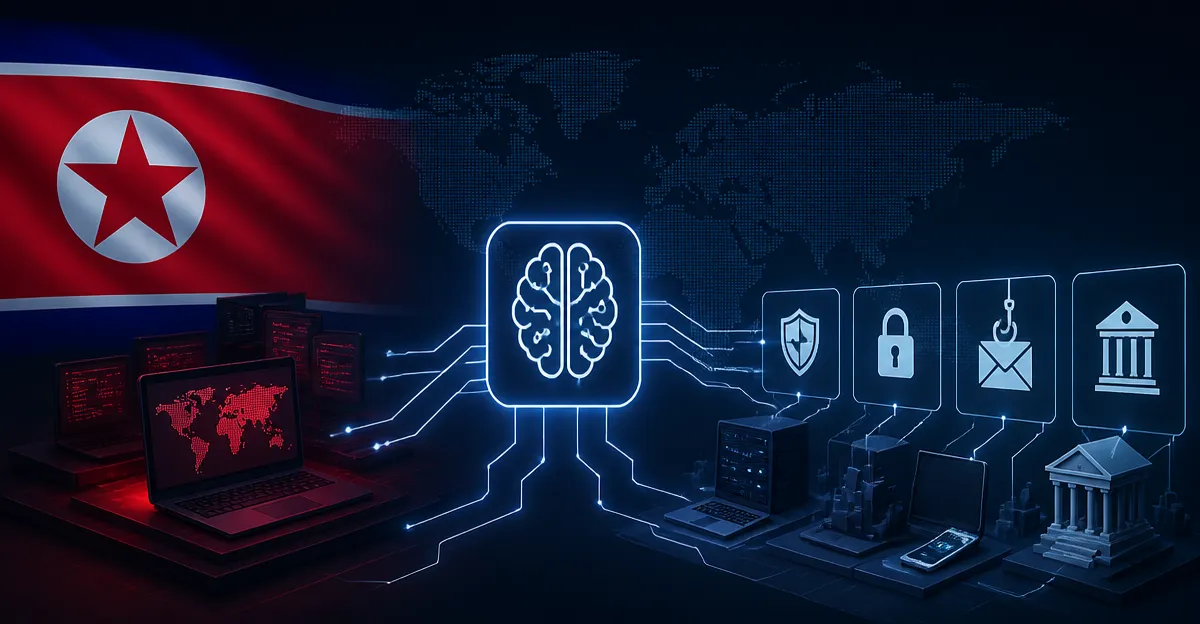
August 10, 2026, (Inside AI) — A North Korean hacking group has built and deployed local large language model tools to automate cyberattacks, analyze stolen data, and craft more convincing phishing campaigns, according to a new report from South Korean cybersecurity firm Genians.
The group, known as Kimsuky, set up infrastructure to run AI models privately using platforms like Ollama, GPT4All, and Msty, alongside retrieval augmented generation (RAG) for document search. This local deployment avoids sending sensitive information to external AI services, Genians said.
Genians also found AI agent development frameworks, speech-to-text software, and Cursor, an AI coding assistant, on systems linked to the campaign. The findings mark a shift from simple generative AI use for phishing lures to integrating models into malware development and attack automation.
“The tools could allow operators to process documents without sending sensitive information to outside AI services,” Genians stated in its report, highlighting the operational security advantage of local AI.
Read: Russian Hacker Used Google Gemini AI for 89% of Cybercrime Operations
The report, released Monday, also uncovered finance and cryptocurrency-themed decoy documents that appeared AI-generated, designed to mimic legitimate investment reports and workplace files. Genians’ findings could not be independently verified.
From Espionage to AI-Powered Automation
Kimsuky has long been a persistent cyber-espionage threat, sanctioned by the U.S. Treasury in 2023 for gathering intelligence on behalf of Pyongyang. The group traditionally relied on spear-phishing and social engineering, but the adoption of local AI models signals a tactical evolution.
By running models locally, Kimsuky sidesteps the data leakage risks of cloud-based AI, a concern shared by many enterprises. The presence of Cursor suggests an effort to accelerate coding for malware or exploit development, while speech-to-text tools could automate the processing of intercepted audio.
This mirrors a broader trend: state-backed groups increasingly experiment with AI to scale operations. In 2024, OpenAI disrupted covert influence operations that used its models for reconnaissance and scripting. Kimsuky’s approach, however, focuses on self-hosted tools, reducing reliance on external platforms that might detect or block malicious use.
What Genians Missed and Why It Matters
Genians did not detail how the AI tools were actually used in live attacks, leaving open questions about operational maturity. The report also lacks indicators of compromise to help defenders hunt for similar setups. Without independent verification, the findings remain a single-source assessment, though consistent with Kimsuky’s history of rapid tool adoption.
Read: MessiahGPT Criminal AI Ransomware Tool Exposed by Trellix
North Korea’s cyber units have evolved from crude DDoS attacks to sophisticated cryptocurrency heists, stealing an estimated $1.7 billion in 2022 alone. Integrating AI could make their phishing lures indistinguishable from legitimate communications, a challenge for traditional email filters.
For defenders, the takeaway is clear: threat actors are not just using AI—they are building private AI pipelines. Monitoring for local model-serving tools like Ollama on unexpected network segments may become a new detection strategy. As Genians noted, the decoy documents’ quality suggests a leap in social engineering craft, demanding a corresponding leap in defensive AI.