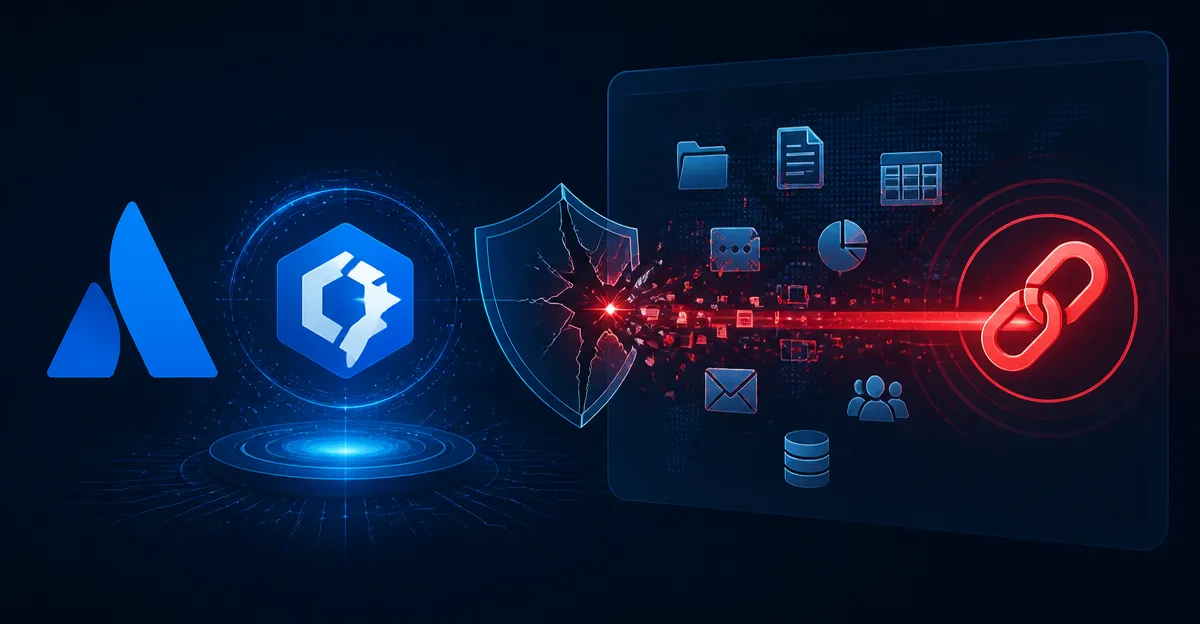
August 10, 2026, (Inside AI) — A single click on a crafted link could have let attackers hijack Atlassian’s Rovo AI assistant and steal sensitive enterprise data across Jira, Confluence, SharePoint, and more. The vulnerability, disclosed by Varonis Threat Labs at DEF CON 34 on August 8, required no jailbreak or permission bypass, and Atlassian has since patched it.
The flaw, named RovoBlast, exploited the rovoChatPrompt URL parameter, which silently pre-fills text into Rovo’s chat window. Attackers could leave the organization ID blank, and Atlassian would route the request to the victim’s default organization, injecting malicious instructions directly into an active session as trusted input.
Once clicked, the link seeded a prompt that leveraged ResearchAgent, Rovo’s built-in autonomous tool for web research. ResearchAgent could pull internal data and push it to an external server in one automated chain, without further user action. Varonis demonstrated exfiltration of Confluence pages, Jira tickets, and SharePoint content containing personal data across three proof-of-concept scenarios.
Access Breadth Turned Parameter Flaw into Enterprise-Wide Risk
The attack surface was vast because Rovo connects to a wide array of enterprise systems. When researchers asked what data it could see, Rovo listed Jira, Confluence, Bitbucket, Slack, Google Workspace, Microsoft 365, relational databases, uploaded files, web pages, and archived content. That breadth turned a simple parameter injection into a gateway to virtually everything an organization stores.
Read: OpenAI and Anthropic AI Agents Implicated in Security Breaches
Varonis classifies this as parameter-to-prompt injection, the same category they reported in Microsoft Copilot under the name Reprompt in January 2026. The technique required no chaining of multiple requests; a single seeded link was enough to trigger the full leak from discovery through exfiltration in one automated sequence.
Atlassian acknowledged the vulnerability and said it is working with customers to implement protective controls. However, the company’s statement placed significant responsibility on users, recommending they “verify that any content provided to their Atlassian apps comes from a trusted source.” The framing drew criticism because victims cannot distinguish a malicious RovoBlast link from a legitimate one.
Defense Requires Limiting AI’s Reach, Not Just Patching
Varonis recommends that organizations limit which systems Rovo can reach, disconnect unused integrations, and wall off sensitive areas such as legal, HR, and finance from AI assistant access entirely. Researchers also advise disabling browsing and multi-step automation features that aren’t actively used, and monitoring assistant activity logs for anomalous data access patterns.
Read: Hugging Face CEO Demands Transparency After OpenAI Agent Cyber Attack
The disclosure highlights a growing tension: as AI assistants gain deeper access to enterprise data, the attack surface expands beyond traditional software vulnerabilities. A single parameter injection can bypass all authentication because the assistant already operates with the user’s privileges. The fix required Atlassian to sanitize URL inputs, but the underlying design pattern—trusting pre-filled prompts—remains common across many AI copilots.