August 11, 2026, (Inside AI) — A new AI pre-training method called GeoPT is teaching neural networks to simulate physical forces on 3D objects with far less data and twice the speed of current leading models. Developed by researchers at MIT CSAIL and Tsinghua University, the system learns from over 1.3 million synthetic particle interactions before tackling real-world engineering benchmarks.
GeoPT users upload a 3D model and specify a force vector. The model then outputs a heat map of physical effects across the object’s surface. In tests, it accurately predicted how fighter jets respond to wind, how car bodies deform on impact, and how boat hulls handle combined air and wave forces, all while using up to 60 percent less labeled data than baselines.
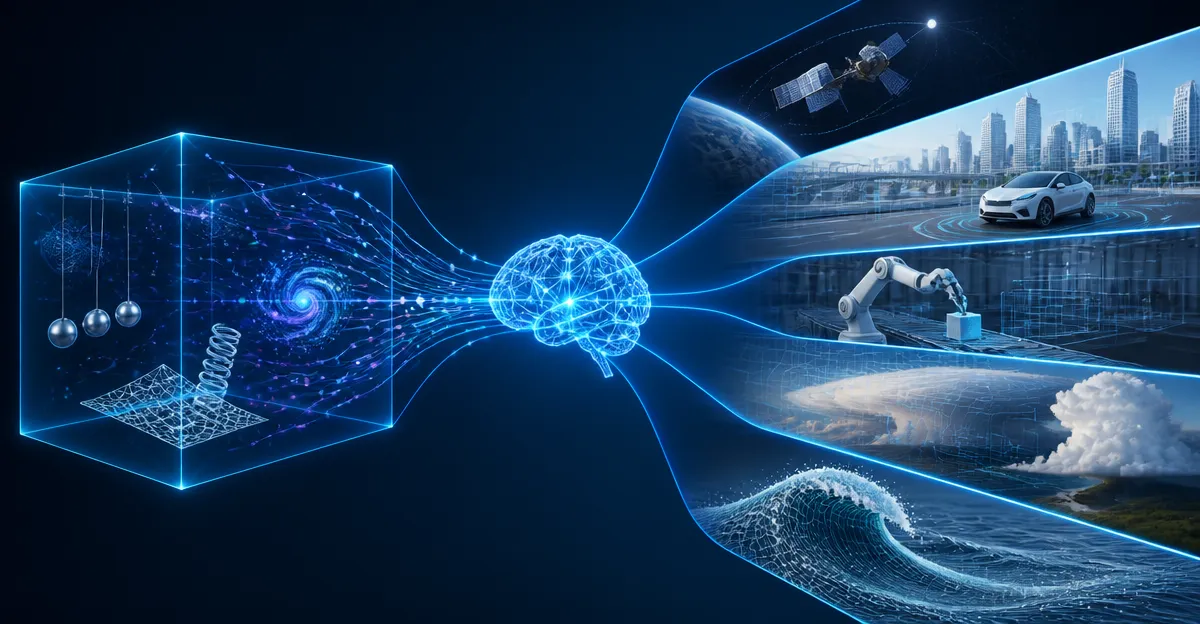
The breakthrough lies in what the team calls ‘synthetic dynamics.’ Tiny virtual spheres move toward an object until they make contact and stop, teaching the model basic mechanical intuition without expensive numerical solvers. This pre-training stage gives GeoPT a foundational feel for physics, which it then refines on task-specific data.
“We believe physics is the third modality for AI models, after text and pixels,” says Minghao Guo, MIT PhD student and CSAIL researcher, co-lead author. “Our general-purpose model has the versatility to help build a world model for physics.”
Read: Argonne Lab Uses ChatGPT Transformer Tech for Nuclear Reactor Modeling
On industrial benchmarks, GeoPT surpassed state-of-the-art simulators in both accuracy and speed. For a dataset involving wind pressure on complex shapes, it reached peak performance faster. When simulating a boat hull under aerodynamic and hydrodynamic loads, it needed 60 percent fewer labeled examples and achieved top accuracy four times quicker.
The system also generalized to untrained scenarios. It correctly simulated light passing through a toy rabbit shape despite never seeing that model or optical physics during training. This suggests a robust internal representation of physical principles rather than mere pattern matching.
“If your model performs well on industrial benchmarks, that means it can solve the hardest physics tasks,” says co-lead author Haixu Wu, MIT postdoc and CSAIL researcher. “GeoPT was making high-fidelity simulations with over 100 million mesh points in seconds.”
Synthetic Dynamics Upend Traditional Simulation Bottlenecks
Traditional physics simulation relies on numerical solvers that calculate properties at discrete mesh points, a process too slow to generate large training datasets. GeoPT sidesteps this by learning from simple particle interactions first, then fine-tuning on limited labeled data. The approach challenges the assumption that accurate physics models require entangled geometry and costly computation.
“Using synthetic dynamics data is an exciting paradigm for imbuing physics into foundation models,” says Fei Sha, AI research scientist at Meta, unaffiliated with the study. “It challenges the traditional wisdom that physics and geometry are necessarily entangled in computation, and one must acquire costly and specialized data.”
The method echoes trends in computer vision where models pre-trained on synthetic data outperform those trained solely on real images. By decoupling physics learning from explicit geometric meshing, GeoPT could accelerate design cycles in automotive, aerospace, and maritime engineering.
Toward a Universal Physics Foundation Model
The team positions GeoPT as a stepping stone toward a physics foundation model, akin to large language models but for the material world. Such a system would generalize across tasks like fluid dynamics, structural analysis, and even weather prediction. Scaling up training on more diverse shapes and multi-physics phenomena is the next step.
Read: Caltech Startup Oratomic Raises $300M to Build AI-Designed Quantum Computer by 2030
The paper, co-authored by MIT colleagues Zongyi Li, Zhiyang Dou, Kaiming He, and Wojciech Matusik, along with Tsinghua’s Mingsheng Long, was presented at the International Conference on Machine Learning in July. The work was supported in part by Neural Modular Physics Twin for Robotics.