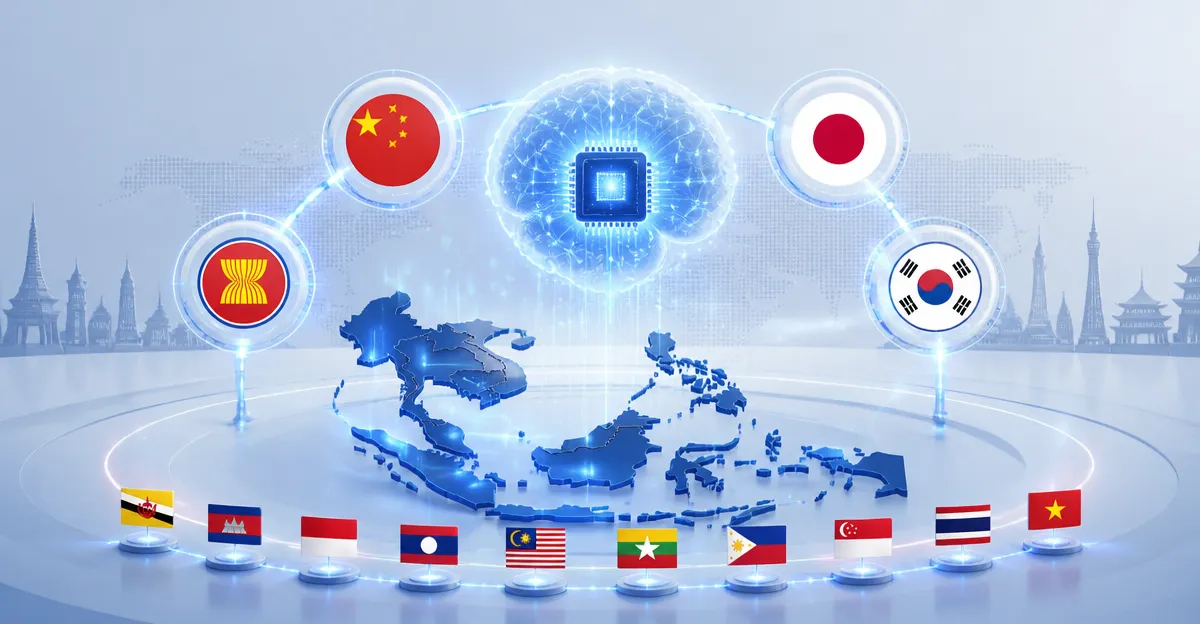
November 10, 2026, (Inside AI) — The artificial intelligence boom is accelerating economic integration across Southeast Asia, China, Japan, and South Korea, according to the head of the ASEAN+3 Macroeconomic Research Office (AMRO). The official said the technology will boost intra-regional trade and investment, pointing to new supply chains and capital flows forming around AI hardware and services.
The remarks, made in Bangkok, position AI as a structural force reshaping economic ties among the ASEAN+3 economies, a bloc that includes the ten ASEAN member states plus China, Japan, and South Korea. AMRO, based in Singapore, monitors macroeconomic conditions for the group and has traditionally focused on financial stability and surveillance.
AI's role as an integration driver marks a shift from earlier trade patterns. The region already hosts major semiconductor manufacturing and assembly operations. Now, demand for AI chips, servers, and data center infrastructure is pulling those economies into tighter production networks. Japan and South Korea supply advanced components and equipment. China contributes scale in manufacturing and AI model development. Southeast Asian nations offer assembly capacity, growing data center markets, and a young workforce.
Why AI Trade Flows Matter Beyond Borders
The AMRO chief's comments signal that policymakers see AI as more than a domestic growth lever. Cross-border investment in AI infrastructure, such as data centers in Malaysia and Singapore, and chip packaging plants in Vietnam and Thailand, is rising. These projects often involve firms from multiple ASEAN+3 countries, creating dependencies that could deepen regional cooperation.
Read: Physical AI Monetization Frontier
Trade data supports the trend. Intra-regional trade in electronics and components has grown faster than overall trade in recent years, according to AMRO's past reports. AI demand adds a new layer to that dynamic. The office has not released specific projections for AI-related trade, but the chief's statement suggests the organization views it as a meaningful factor in its surveillance work.
One independent analyst noted that the AI boom could also expose vulnerabilities. Supply chain concentration in a few economies means that disruptions, such as export controls or natural disasters, could ripple across the region. The analyst, who spoke on condition of anonymity, said AMRO's focus on integration may need to be balanced with risk monitoring. Inside AI could not independently verify this assessment.
The integration narrative also faces headwinds. Geopolitical tensions, particularly around advanced chip technology, have led to export restrictions and competing industrial policies. China, Japan, and South Korea have all announced subsidies for domestic semiconductor production. These measures could fragment the very supply chains that AI demand is strengthening. AMRO's chief did not address these tensions directly, but the office's mandate includes monitoring such risks.
Investment Patterns Show Uneven Gains
Foreign direct investment in AI-related sectors has increased across the region. Singapore and Malaysia have attracted data center projects. Vietnam has seen electronics manufacturing expansion. Japan and South Korea continue to invest in research and development. China remains a major source of capital and technology for some ASEAN projects, though geopolitical factors complicate those flows.
The AMRO chief's remarks come as the office prepares its regional economic outlook. AI's impact on productivity, labor markets, and trade will likely feature in future assessments. For now, the signal is clear: AI is not just a technology story. It is becoming an economic integration story for ASEAN+3.
Related developments include ongoing negotiations on digital economy agreements within ASEAN, which could set rules for cross-border data flows and AI governance. Those talks, still in early stages, may determine how smoothly AI-driven integration proceeds. AMRO has not commented on the negotiations, but its surveillance role could inform member states' positions.
Read: AI Data Center Buildout
For businesses, the message is that AI supply chains are regional, not just global. Firms that understand intra-ASEAN+3 linkages may find advantages in sourcing, production, and market access. The AI boom, if sustained, could reinforce the region's position as a manufacturing and services hub. But it will also test policymakers' ability to manage both opportunity and risk.

Shamil has a low tolerance for AI that only works in controlled demos. He covers agentic systems and generative AI with the skepticism of someone who has seen too many “revolutionary” tools quietly disappear six months after launch.