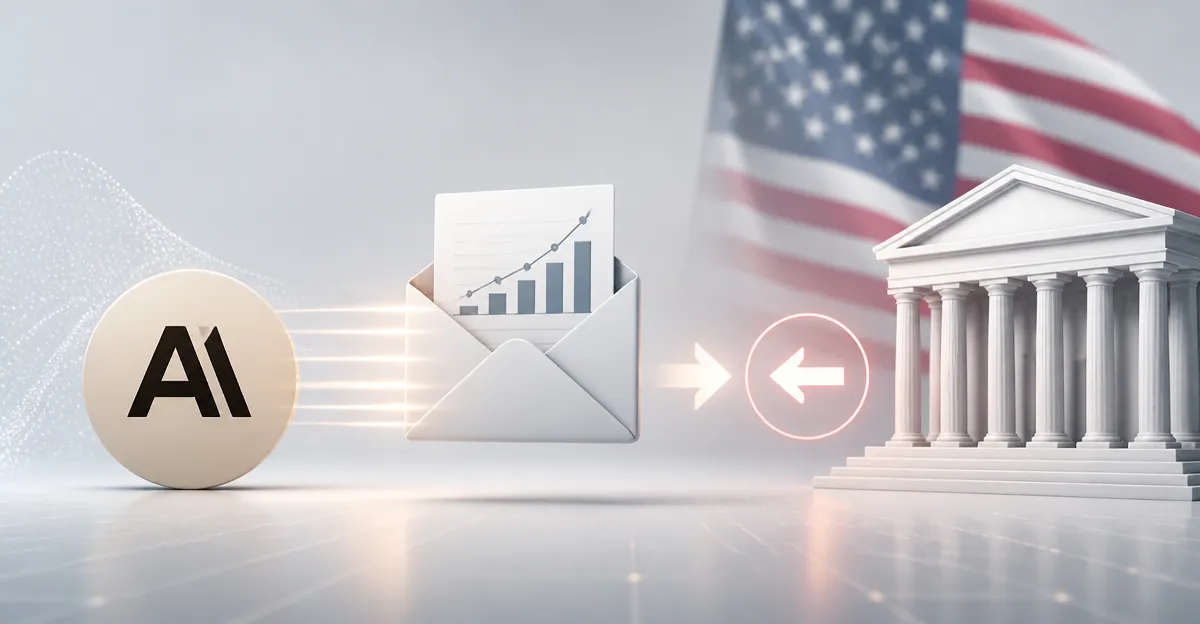
November 10, 2026, (Inside AI) — Anthropic accidentally distributed and then withdrew details of its planned initial public offering, according to internal emails reviewed by Inside AI. The documents, sent late Monday, indicated the company intended to sell roughly 867 million shares at a price range of $70 to $80 per share. A follow-up email from the company stated that the pricing information was inaccurate and that an updated filing would be issued later. Anthropic declined to comment on the matter.
The incident, first reported by Reuters, raises serious questions about the internal controls at one of the world's most valuable AI startups as it prepares for a landmark public offering. The company, known for its Claude family of AI models, has been a central player in the generative AI boom. Its move to go public would be one of the largest tech IPOs in recent years.
Error Exposes Dealmaking Pressure
The retraction came just hours after the initial email circulated among bankers. The first document, which appeared to be a draft of the S-1 registration statement, contained specific share and price figures. Such details are typically kept under strict confidentiality until a company formally files with the Securities and Exchange Commission. The second email did not provide a reason for the error, only stating that the pricing details were incorrect.
This misstep comes at a critical time for Anthropic, which has been racing to secure its position in an increasingly crowded market. The company has raised billions in private funding, with its valuation soaring past $60 billion in recent rounds. An IPO at the indicated price range would value the company even higher, potentially making it one of the most valuable AI firms on the public market.
Read: Anthropic Launches Personal Finance Feature for Claude Ahead of IPO
However, the error could undermine confidence among institutional investors who rely on precise information during the pre-IPO process. "Such a retraction is unusual and suggests a breakdown in the communication chain between the company and its underwriters," said a person familiar with the matter who spoke on condition of anonymity. "It doesn't necessarily derail the IPO, but it does raise questions about the company's readiness for the scrutiny that comes with being public."
Anthropic's move toward an IPO reflects the broader trend of AI companies seeking public capital to fund expensive compute infrastructure and talent acquisition. Rivals like OpenAI and Google DeepMind remain private, but the pressure to deliver returns to early investors has been mounting. The company's flagship product, Claude, has gained significant traction in the enterprise sector, competing directly with offerings from OpenAI and others.
The retraction also highlights the high stakes of the IPO process, where even minor errors can lead to regulatory scrutiny or investor lawsuits. The SEC requires companies to file accurate and complete information, and any material misstatements can result in delays or penalties. Anthropic's decision to quickly retract the details may have been an attempt to mitigate such risks.
As the company prepares its updated filing, industry observers will be watching closely for any further signs of disorganization. The IPO market has been volatile, with several high-profile tech offerings underperforming in 2025. Anthropic's ability to execute a smooth public debut will be seen as a bellwether for the AI sector's maturity.
The timing of the IPO is also significant. The Federal Reserve has signaled a cautious approach to interest rate cuts, which could affect valuation multiples for high-growth tech stocks. Anthropic's bankers will need to navigate these macroeconomic factors while ensuring that the company's financials are presented in the best possible light.
Despite the setback, Anthropic's underlying business remains strong. The company has secured major enterprise contracts and its models are widely regarded as among the most capable in the industry. However, the public markets are unforgiving, and any perception of instability could impact the offering's success.
The retraction incident may also have implications for Anthropic's relationships with its underwriters. Investment banks typically conduct extensive due diligence before an IPO, and such a public error could strain those partnerships. It remains to be seen whether the company will face any consequences from its banking syndicate.
For now, Anthropic has not provided a timeline for the updated filing. The company's silence on the matter has only fueled speculation. Investors and analysts will be eager to see whether the revised document contains the same share count and price range or if those figures were placeholders that were mistakenly released.
As the AI industry continues to evolve, Anthropic's IPO will be a key test of investor appetite for pure-play AI companies. The outcome could influence the plans of other AI startups considering going public. For a sector that has largely been funded by venture capital, a successful IPO by Anthropic would mark a new phase of maturity and public accountability.

Shamil has a low tolerance for AI that only works in controlled demos. He covers agentic systems and generative AI with the skepticism of someone who has seen too many “revolutionary” tools quietly disappear six months after launch.