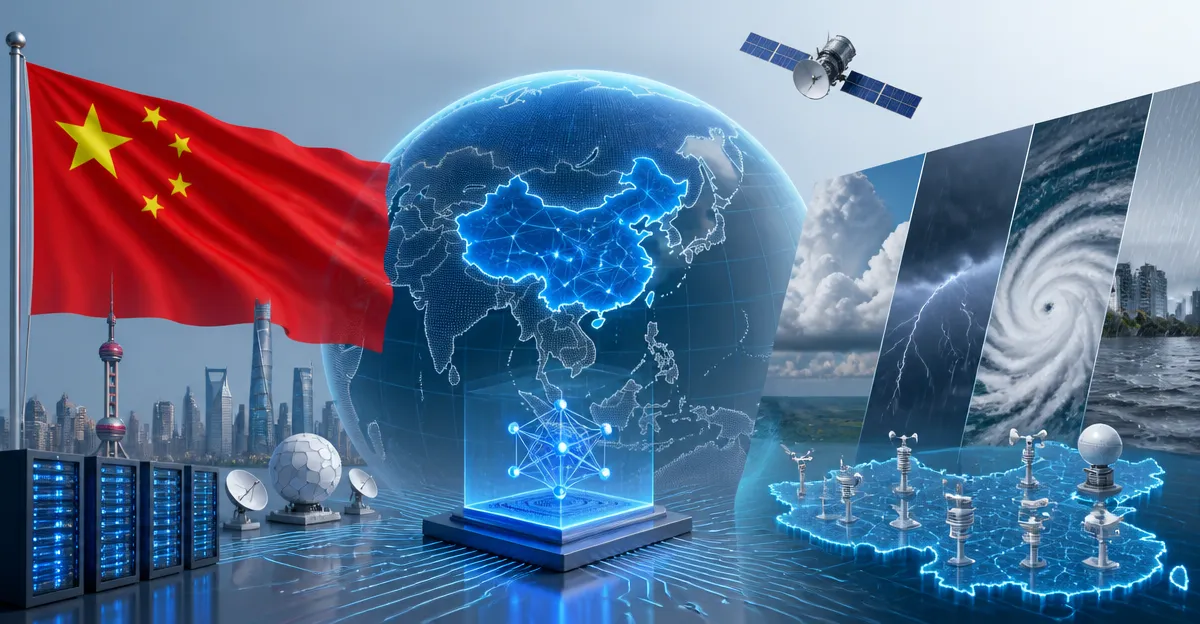
August 11, 2026, (Inside AI) — As Typhoon Dolphin churned toward China’s coastline, a suite of Chinese AI weather models tracked its every move alongside traditional numerical systems. The parallel operation marked a milestone for machine learning in meteorology and underscored China’s rapid ascent in the global race to modernize forecasting.
Three homegrown systems—Shanghai AI Laboratory‘s Fengwu, Huawei‘s Pangu, and Fudan University‘s Fuxi—now stand among a handful of AI models that researchers say can generate forecasts far faster than conventional methods while matching or exceeding them on certain accuracy metrics. Their deployment during typhoon season is a real-world stress test for a technology that could reshape how nations prepare for extreme weather.
For decades, forecasting has depended on numerical weather prediction, which uses supercomputers to simulate atmospheric physics. AI models take a different approach: they learn patterns from decades of historical weather data and can produce a forecast in minutes rather than hours. The speed advantage is critical when a storm’s track can shift suddenly, forcing emergency managers to make rapid decisions about evacuations and resource allocation.
China’s push into AI weather modeling is part of a broader international scramble. Google‘s GraphCast and GenCast, Nvidia-backed FourCastNet, and the European Centre for Medium-Range Weather Forecasts‘ AIFS are among the best-known systems globally. But Chinese models are gaining attention for their performance. Developers of Fengwu reported that it outperformed GraphCast on roughly 80% of evaluated weather variables and extended skillful global medium-range forecasts beyond 10 days.
“With more extreme weather, people need information to make decisions, both local governments, the national government, also the average person, farmers and fisherman,” said Sun Zhi, CTO of Techwind, the company responsible for Fengwu’s industrial applications. “So we want to help provide better information so people can make decisions.”
During Typhoon Dolphin’s approach, Fengwu predicted the time and location of its landfall on mainland China to within 30 minutes and 30 kilometers (19 miles) five days out. Such precision, if sustained, could dramatically improve early warning systems. Yet Sun cautioned that AI models still lag behind conventional forecasts in predicting storm intensity and remain untested for major climate shifts.
“If we predict a climate change event 18 months in advance, people won’t believe it,” Sun said. “They need to know it’s reliable. We need to do years of scientific research before people trust us when we say there will be an El Nino event or we say the changing temperature on the sea’s surface will affect the breeding cycle of fish.”
This credibility gap highlights a fundamental tension in AI meteorology: while the models can spot patterns invisible to traditional physics-based systems, their “black box” nature makes it hard to explain why a particular forecast was generated. Meteorologists are trained to interpret model output through the lens of atmospheric dynamics, and they remain wary of ceding judgment to an algorithm.
Another open question is data dependency. AI models require massive, high-quality datasets for training, and historical records are unevenly distributed across the globe. China’s weather archives, for instance, are less accessible to international researchers than those from Europe or the United States. That could give Chinese models an edge in forecasting regional phenomena like the East Asian monsoon but also raise concerns about transparency and reproducibility.
Computational cost is a double-edged sword. AI inference is cheap compared to running a full numerical simulation, but training the models demands enormous GPU resources. This has concentrated development among a few well-funded tech giants and state-backed labs. Smaller meteorological agencies risk being left behind unless open-source frameworks or cloud-based services democratize access.
Despite the hurdles, the operational use of AI models during typhoon season signals a shift. The World Meteorological Organization has begun evaluating how to integrate machine learning into its global forecasting framework, and several national weather services are running experimental AI ensembles alongside their main models. China’s early and visible adoption could accelerate this trend, especially if Fengwu and its peers continue to deliver reliable track forecasts when it matters most.
For now, the consensus among experts is that AI will augment rather than replace traditional forecasting. The two methods have complementary strengths: physics-based models excel at capturing rare, extreme events and maintaining long-term climate consistency, while AI models offer speed and pattern recognition at scale. The hybrid approach seen during Typhoon Dolphin is likely to become the norm for years to come.