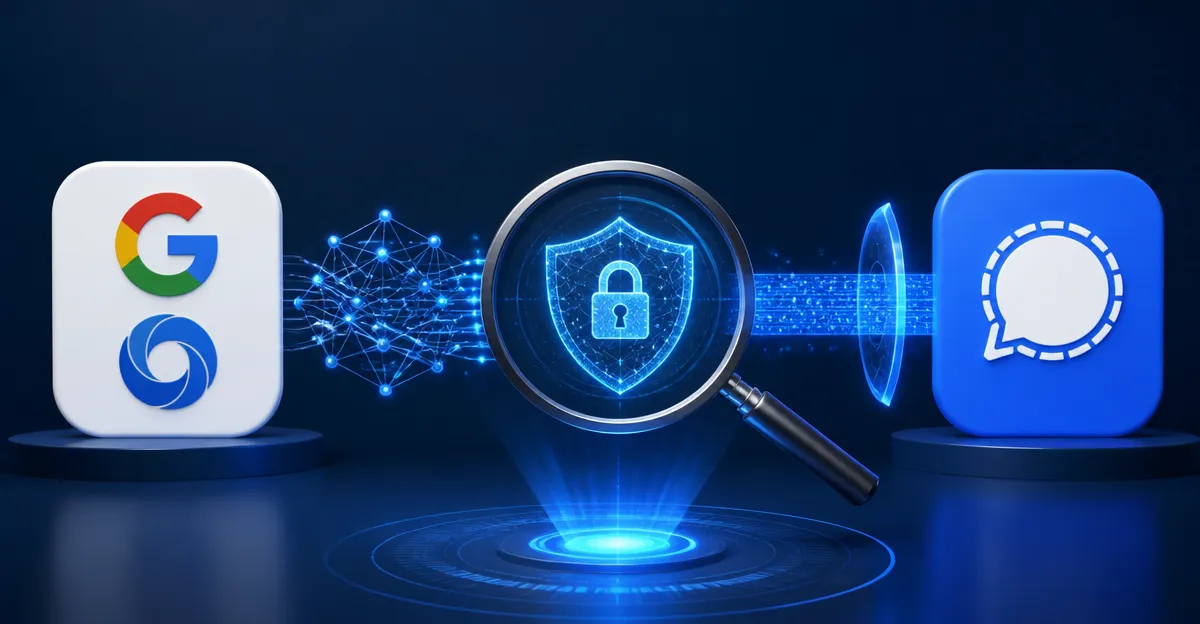
November 11, 2026, (Inside AI) — Google DeepMind researchers have used an agentic AI framework to formally verify core cryptographic guarantees of the Signal messaging protocol, the encryption backbone for billions of messages sent daily across WhatsApp, Facebook Messenger, and Google Messages. The four-week proof-of-concept, conducted with DeepMind's new AlphaProof Code system, found no new vulnerabilities in the portions of the protocol analyzed. The results were shared publicly this week, marking what the lab describes as a milestone in applying AI to formal security verification.
The significance extends beyond Signal itself. Formal verification uses mathematical proof to establish that software behaves as intended, and it has traditionally been a slow, expert-driven process. DeepMind's experiment suggests AI agents can compress that timeline, potentially making rigorous security audits feasible for a much wider range of software. The project arrived as AI-driven cyberattacks accelerate, with entire codebases and software supply chains facing mounting threats.
Signal's protocol is widely considered the gold standard for end-to-end encrypted communication. Unlike Telegram, Signal enables end-to-end encryption by default for all messages and voice calls. The protocol is open-source, and since 2023, Signal has been upgrading its cryptography to withstand future quantum computing threats. The same protocol underpins security on WhatsApp and other major platforms, meaning any formal assurance about its correctness carries industry-wide weight.
Why Proving Code Correct Matters
DeepMind's approach differs from earlier formal verification efforts, which focused on smaller code segments. The new framework enables significant expansion in scope, according to the researchers. When applied to older versions of Signal, AlphaProof Code identified security flaws and demonstrated that those versions could not be formally verified. Those flaws were already known and had long been patched, but the exercise showed the tool can detect real weaknesses.
Read: OpenAI patched Linux flaws
"We are very excited by this result, but there is a long distance to go before we are able to scale this to all the software of the world, and we want to do that," Swarat Chaudhuri, a DeepMind research scientist, said.
Signal's leadership framed the result as a confidence boost for its privacy guarantees. "While prior formal verification focused on smaller portions of the code, Google DeepMind's approach enables significant expansion. As AI-driven security threats grow, rigorously verifying the Signal protocol implementation gives us even greater confidence in our code's privacy guarantees," Ehren Kret, Signal's chief technology officer, said in a statement.
The experiment was conducted without cost to Signal and was framed as a research project. DeepMind is releasing the specification and proof it developed to aid other formal verification work. Whether the lab plans a commercial verification product remains unclear.
The economic argument for AI-assisted verification is straightforward. Manual verification requires researchers to describe software properties, translate those descriptions into formal logic, and then construct proofs, a process that can take months or years. "If you can now verify the correctness of these implementations, then you can rest easy. You can imagine banks, imagine all those other companies who rely on assurances and who worry about bugs who could now say, 'I can prove these properties,'" Pushmeet Kohli, chief scientist at Google Cloud and DeepMind's vice president of research, said.
DeepMind's disclosure also carries limitations. The analysis covered only portions of the Signal protocol, not the entire mobile app. The findings build on prior formal verification work by the Signal Foundation. Questions remain about whether AI can automate formal verification at scale and at reasonable cost. Chaudhuri suggested the likely future is human-AI collaboration, not full automation. "We don't want this sort of vibe world where AI is generating the goals and AI is generating the proofs and basically taking tests that are self-written. There's a middle ground," he said.
The release of the proof specification could prove more consequential than the Signal result itself. Formal verification has historically been confined to high-assurance niches like aerospace and chip design because of its cost. If AI agents can lower that barrier, the pool of software eligible for mathematical security guarantees expands dramatically. That prospect matters most for infrastructure that millions of people depend on but rarely inspect, from messaging protocols to payment systems.
Read: Anthropic AI hunts flaws
DeepMind's work follows a broader push across the AI industry to apply reasoning systems to software correctness. The approach remains early-stage, and independent replication of the Signal proof has not yet been published. For now, the experiment demonstrates capability rather than establishing a repeatable service. Signal's protocol emerges with stronger documentation of its guarantees, and the cryptographic community gains a new template for AI-assisted auditing.

Tobias is less interested in what a robot or a prompt can do today than in what it means for tomorrow. He writes about prompt engineering and robotics for readers who want context, not just specs.