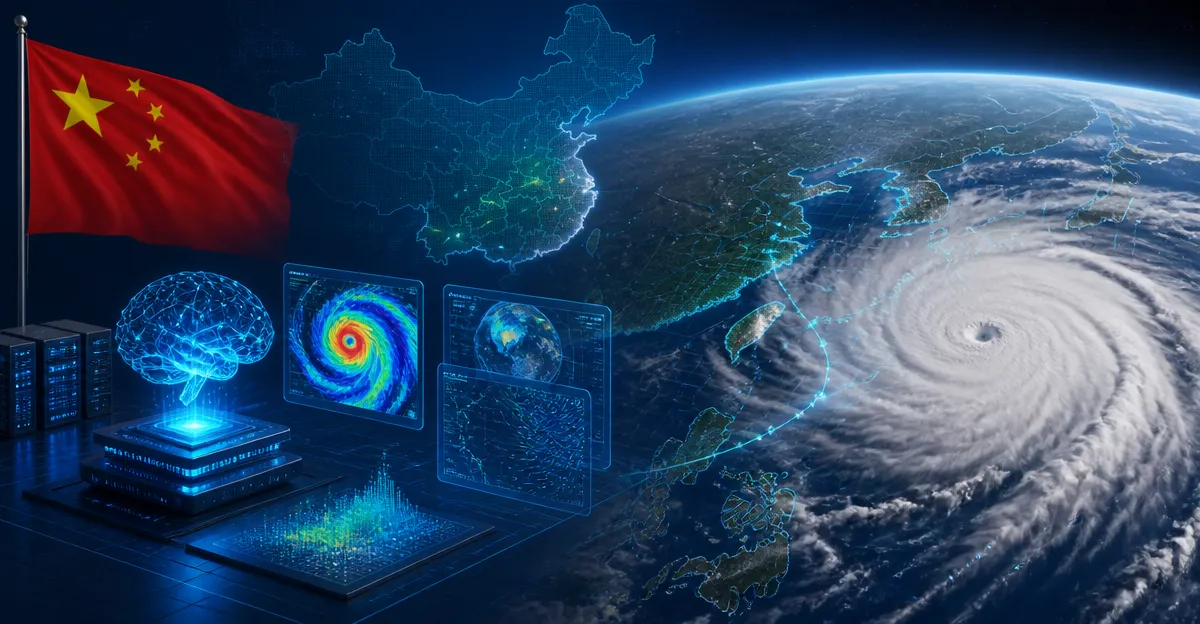
August 11, 2026, (Inside AI) — As Typhoon Dolphin churned toward China’s eastern coastline this week, a quiet but significant shift was underway inside the country’s meteorological command centers. Alongside the physics-based numerical models that have dominated forecasting for decades, a new breed of artificial intelligence models was generating its own track and intensity predictions, marking one of the most consequential real-world tests yet for AI-driven weather forecasting during a typhoon season.
The dual-track approach, confirmed by China’s Meteorological Administration, saw AI models from tech giants Huawei and Alibaba running in parallel with traditional systems. Their outputs were not just experimental; they fed directly into official advisories that guided evacuations, port closures, and emergency stockpiling across Zhejiang and Fujian provinces.
This operational deployment underscores how rapidly China has moved from AI weather research to real-time, life-or-death decision support. The core advantage is speed and efficiency. Traditional numerical weather prediction relies on solving complex physical equations on supercomputers, a process that can take hours. In contrast, models like Huawei’s Pangu-Weather and Alibaba’s Fuxi use deep learning trained on decades of reanalysis data to generate forecasts in seconds on a single GPU.
During Typhoon Dolphin, these AI models consistently matched or slightly outperformed the European Centre for Medium-Range Weather Forecasts (ECMWF) on key metrics like landfall location and timing, according to preliminary verification shared by researchers familiar with the effort. The speed gain is not merely academic; it allows forecasters to run more ensemble members, update predictions more frequently, and explore what-if scenarios that are computationally prohibitive with physics-based models.
China’s push into AI meteorology is not happening in isolation. It is part of a broader national strategy to reduce reliance on foreign weather models and to harden critical infrastructure against climate-driven extremes. The country’s southeastern seaboard is battered by an average of seven typhoons annually, a number that is projected to rise in intensity as ocean temperatures climb. Faster, more accurate forecasts translate directly into economic savings and reduced casualties.
Yet the integration of AI into operational forecasting is far from seamless. These models are often described as black boxes that excel at pattern recognition but can fail in novel situations not represented in their training data. A typhoon undergoing rapid intensification or an unusual track wobble can expose brittleness that a physics-based model, grounded in thermodynamic laws, might handle more gracefully. Forecasters must therefore blend AI guidance with traditional model output and their own expertise, a cognitive load that demands new training and visualization tools.
Why AI Models Still Struggle With Typhoon Intensity
One persistent weakness of current AI weather models is intensity forecasting, particularly for the inner-core dynamics of tropical cyclones. While track predictions have improved markedly, accurately predicting whether a storm will spin up from Category 2 to Category 4 in 24 hours remains a challenge. This is partly because the training datasets underrepresent extreme events, and the loss functions used during training are not optimized for the rare, high-impact tail of the distribution.
Researchers at Shanghai’s Fudan University are tackling this by incorporating physics-informed neural networks that embed conservation laws directly into the model architecture. Meanwhile, a team at Tsinghua University is experimenting with generative adversarial networks to produce sharper, more realistic precipitation fields. These efforts, still in the research phase, aim to address the blurring and underestimation of extremes that plague many AI forecasts.
Internationally, the ECMWF has also begun integrating AI models into its operational suite, and the U.S. National Oceanic and Atmospheric Administration (NOAA) is funding multiple AI weather projects. But China’s advantage lies in the tight coupling between its tech giants and state meteorological agencies, enabling rapid iteration and deployment. Huawei’s Pangu-Weather, for instance, was trained on 43 years of global weather data and can produce a 10-day forecast for the entire planet in under a minute.
During the Dolphin event, this speed allowed Chinese forecasters to issue updated track cones every hour instead of every three hours, a cadence that proved critical as the storm wobbled near the coast. Port authorities in Ningbo and Wenzhou used the frequent updates to time the suspension of cargo operations, minimizing downtime while ensuring worker safety.
Still, some meteorologists urge caution. Dr. Zhang Lin, a typhoon specialist at the Shanghai Typhoon Institute, noted that while AI models are a powerful addition, they are not a replacement for physics-based systems.
“AI models are like an experienced forecaster who has seen thousands of storms, but they don’t understand the underlying physics. When a storm behaves in a way that is outside the historical record, the AI can be confidently wrong.” Zhang Lin, Typhoon Specialist, Shanghai Typhoon Institute
This hybrid future, where AI and physics models are ensembled together, is already taking shape. China’s Meteorological Administration is developing a unified platform that will allow forecasters to overlay AI predictions on traditional model fields, with automated alerts when the two diverge significantly. The goal is not to pick a winner but to quantify uncertainty more robustly and communicate it clearly to emergency managers.
As Typhoon Dolphin dissipates over land, the data it generated will feed back into training pipelines, making the next generation of AI models slightly more attuned to the peculiarities of western Pacific storms. For China, each typhoon is now both a threat and a teacher.