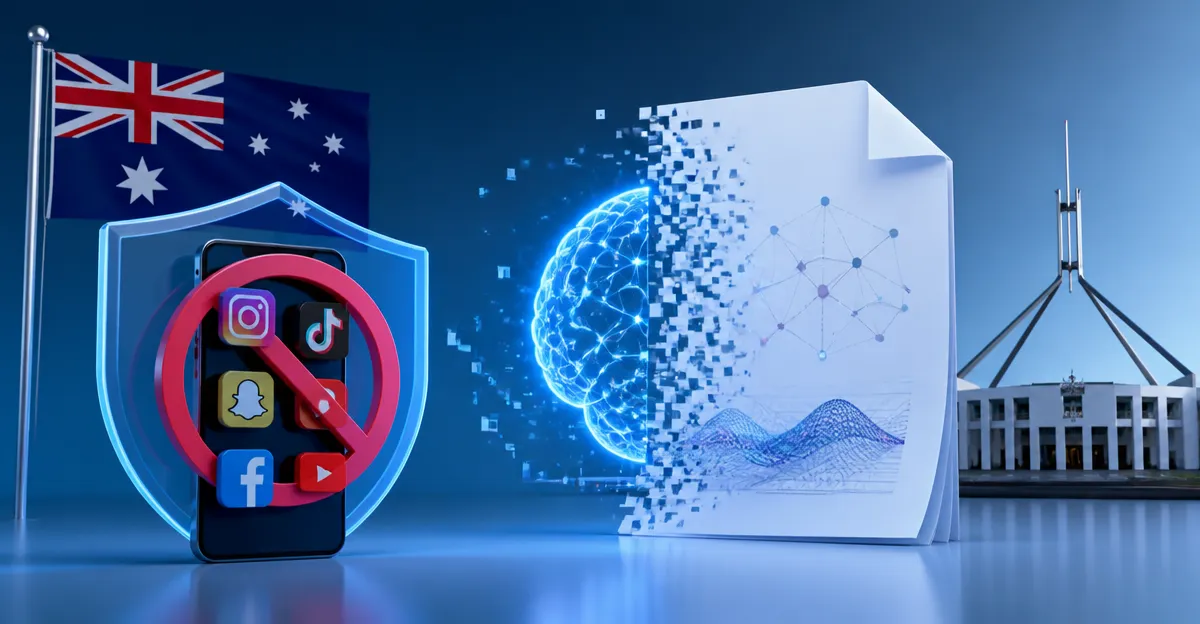
August 17, 2026, (Inside AI) — A government-commissioned report that helped justify Australia’s under-16 social media ban contains at least six citation errors that appear to be AI hallucinations, according to a Guardian Australia analysis and testimony before a Senate inquiry.
The $3.48 million age assurance technology trial was run by the UK-based Age Check Certification Scheme (ACCS) last year. It tested technologies that could be used by social media platforms to enforce the ban, which took effect in December 2025.
Communications Minister Anika Wells had cited the report as showing “many effective options” for age checking. But a chapter on “emerging technologies” includes Digital Object Identifiers (DOIs) that link to nonexistent papers, DOIs pointing to incorrect studies, and author-journal-year combinations that match no known reference.
ACCS initially denied using AI in the report, then conceded ChatGPT was used to rewrite paragraphs more succinctly. The concession came only after Guardian Australia identified four links containing metadata showing ChatGPT as the source.
“We did not use AI in the generation of the report or the cited materials … Each one of them were checked as genuine links and reports and that they were relevant to the specific issue being cited,” an ACCS spokesperson said.
The spokesperson later provided corrected references, but those too contained errors. One cited article was apparently accessed in March 2025, yet a lead author confirmed it was not publicly available until June 2025. The person originally named as lead author, “Jamil,” had never been on the paper.
At Friday’s Senate hearing, department officials said ACCS blamed broken links that had previously worked. First Assistant Secretary Sarah Vandenbroek said ACCS “assured us that the links were all checked at the time that the document was published, and they all worked then.”
Officials called it a “handful of errors” in 26 pages of citations within a 1,000-page report. They have not independently verified ACCS’s explanation, saying it would be “very difficult” to go back and check.
Pattern of AI errors in government contractor work
The incident follows a 2025 controversy in which consulting firm Deloitte refunded part of a $440,000 government contract after errors were identified and the firm admitted using AI. That case involved submissions to a different inquiry.
Prof Christian Downie of the Australian National University, who has studied AI hallucinations in government submissions, said false citations “could lead to bad decisions” and “erode public confidence and trust” in institutions.
“One would assume the government is already thinking about this, and that is going to have to require contractual arrangements and presumably penalties to discourage this type of behaviour,” Downie said.
Independent Senator Fatima Payman called for consequences. “The saga of last year’s Deloitte AI slop report should have marked the end of slack referencing in reports by government contractors,” she said.
“The government must demand an apology and refund from the contractor behind the report,” Payman added.
The department said it is examining the concerns and will engage with ACCS as appropriate. Questions to Minister Wells’ office were redirected to the department.
Verification gaps raise procurement questions
The ACCS report’s citation problems highlight a broader challenge: government agencies increasingly rely on external contractors for technical assessments, yet lack efficient mechanisms to verify the integrity of AI-assisted work product.
ACCS maintained that including ChatGPT metadata in links constituted disclosure, and that all links were human-verified. But the Guardian’s findings of six distinct error types in one section suggest verification fell short of the standard implied by a $3.48 million contract.
The Senate inquiry is considering whether to strengthen the social media ban law. The reliability of evidence underpinning that law now faces scrutiny alongside the policy itself.