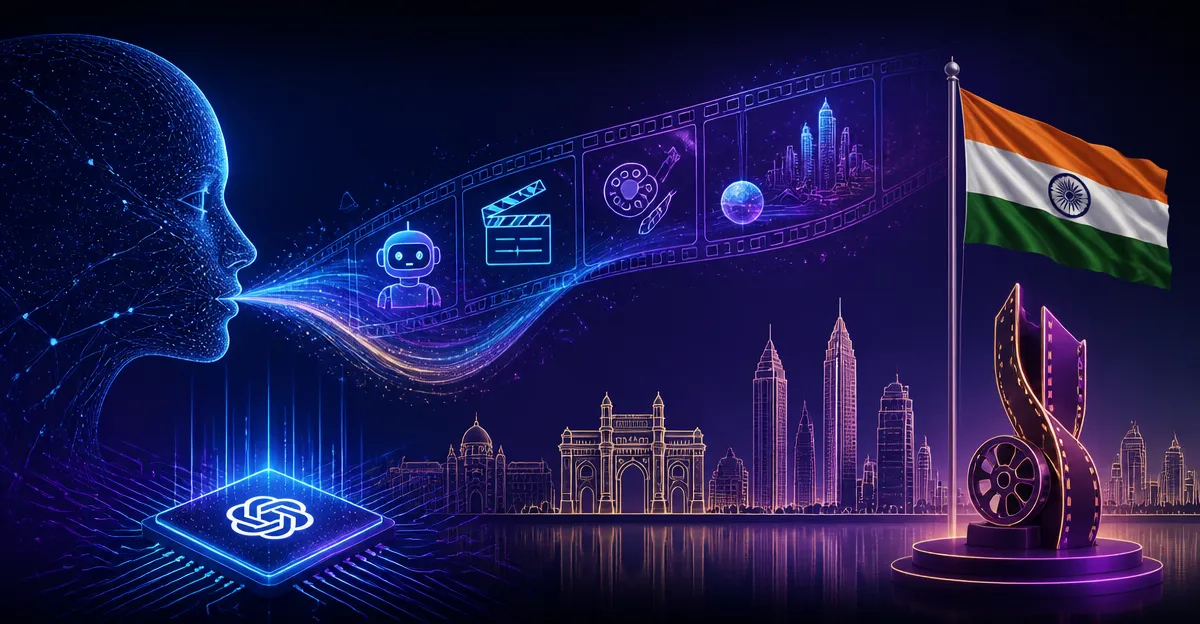
August 17, 2026, (Inside AI) — At the Mumbai International Storytelling Festival (MIST) 2026, a panel of storytellers argued that artificial intelligence may not diminish human narrative. Instead, AI could make live oral storytelling more valuable.
The discussion, titled The Art of Narrative: Multiple Storytelling Forms, took place at the National Theatre for Performing Arts. It was moderated by Usha Venkatraman, founder of the Mumbai Storytellers Society (MSS), which organised the two-day event.
Poet Ameen Haque, founder of Storywallahs, said dominant trends always create counter-trends. He suggested that AI’s rise could push audiences back toward oral storytelling.
“Every dominant trend gives rise to the counter. The rise of colour photography is what made black-and-white photography special,” said Haque, founder, Storywallahs.
Read: Literary Translators Not Redundant in AI Age, Say Rita Kothari and Arunava Sinha
Haque referenced media theorist Marshall McLuhan. A new medium does not replace an older one, he said. It changes how people experience it.
He also challenged the idea of shrinking attention spans. People still watch long series like Game of Thrones or The Family Man, he noted. A compelling story can hold attention even in a distracted world.
The panel included Kenyan-Scottish storyteller Mara Menzies, Sowmya R Srinivasan, and Hema Subramanian. Each offered a distinct view on how stories connect with audiences.
Srinivasan runs Soul Story Mandala. She uses folktales to help people access memories and emotions. Her method turns a shared story into a personal journey.
“In Soul Story Mandala, a story is told and people connect to how they feel about the story. The images and the memories take them on a journey. You choose to take what you want from that story and that becomes your point of transformation,” she said.
Read: Michael Caine’s AI Voice for The Odyssey Audiobook Sparks Debate on Human Creativity
Subramanian, an expressionist, focused on the storyteller’s craft. She said the delivery depends on the character and emotion at the story’s centre.
“As a storyteller, you don’t remain yourself. You actually get into the story, you understand the character, you try to live the space the character is living in,” she said.
Menzies spoke about moving between live performance and the written word. Her book Blood and Gold: A Journey of Shadows began as a live performance. It toured 27 countries before becoming a novel.
Turning the performance into a book meant finding words for gestures and facial expressions. But writing also let her expand the story beyond an hour-long show.
Oral Tradition Gains a Digital Counterweight
The panel’s argument echoes a broader cultural shift. As AI-generated content floods digital platforms, audiences may seek authentic human presence. Live storytelling offers spontaneity, eye contact, and shared emotion that algorithms cannot replicate.
This is not the first time technology has reshaped narrative. The printing press, radio, and television each sparked fears about oral tradition’s decline. Yet storytelling adapted and survived each shift.
At MIST 2026, the focus was not on resisting AI. It was on understanding how AI changes the value of human performance. The speakers suggested that scarcity of human connection could make live storytelling more prized.
The festival itself reflects this belief. It brings together storytellers from multiple countries and traditions. Organisers see the event as a space where technology and oral heritage can coexist.
Industry observers note that AI tools are already used in scriptwriting and translation. But the core of storytelling remains a human act of choosing what to reveal and what to withhold. That choice is shaped by lived experience, not training data.
For practitioners like Haque, the counter-trend is already visible. As AI makes content cheaper and faster, audiences may pay more attention to stories told by a person in the room. The medium becomes the message, as McLuhan might say.
The panel did not offer a roadmap for integrating AI into oral storytelling. Instead, it posed a question: what happens to narrative when machines can generate infinite stories? The answer may be a renewed hunger for the finite, imperfect, and human.