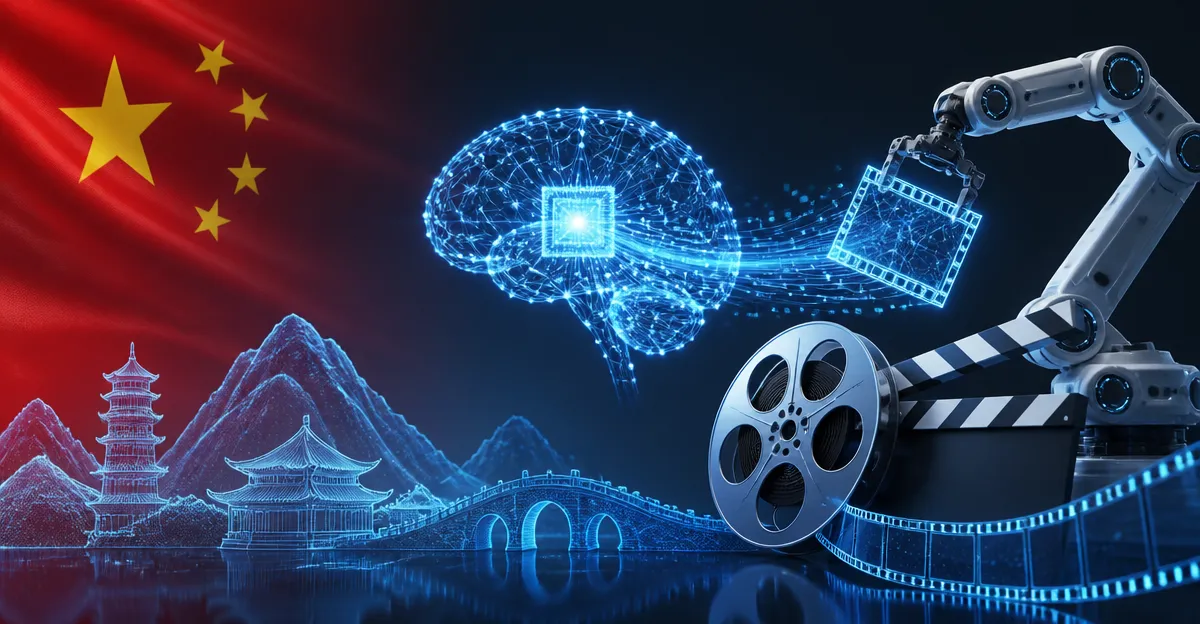
September 28, 2026, (Inside AI) — China's first hyper-realistic theatrical feature film produced with artificial intelligence throughout its production process will hit cinemas nationwide on October 23, 2026. Bona Film Group announced the release date on Sunday for Sanxingdui: Future Past, a 100-minute science fiction film that has secured an official screening license, according to sources.
The film represents a significant milestone in AI-assisted filmmaking, moving beyond short videos and online mini-series into long-form theatrical storytelling. It signals that AI video generation has reached a level of technical maturity sufficient for feature-length cinema, though questions remain about whether this approach can scale into a sustainable industrial workflow.
Sanxingdui: Future Past combines the ancient Shu civilization with a futuristic sci-fi setting. All characters are original digital creations, with no digital replicas of real actors involved. This approach sidesteps image-rights authorization issues that have plagued other AI-assisted productions.
AI did not act as an automated director. According to the production team, AI handled image generation and content production tasks, while creative concept, narrative direction, and final artistic decisions remained with a professional team of more than 100 people at Bona's AIGMS division, following a conventional film-production workflow.
Read: Alibaba launches Wan3.0 AI video model after $10 billion share sale
This division of labor highlights a critical challenge in AI filmmaking: generating a short clip does not mean maintaining consistency throughout a feature-length film. Characters may look different from one shot to the next, while facial expressions, movements, costumes, and background details can shift during generation. Such inconsistencies may be manageable in a few-second clip, but they become a much bigger problem in a 100-minute theatrical production.
To address this, the team manually calibrated details such as characters' micro-expressions frame by frame to reduce the uncertainty of AI-generated content. The goal was to meet theatrical production standards, including 4K image quality, high dynamic range color, and multi-channel surround sound.
The production took two years to complete, using more than 1.2 million source images and going through over 100 full-film iterations. During production, the Infinite Canvas system developed by Boka Film Cloud integrated scripts, storyboards, characters, sets, lighting, and other audiovisual assets into a unified creative environment.
This mirrors a broader trend in AI infrastructure: the challenge is no longer simply generating content, but making the entire production workflow work efficiently. Generating an impressive individual shot is becoming increasingly easy. The harder part is maintaining consistency in characters, environments, lighting, and visual language across a 100-minute film.
The film's plot revolves around mysteries left behind by the Sanxingdui civilization. Mysterious symbols found on Sanxingdui bronzeware conceal a binary code that could not have originated 3,000 years ago. In the future, super AI spreads across the world, and humans increasingly hand over their decisions and judgment to algorithms, eventually triggering a systemic crisis.
Iconic Sanxingdui artifacts, including the Bronze Sacred Tree, Bronze Standing Figure, and Bronze Masks with protruding eyes, will be brought to life in a futuristic sci-fi setting. AI is not only a production tool in the film but also one of its central themes. As humans become increasingly dependent on algorithms to make decisions, how can we preserve our own ability to judge and choose?
The film previously appeared at the Cannes Film Festival and the Hong Kong International Film & TV Market, where it released an international concept trailer.
AI filmmaking is going through a clear evolution, from several-second visual demos to short videos, advertising, and online series, and now to theatrical feature films. Being able to generate is only the first step. Being able to generate long-form content consistently and eventually integrate AI into an industrial-scale production workflow is the bigger challenge.
Whether Sanxingdui: Future Past can make that model work will only become clear after its theatrical release on October 23. But at the very least, the film is pushing AI filmmaking beyond the question of whether it can be done, toward a more fundamental one: can AI become part of the film industry itself?