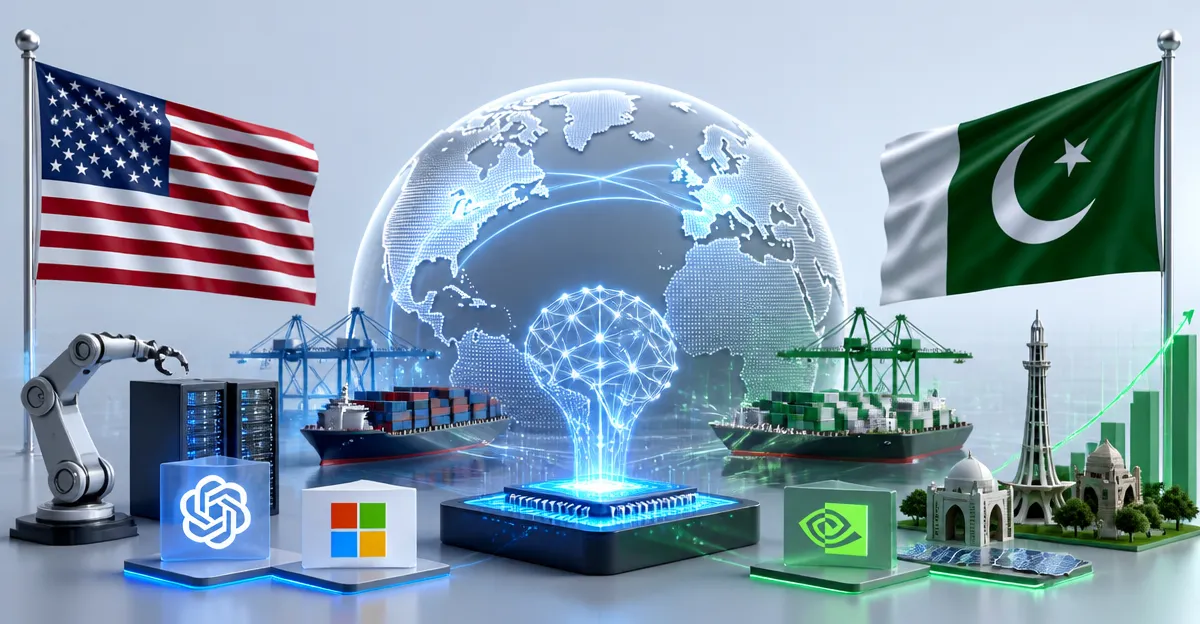
August 17, 2026, (Inside AI) — The United States is formally positioning artificial intelligence as the centerpiece of a renewed trade and investment push with Pakistan, signaling a strategic recalibration of bilateral economic ties around emerging technologies.
US Charge d’Affaires Natalie A Baker outlined the shift during a visit to Lahore this week, identifying AI, software development, and digital services as priority areas for cooperation. Her meetings with Punjab Chief Minister Maryam Nawaz Sharif and adviser Ali Dar focused on policies to encourage investment, entrepreneurship, and technological development in Pakistan’s most populous province.
The diplomatic overture arrives as Pakistan’s technology sector shows measurable momentum. Baker toured three US-based firms operating in Lahore: NetSol Technologies, CodeNinja, and Game District. The visits underscored a growing footprint of American technology companies in Pakistan’s software export market, which has expanded steadily despite macroeconomic volatility.
Bilateral trade exceeded $8 billion in 2025, with the United States remaining Pakistan’s largest export market for over two decades. Baker framed AI cooperation as a natural extension of that relationship, arguing that American innovation and private sector partnerships could “help create jobs, expand economic opportunities and support shared prosperity between the two countries.”
Read: Alibaba Cloud Eyes Punjab IT Sector for Strategic AI Partnership
AI Diplomacy Meets a Maturing Tech Workforce
Pakistan’s technology sector has quietly become one of the country’s most reliable export engines. Software and IT services exports crossed $3.2 billion in fiscal year 2025, according to the State Bank of Pakistan, with AI-adjacent services accounting for a growing share. More than 300,000 IT professionals work across the country, and Lahore alone hosts dozens of venture-backed startups focused on fintech, logistics, and enterprise software.
Baker’s itinerary reflected that reality. At the National Institute of Technology, she highlighted a partnership with Arizona State University as a model for how American education expertise can benefit Pakistani students while strengthening institutional ties. The meeting signals that workforce development, not just trade policy, is central to the US approach.
At a separate roundtable, Baker pointed to US leadership in artificial intelligence and stressed the importance of trusted partnerships in converting technological innovation into economic growth, job creation and broader prosperity.
The emphasis on “trusted partnerships” carries geopolitical weight. Pakistan has deepened technology cooperation with China through the China-Pakistan Economic Corridor, including data infrastructure and digital connectivity projects. Washington’s AI-focused outreach appears calibrated to offer an alternative pathway rooted in American technology standards and private sector collaboration.
Commercial Signals and Policy Gaps
Baker also visited the new Lahore outlet of American restaurant chain PF Chang’s, a symbolic stop highlighting the potential for expanded commercial partnerships beyond technology. The broader message: US economic engagement with Pakistan is not confined to a single sector, but AI and digital services represent the highest-growth frontier.
Still, significant structural barriers remain. Pakistan’s technology sector has long struggled with inconsistent tax policy, limited access to venture capital, and regulatory uncertainty around data protection and cross-border data flows. No bilateral digital trade agreement currently exists between Washington and Islamabad, and US tech firms operating in Pakistan must navigate a patchwork of provincial and federal rules.
Baker’s visit did not announce new funding commitments or specific policy changes. Instead, it established a diplomatic framework for future negotiations. The presence of a dedicated AI adviser in Punjab’s government suggests Pakistani officials are receptive to formalizing cooperation, but concrete agreements will require sustained engagement.
Read: Punjab Approves Rs7.4 Billion Cloud System to Power AI Governance in Pakistan
The timing is notable. Global competition for AI talent and market access has intensified sharply, with the United States, China, and the European Union each pursuing technology partnerships across South Asia. Pakistan, with its young workforce and growing English-proficient developer base, represents an underutilized node in that competition.
For now, the visit signals intent. Whether AI-led trade expansion materializes will depend on follow-through from both governments, private sector investment appetite, and Pakistan’s willingness to align its regulatory environment with the standards that American technology partnerships typically require.