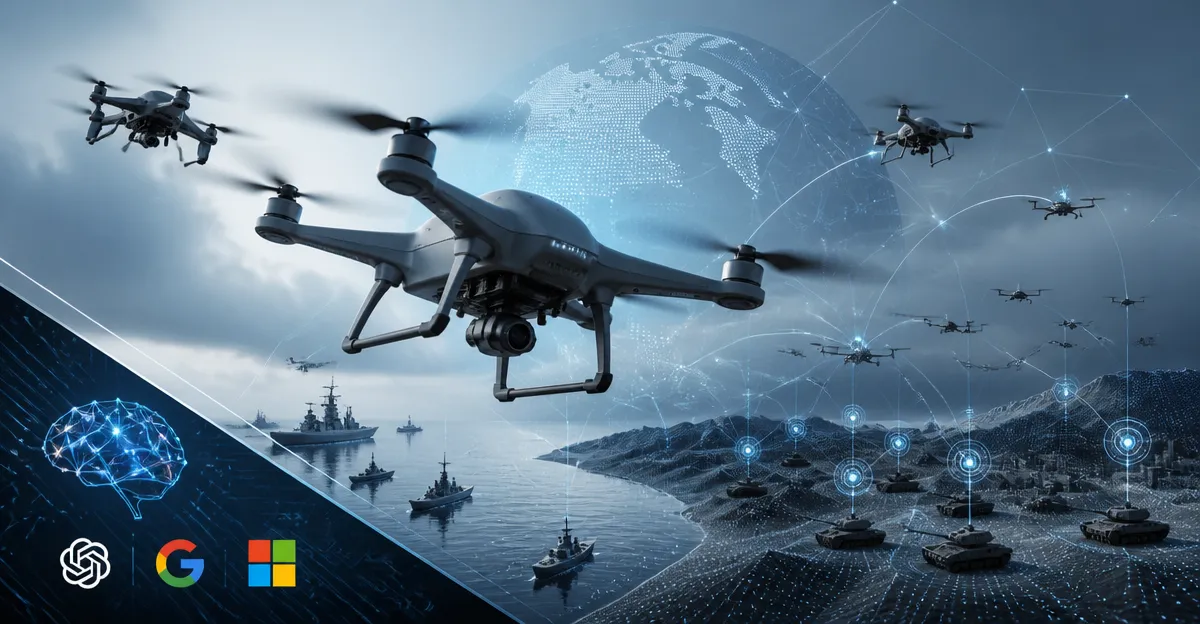
August 19, 2026, (Inside AI) — A military surgeon in London has issued a stark warning about autonomous weapons, arguing that the danger of AI in warfare is not a distant superintelligence problem but a present-day reality already loaded into drones and other systems.
Dr Darren Mann, a military surgeon, writes that machines which “kill without distinction, answerable to no one, leave no one safe.” His letter responds to recent expert warnings about an AI arms race and the challenge of controlling advanced systems.
Mann challenges the framing that loss of control over AI is a future threat. He states that autonomous weapons already pose a direct risk to civilians today. An autonomous drone ordered to clear a “kill box” will kill whatever is inside, whether combatant or child, because the instruction itself cannot encode the principle of distinction between lawful and unlawful targets.
The core issue, Mann argues, is not whether a superintelligence can be trusted to control itself. In warfare, the check can be a deterministic system built on the Geneva conventions, with auditable judgments returned to a human operator. “We need not trust it; we can check it,” he writes, noting that some researchers are already working on such safeguards.
Read: Can AI Make Moral Decisions in War? The Iran Strike That Tests the Limits
Mann also warns of a strategic fallacy. Autonomy is marketed as combat without friendly casualties, making war seem easier to start. But removing humans from the targeting loop does not remove nations from war. Ground must still be won and held, and the dead still come in attack or defense. “Armies no longer go to war; nations do,” he writes.
Why the principle of distinction cannot be coded away
The principle of distinction is a cornerstone of international humanitarian law, requiring combatants to distinguish between military objectives and civilians. Mann argues that no instruction can close the gap between a target and a lawful target, because the instruction itself was lawful even when applied indiscriminately.
His argument aligns with longstanding concerns from human rights organizations and legal scholars. The International Committee of the Red Cross has repeatedly called for human control over the use of force, warning that autonomous weapons risk violating the Geneva conventions and eroding accountability.
Mann’s proposed solution differs from purely technical approaches. Instead of asking an opaque AI to explain itself, he suggests a deterministic rulebook based on international law, with judgments that can be audited and returned to human decision-makers. This echoes work on formal verification and explainable AI in military contexts, though such systems remain largely experimental.
Autonomy does not make war bloodless
The letter also challenges a key selling point of autonomous weapons: that they reduce own-side casualties and therefore make war more palatable. Mann calls this a fallacy. Even if no human soldier is in the targeting loop, ground operations still require human presence, and casualties continue on both sides.
This perspective is supported by military historians who note that technological advantages rarely eliminate the human cost of war. Drones and precision munitions have changed tactics, but conflicts in Ukraine, Gaza, and elsewhere show that ground forces and civilian populations still bear the heaviest burdens.
Read: 1,367 AI Experts Warn: Uncontrolled AI Arms Race Puts Humanity at Risk
Mann concludes with a broader philosophical warning. If militaries cannot teach a drone to keep the laws of war, they will not teach a greater intelligence to keep faith with human values. Abandoning those laws for survival confuses interests with values. “Our interests do not merely permit us to hold the line; they demand it,” he writes.
The letter appears amid growing international debate over autonomous weapons. The United Nations has held years of discussions on lethal autonomous weapons systems, but no binding treaty has emerged. Meanwhile, militaries in the United States, China, Russia, and other nations continue to develop and deploy increasingly autonomous systems.