July 21, 2026, (Inside AI) — The Pentagon’s investigation into a deadly February 28 strike on an Iranian primary school remains stalled four months later, as senators demand answers and a Bloomberg report traces the error to outdated satellite intelligence. The attack, which killed more than 150 people—most of them children—was enabled by Palantir’s Maven Smart System (MSS), an AI platform that processed over 1,000 targets on the first day of the US-Israel war on Iran.
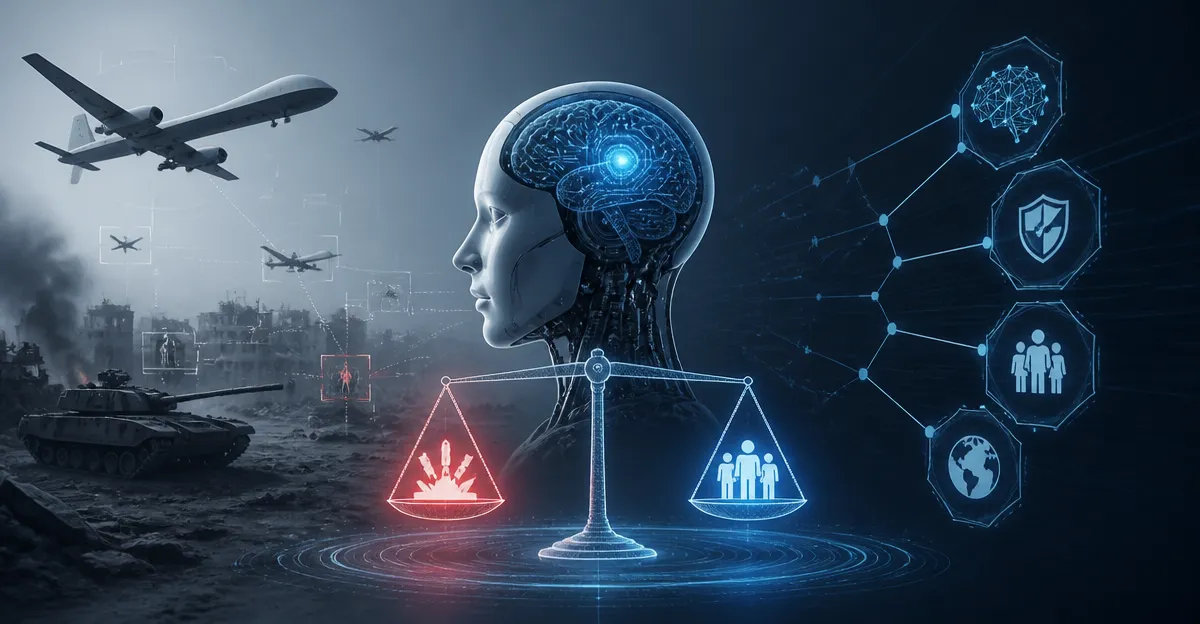
The incident crystallizes an urgent question: can AI systems make moral decisions in war? As militaries embed AI deeper into kill chains, the debate shifts from technical accuracy to moral agency. The Maven system, integrated with Anthropic’s Claude and fed by 150 data sources, compresses targeting timelines from hours to seconds, but critics warn this speed erodes the deliberation essential for ethical warfare.
Speed Over Scrutiny: The Moral Cost of Compressed Kill Chains
Global military AI spending is projected to hit $19.3 billion by 2030, driven by the Pentagon’s goal to become an “AI-first fighting force.” Central to this shift is the OODA loop—observe, orient, decide, act—a decision model that prioritizes speed. Admiral Brad Cooper, head of US Central Command, stated in March that “Humans will always make final decisions on what to shoot and what not to shoot and when to shoot, but advanced AI tools can turn processes that used to take hours and sometimes even days into seconds.”
Yet, Elke Schwarz, professor of political theory at Queen Mary University London, argues this very acceleration undermines moral reasoning. “There is an implicit tension in the mandate for moral deliberation—ethical deliberation, legal deliberation—which takes time, and which requires a different way of thinking about action,” she told Al Jazeera. “You’re saying: we’re going to sacrifice a more rigorous deliberative process in the interest of speed and scale.”
Schwarz, author of Death Machines: The Ethics of Violent Technologies, insists AI cannot replicate moral judgment. “Ethics is a social practice,” she said. “It rests on the fact that we take each other’s vulnerability very seriously, and that we trust one another not to violate that unless circumstances dictate. A system is a computational system. It has no concept of the meaning of human life. It has no concept of mourning, of suffering.”
The Maven system’s design illustrates the problem. It pulls data from satellites, drone videos, signals intelligence, and social media, then uses an AI recommender to propose weapons. Anthropic’s Claude allows natural-language queries, but tensions flared in March when the Pentagon blacklisted Anthropic as a “supply-chain risk” after it refused to loosen restrictions on autonomous weapons. Anthropic sued the government, highlighting the friction between ethical guardrails and operational demands.
Research from the Max Planck Institute for Human Development shows that delegating tasks to AI creates a “moral distance,” making people more willing to accept harmful outcomes. This aligns with reports that the Pentagon slashed its Civilian Protection Center of Excellence from 40 staff to nine, leaning on AI tools to speed civilian harm assessments—a move critics call reckless given Maven’s undisclosed error rate.
When Algorithms Outrun Accountability
The Minab strike is not an isolated failure. In 2024, the Israeli military’s Lavender system, an AI-assisted targeting tool, had an estimated 10 percent error rate, with human oversight sometimes reduced to seconds before a strike. Legal scholars warned it risked violating international humanitarian law. Schwarz dismisses the idea that AI could constrain unethical militaries: “If a military has a system that scales up and speeds up the violence they want to enact, they’re not going to abdicate to a system that says ‘no, you shouldn’t do that.’”
She also rejects the notion of agentic AI displaying moral emotions as a “marketing gimmick,” stressing that “grappling with principles” and “weighing of how many lives are at stake” cannot be programmed. “To pretend that an AI system can be a moral decision-maker constitutes, for me, an abdication of this uniquely human task—to weigh, understand the weight, feel the weight of a morally difficult decision for which one might bear the burden of responsibility.”
The Pentagon maintains that no AI weapons will be fully autonomous, but the gap between policy and practice widens as systems like Maven become default infrastructure. Project Maven, launched in 2017, originally aimed to analyze drone footage; Google withdrew in 2018 after 4,000 employees protested. Today, over 20,000 personnel use it across 35 tools, and its role in the Iran war signals a permanent shift toward algorithmic warfare.
As the Pentagon’s investigation drags on, the fundamental tension remains: militaries seek decision advantage through speed, but moral responsibility demands pause. Whether AI can ever bridge that divide is not just a technical question—it is a test of whether humanity will outsource its most consequential choices to systems that cannot comprehend what they destroy.