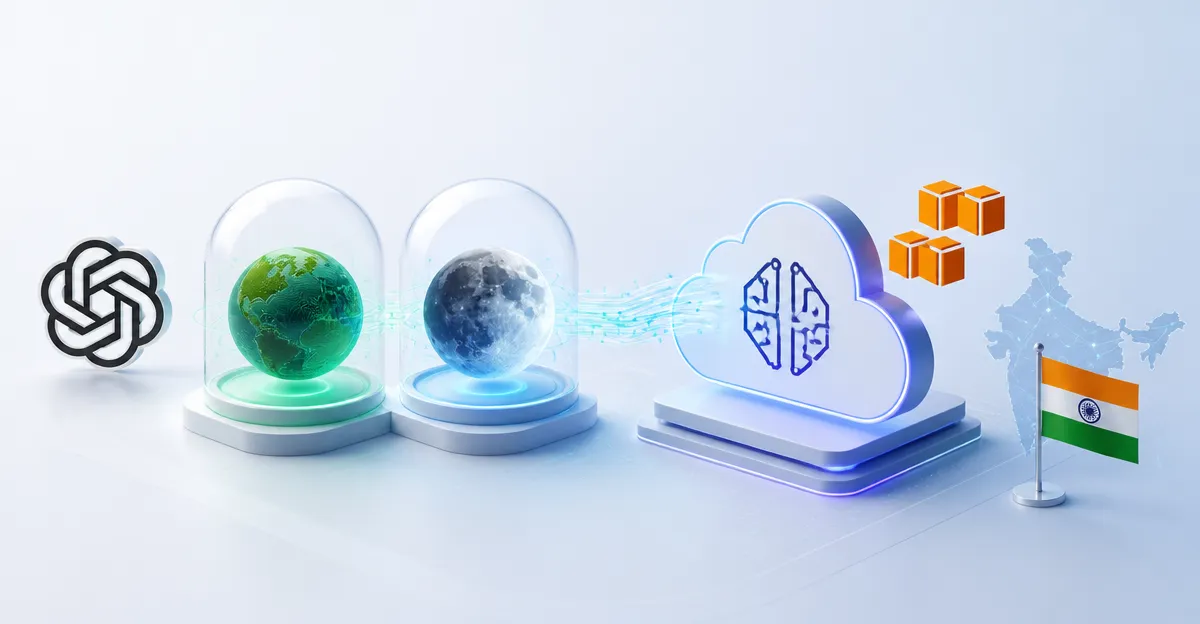
August 20, 2026, (Inside AI) — Amazon Web Services has made OpenAI‘s GPT-5.6 Terra and Luna models available on Amazon Bedrock in India, with inference processed locally on AWS infrastructure. The move lets Indian organizations run frontier AI models without sending data overseas.
The launch targets financial services, healthcare, public sector, and startup customers. In-country inferencing means AI tasks run on servers physically located in India, a key requirement for data residency and regulatory compliance.
Satinder Pal Singh, Director of Solution Architecture at AWS India and South Asia, said the deployment gives customers governance controls they demand on trusted infrastructure.
“By bringing OpenAI advanced models to India, we are giving customers the ability to build transformative AI applications with in-country inferencing and governance controls that organisations in India demand – all on the trusted AWS infrastructure they already use,” Satinder Pal Singh, Director, Solution Architecture, AWS India and South Asia
The models are part of the GPT-5.6 family launched by OpenAI on July 9. Terra is a general-purpose model for enterprise workloads, offering better performance at lower cost than predecessors. Luna is built for high-volume, latency-sensitive tasks like summarization and classification.
Pricing has dropped sharply. OpenAI recently cut Luna costs by up to 80% and Terra by up to 20%, with new rates reflected on Bedrock. This positions the models as cost-effective options for scale deployments.
Nitin Bawankule, Head of Enterprise Sales for India at OpenAI, emphasized practical adoption for regulated sectors.
“Businesses want models that can help teams write better software, work through complex information, and make higher-quality decisions in the flow of work. For many organisations in India, especially in regulated sectors, local inferencing is a key part of adopting AI with confidence. Making our models available through Amazon Bedrock gives more organisations a practical way to bring that capability into production,” Nitin Bawankule, Head of Enterprise Sales, India, at OpenAI
Local inference reshapes India’s enterprise AI calculus
India’s data localization push has accelerated since the Digital Personal Data Protection Act, 2023. Regulated sectors like banking and healthcare face strict mandates to keep sensitive data within borders. Local inference on Bedrock directly addresses that barrier.
Competitors have moved similarly. Google Cloud offers Vertex AI with region-specific endpoints in Mumbai and Delhi. Microsoft Azure provides OpenAI models via Azure OpenAI Service with data residency in Indian regions. AWS’s announcement intensifies this three-way race for enterprise AI workloads.
The timing aligns with OpenAI’s broader strategy to expand enterprise reach through hyperscaler partnerships. By embedding models in Bedrock, OpenAI avoids building its own Indian data centers while meeting localization demands through AWS infrastructure.
What the launch leaves unanswered
AWS did not specify which Indian regions host the inference endpoints. Latency-sensitive applications may perform differently in Mumbai versus Hyderabad. Also unclear is whether fine-tuning capabilities are available locally or only via US-based infrastructure.
Security researchers have raised concerns about model inversion attacks on frontier systems. Local hosting reduces data transit risk but does not eliminate inference-time vulnerabilities. Indian enterprises must still implement robust access controls and monitoring.
Use cases cited by AWS include agentic coding, data analysis, agent workflows, ChatGPT Work, production inference, software development, regulated workflow automation, sensitive data analysis, and high-volume customer applications. These span both generative and agentic AI categories.
The announcement follows a pattern of AWS expanding Bedrock’s model catalog rapidly. Bedrock already hosts models from Anthropic, Meta, Mistral, and Cohere. Adding OpenAI models removes a key competitive gap, especially for enterprises already standardized on AWS.
Indian startups building on Bedrock can now access frontier models without separate OpenAI API contracts. This simplifies procurement and compliance for early-stage companies in regulated sandboxes.
Looking ahead, the real test will be production adoption rates in banking and government. If local inference delivers on latency and compliance promises, AWS could capture a significant share of India’s enterprise AI spend, projected to exceed $5 billion by 2027 according to industry estimates.