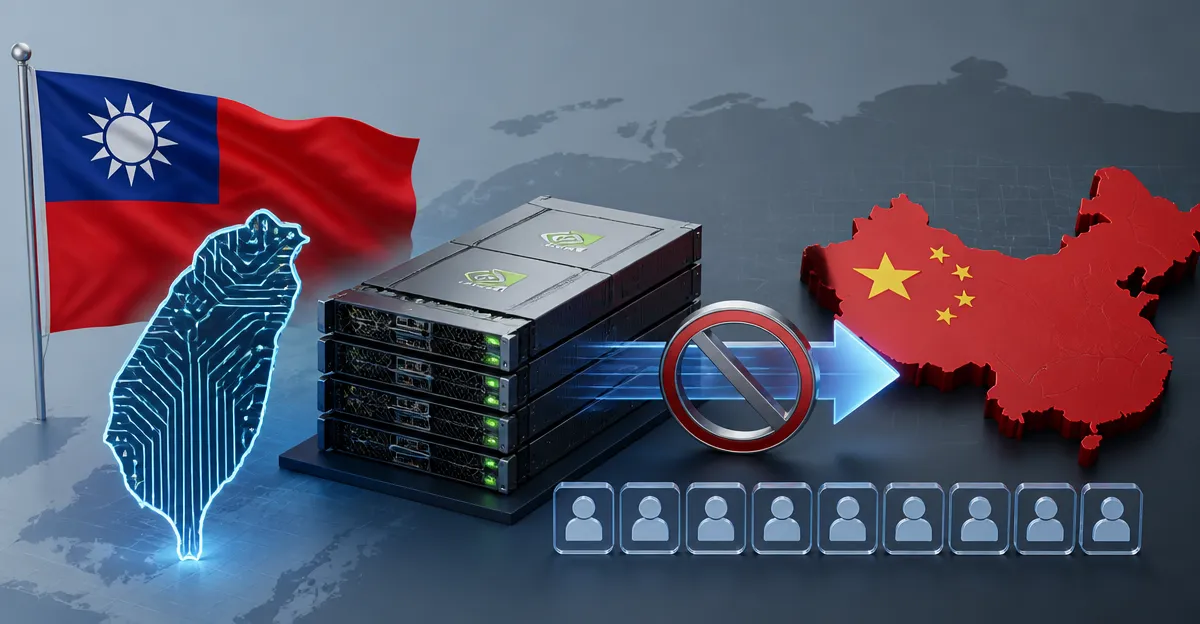
August 24, 2026, (Inside AI) — Prosecutors in Keelung, northern Taiwan, indicted nine people on Monday for allegedly smuggling AI servers to China in violation of export controls. The accused include employees at Nvidia and Super Micro, two major suppliers of accelerated computing hardware.
The indictment marks a rare criminal case involving staff from leading U.S.-based technology firms operating in Taiwan. It signals heightened enforcement of rules designed to keep advanced chips and systems out of China.
The suspects allegedly shipped servers containing high-end AI accelerators without required export licenses. Taiwan has tightened scrutiny of re-exports since Washington imposed sweeping semiconductor restrictions on China in October 2022.
Neither Nvidia nor Super Micro immediately commented on the indictments. The Keelung District Prosecutors Office did not disclose the defendants’ names or specific roles at the companies.
Taiwanese law prohibits unauthorized transfers of strategic high-tech goods to China. Violations can carry prison sentences and heavy fines. Prosecutors said the case involved multiple shipments over an unspecified period.
Investigators allege the group falsified end-user information and routed servers through intermediary destinations. Such tactics are common in illicit procurement networks seeking to bypass export controls.
The case highlights the challenge of policing global supply chains. Taiwan is the world’s most advanced semiconductor manufacturing hub. Its ports and logistics firms handle enormous volumes of electronics components.
China has faced growing difficulty acquiring Nvidia’s most powerful chips. U.S. rules prohibit sales of the A100, H100, and newer accelerators to Chinese entities. Nvidia responded by designing export-compliant variants like the H20 for the China market.
Super Micro builds server systems using Nvidia GPUs and other components. The company has manufacturing operations in Taiwan and elsewhere in Asia. It has faced past scrutiny over supply chain compliance.
The indictments come amid broader U.S. pressure on allies to enforce export controls. Washington has pushed Taiwan, South Korea, and Japan to close loopholes that allow restricted technology to reach China.
In 2023, Taiwan’s government amended its foreign trade act to increase penalties for illegal technology transfers. The changes followed several high-profile smuggling cases involving semiconductor equipment.
Legal experts say prosecuting individual employees, rather than only companies, reflects a shift in enforcement strategy. Authorities increasingly target supply chain insiders who facilitate illicit shipments.
The Keelung case may also involve customs brokers and freight forwarders. Such intermediaries often handle documentation that obscures final destinations.
China has not commented on the indictments. Beijing has repeatedly criticized U.S. export controls as unfair and economically coercive.
The case could strain already tense cross-strait relations. Taiwan’s government has aligned its export policies more closely with U.S. national security priorities.
Industry analysts expect more enforcement actions as AI hardware demand grows. The global market for AI servers is projected to exceed $150 billion by 2027, according to multiple research firms.
Nvidia’s data center revenue reached $115 billion in fiscal 2025, driven by demand for AI training and inference systems. Super Micro reported revenue of $14.9 billion in the same period.
The indictments serve as a warning to employees across the technology supply chain. Individual accountability is becoming a central tool in export control enforcement.
Prosecutors are expected to release additional details as the case proceeds. The defendants face trial in a Taiwanese court, with proceedings likely to begin within months.