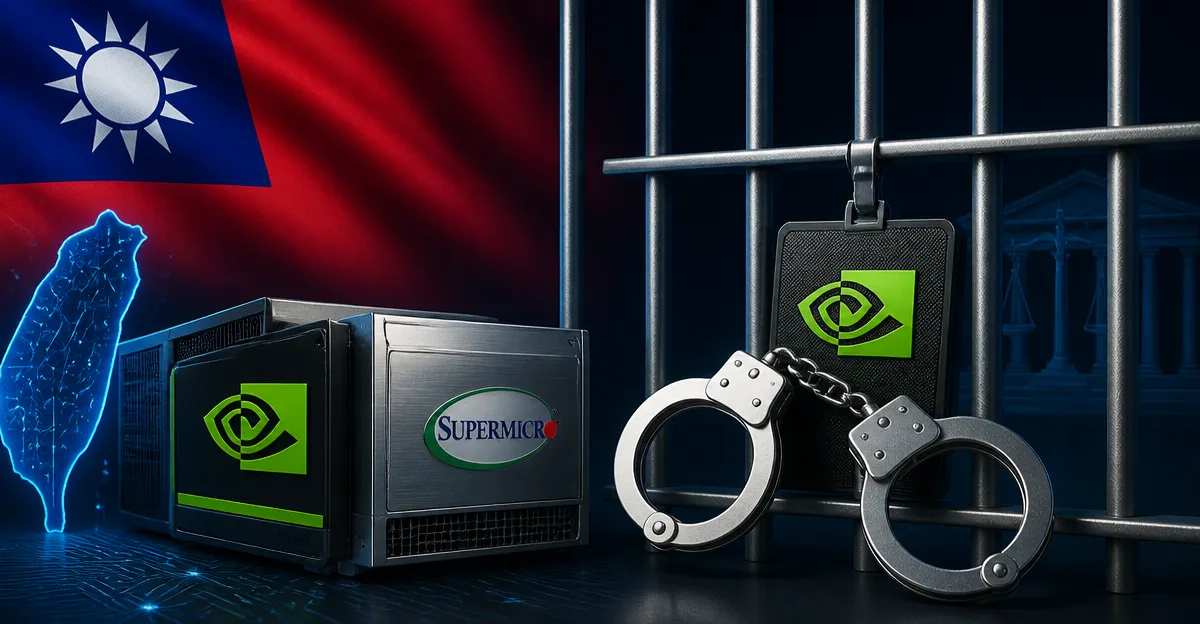
July 28, 2026, (Inside AI) — Taiwanese prosecutors have detained an Nvidia employee as part of an ongoing investigation into the alleged illegal export of Super Micro AI servers to China, according to local media reports. The servers reportedly contained Nvidia chips subject to U.S. export controls, which have prohibited such sales to mainland China since 2022.
The Keelung District Prosecutors Office confirmed that a suspect, identified only by the surname Chang, was questioned on July 24 after authorities searched his home and workplace. The office did not disclose his employer, but Taiwan's Mirror Media reported that Chang works for Nvidia. Chang was detained after prosecutors argued he posed a flight risk and could destroy evidence or collude with others.
This detention marks a significant escalation in a probe that has already ensnared multiple individuals and companies. It is the third round of searches, following earlier actions in May and June. In May, three people were detained for allegedly smuggling Super Micro servers with restricted Nvidia chips to China. In June, two Super Micro employees at its Taiwan unit were detained.
Nvidia did not confirm Chang's employment. In a statement to Reuters, the company said:
"We primarily sell our products to well-known partners, including OEMs (original equipment manufacturers), who help us ensure that all sales comply with U.S. export control rules."
The case underscores the tightening net around semiconductor export controls, as the U.S. and its allies seek to prevent advanced AI technology from reaching China. Taiwan, a critical hub for advanced chip production, has strengthened its own export restrictions in recent years. The island produces over 90% of the world's most advanced semiconductors, making it a focal point for enforcement.
This investigation is not occurring in a vacuum. In March, the U.S. Justice Department charged three people associated with Super Micro, including co-founder Liang-Chi Liu, with helping smuggle at least $2.5 billion worth of U.S. AI technology to China. The charges highlighted a complex web of shell companies and mislabeled shipments designed to evade detection.
The alleged scheme involved exporting servers to countries like Malaysia and South Korea before rerouting them to China, according to court documents. This mirrors tactics seen in other export control violations, where transshipment hubs are used to obscure final destinations. The involvement of an Nvidia employee, if confirmed, would suggest that individuals at the chip design level may have played a role in facilitating the illicit trade.
Export controls on advanced AI chips have been a cornerstone of U.S. policy since October 2022, when the Biden administration imposed sweeping restrictions. These rules have been progressively tightened, with updates in 2023 and 2024 closing loopholes and expanding the list of controlled items. Nvidia's A100 and H100 GPUs are among the most sought-after chips for AI training, and their export to China is strictly prohibited without a license.
However, enforcement remains challenging. A 2024 report by the Center for Strategic and International Studies noted that smuggling networks have adapted quickly, using front companies and falsified end-user certificates. Taiwan's role is particularly sensitive given its tense relationship with China, which claims sovereignty over the island.
The latest detention raises questions about corporate compliance programs. Nvidia's statement emphasizes its reliance on OEM partners, but the probe may test the extent of due diligence required under U.S. law. The Export Administration Regulations impose strict liability on exporters to know their customers and end uses, and ignorance is not a defense.
For Super Micro, the case adds to mounting legal woes. The company has not been charged in the U.S. case, but the indictment of its co-founder and the Taiwan detentions suggest a systemic issue. Super Micro's servers are widely used in data centers, and any disruption could ripple through the AI supply chain.
The investigation is ongoing, and prosecutors have not ruled out further arrests. As global tensions over AI technology intensify, this case serves as a stark reminder that the battle for chip supremacy is being fought not just in labs and factories, but in courtrooms and interrogation rooms across the semiconductor supply chain.