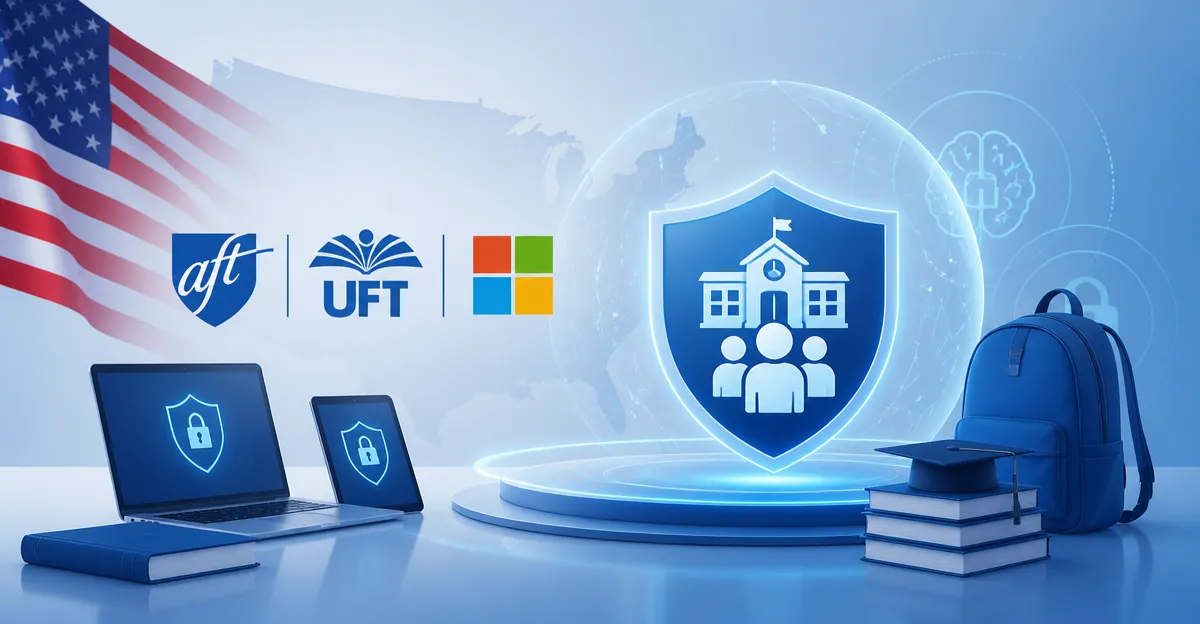
September 9, 2026, (Inside AI) — A landmark agreement between two major teachers' unions and Microsoft establishes the first legally enforceable national standard for AI safety and privacy in U.S. schools. The pact, announced in New York, gives parents and educators contractual control over student data and AI use in classrooms.
The American Federation of Teachers, the United Federation of Teachers, and Microsoft unveiled the "National AI Safety & Privacy Standard" after months of negotiations. It arrives amid a vacuum of federal and state rules governing artificial intelligence in education.
Unions Forge Contractual Shield Where Regulators Lag
The agreement prohibits tech companies from using student data to train AI models. It bans tracking of students, requires human oversight for AI decisions, and mandates plain-language transparency about how AI tools work. School districts can embed these protections directly into their Microsoft customer agreements, making them contractually enforceable.
AFT President Randi Weingarten framed the deal as a necessary intervention. "We have forged a hard-fought, iron-clad privacy agreement with real teeth that protects students and families, because no one else, including the federal government, has stepped up to do the real work," Weingarten said. "We can get angrier and angrier, or we can act decisively; anything less than legally enforceable provisions is simply a wish list."
The standard rests on three pillars: protecting privacy, enhancing safety, and providing transparency and control. Student and educator data cannot be sold, repurposed, or used to train AI models. Schools retain control over data use, retention, and deletion. AI systems must avoid harmful or manipulative experiences and meet rigorous security standards.
Microsoft Vice Chair and President Brad Smith signaled the company's intent to scale the framework. "This standard sets a high bar for child privacy and AI safety, and we'll extend this agreement to every school district across the country," Smith said.
UFT President Michael Mulgrew, who leads the 200,000-member New York City affiliate, emphasized enforcement power. "Educators are stepping in to do what we do best: protect our students. This agreement gives families and school districts the information and privacy protections they have been demanding, and it empowers school districts to end agreements and seek damages from bad actors who break the rules. It starts to level the playing field in a competitive, ever-changing arena that lacks the guardrails our children and school communities need," Mulgrew said.
A Policy Ripple Across Major Districts
The announcement follows New York City Public Schools' recent screens and AI ban. In May, Weingarten called for a total screen ban from kindergarten through second grade, a ban on student-facing AI in elementary school, and a ban on social companion chatbots for students under 16. Similar frameworks have been adopted by the Los Angeles Unified School District and New York State United Teachers.
The agreement builds on the AFT's 2024 "Commonsense Guardrails for Using Advanced Technology in Schools," which established nine core principles. The union also launched the National Academy for AI Instruction to train educators on AI tools and student safety.
Weingarten noted gaps in existing privacy laws. "HIPAA and FERPA never envisioned the advent of AI," she said, "and in the absence of those protections, tech companies need to take responsibility for the products they create and market to students, educators and communities."
The agreement's contractual nature marks a shift from voluntary guidelines. Districts can terminate agreements and pursue damages for violations, creating financial accountability for tech vendors. This approach sidesteps stalled legislative efforts and uses procurement power as a regulatory lever.
Industry observers note that Microsoft's participation sets a competitive benchmark. Other major education technology providers may face pressure to adopt similar terms as districts negotiate renewals. The standard could become a de facto national template even without federal action.
The full agreement and a fact sheet are available for public review. Microsoft, traded on Nasdaq under the symbol MSFT, has positioned the pact as part of its responsible AI mission. The company said it remains committed to making AI broadly available while empowering every person and organization to achieve more.