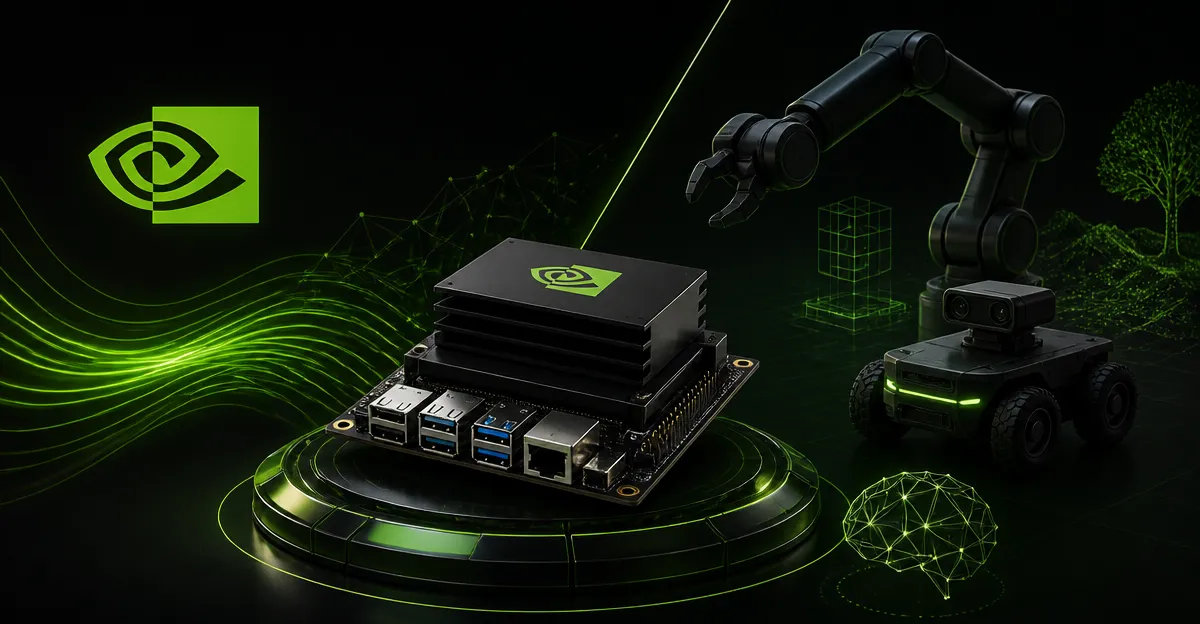
August 25, 2026, (Inside AI) — NVIDIA has introduced the Jetson Orin Nano 2, a robotics computer that targets entry-level edge AI with double the inference speed of its predecessor and a 40 percent power reduction at equal performance. The module carries 78 trillion operations per second of AI compute, 8GB of memory, and an 8-core Arm CPU. Availability is expected in the first half of 2027.
The announcement lands as small and medium frontier models reach accuracy levels that once required far larger systems. NVIDIA positions the new device as a way to bring generative AI into physical machines such as robots, delivery and inspection drones, and vision AI systems. The company says more than 3 million developers already build on its robotics stack.
Deepu Talla, vice president of robotics and edge AI at NVIDIA, framed the launch around real-time intelligence at the edge.
“Today’s small and medium frontier models have reached the accuracy of last year’s largest frontier models, unlocking real-time intelligence for edge devices,” Deepu Talla, vice president of robotics and edge AI at NVIDIA.
Read: Apple’s On-Device AI Hardware
“The Jetson Orin Nano 2 computer puts that breakthrough within reach of millions of developers, delivering the performance and energy efficiency needed for real-time reasoning at the edge.” Deepu Talla, vice president of robotics and edge AI at NVIDIA.
The device keeps the same compact form factor as the Jetson Orin Nano Super. In 15-watt mode, it delivers the same performance as its predecessor while consuming 40 percent less power. Improved Tensor Cores and higher memory bandwidth drive the gains.
Developers can run the latest large language models and vision language models optimized for memory-efficient edge inference. Supported open models include NVIDIA Cosmos and NVIDIA Nemotron, along with Gemma 4 and Qwen 3. The software stack includes NVIDIA Jetson agent skills.
Early adopters test real-world edge workloads
Cognex, Doosan Bobcat, and Matic are among the first to adopt or explore the new computer. Wing, a drone delivery company and subsidiary of Alphabet, currently uses Jetson Orin Nano Super in its delivery fleet and plans to evaluate the new device for faster, safer residential deliveries.
Dinuka Abeywardena, head of perception at Wing, described the operational stakes.
“Drone delivery depends on AI that can enable fast, reliable understanding of the real world,” Dinuka Abeywardena, head of perception at Wing.
“Wing is exploring Jetson Orin Nano 2 to give us a path to more responsive, energy-efficient drones that can help make deliveries quicker and more dependable for customers.” Dinuka Abeywardena, head of perception at Wing.
Read: OpenAI’s Jalapeño Inference Chip
Matic Robotics is adopting the device for home cleaning robots. The company wants conversational AI, gesture detection, precision mapping, semantic understanding, and autonomous cleaning in dynamic environments.
Navneet Dalal, cofounder and CEO of Matic Robotics, tied the hardware to practical home robot demands.
“Home robots need to understand people, map spaces precisely, understand the layout of objects and spaces, and clean autonomously in dynamic and constantly changing environments,” Navneet Dalal, cofounder and CEO of Matic Robotics.
“With Jetson Orin Nano 2, Matic can run state-of-the-art AI models at the edge in a compact home robotics platform built for real-time perception, interaction and navigation.” Navneet Dalal, cofounder and CEO of Matic Robotics.
Ecosystem builds carrier boards and reference designs
More than 20 partners are building carrier boards, hardware systems, customized AI software, and reference solutions. The list includes AAEON, ADLINK, Advantech, Aetina, Antmicro, Aptiv, Auvidea, AVerMedia, Chuanglebo, Connect Tech, ForeCR, JWIPC, Neurealm, Plink, Realtimes, RidgeRun, RS, Seeed Studio, Tauro Tech, Twowin, TZTEK, and YUAN.
That ecosystem matters because entry-level edge AI buyers rarely deploy bare modules. They need integrated boards, thermal designs, and software support to accelerate time to market. The partner roster spans industrial computing, embedded vision, and robotics suppliers.
NVIDIA has not disclosed pricing for the module or developer kit. The first half of 2027 availability window gives partners time to build products around the new silicon.
The launch follows a pattern NVIDIA has used across its Jetson line: ship a developer kit, seed partners, and let the ecosystem create application-specific systems. The Orin Nano 2 extends that strategy to smaller, more power-constrained devices where generative AI was previously impractical.