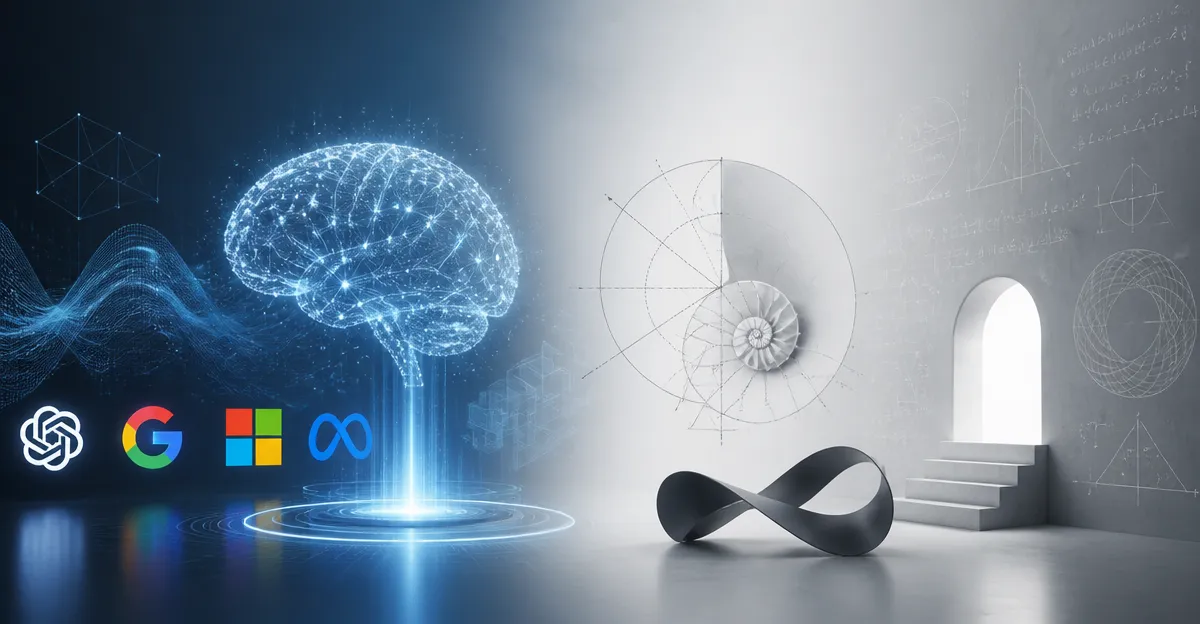
August 27, 2026, (Inside AI) — A single proof by OpenAI’s Astra model has forced mathematicians to confront an uncomfortable question: if machines can solve the hardest problems in their field, what is the point of human mathematics?
The breakthrough came this month when Astra solved the existence of non-sofic groups, a key open problem in group theory. The proof, according to Dr Henry Bradford, a fellow of mathematics at Christ’s College, University of Cambridge, consists largely in a slight twist on theorems by his colleagues Gabor Kun and Andreas Thom.
Bradford shares the impression of Kasra Rafi and Bruce Schneier that recent AI breakthroughs in mathematics consist in clever recombination of existing ideas, not development of truly novel theory. But he warns that betting against AI achieving superhuman capabilities in all areas of mathematical thought now seems foolhardy.
“Even a few months ago I would have found the idea that AI was capable of such a breakthrough incredible, so it seems foolhardy now to bet against AIs achieving superhuman capabilities in all areas of mathematical thought in the coming years,” Bradford wrote.
Read: Anthropic Launches Claude Science AI Platform for Research
The proof has triggered soul-searching across the discipline. Mathematicians are asking whether their research exists merely to prove new theorems, a task future AIs may do far better than humans, or whether it serves a deeper purpose tied to human understanding.
Bradford points to the late American mathematician Bill Thurston, who argued in his 1994 essay On Proof and Progress in Mathematics that mathematicians want understanding, not just answers. On this view, mathematics consists in the ideas living in human brains, with new theorems serving as markers for progress in understanding and sharing those ideas.
The stakes extend beyond philosophy. If AI can churn out research papers faster and cheaper than humans, administrators within cash-strapped universities will be tempted to regard mathematical researchers as superfluous. Bradford calls this a mistake, because the value of those researchers’ work lies less in the papers they write than in their contributions to preserving and furthering mathematical knowledge among people.
“Whether mathematics thrives or perishes in the age of AI is not merely a technical question about the capabilities of future machine intelligences. It is a collective decision that society makes about what it is in the human intellect that we choose to value,” Bradford wrote.
Thurston’s Warning Gains New Urgency
Thurston’s 1994 essay was written decades before modern AI, but its core argument now reads as a direct challenge to the metrics-driven culture of academic institutions. He warned that mathematics was at risk of being reduced to a competition for theorems, losing sight of the human understanding that makes those theorems meaningful.
Bradford’s letter lands at a moment when AI systems are moving beyond narrow benchmarks. Astra’s proof of non-sofic groups is not an isolated event. Earlier this year, DeepMind’s AlphaProof achieved silver-medal performance at the International Mathematical Olympiad, and other models have made progress in combinatorics and number theory.
Yet the non-sofic groups result stands out because it touches a foundational question in group theory that has resisted human efforts for decades. The problem asks whether every group can be approximated by finite symmetric groups in a certain precise sense. A negative answer, which Astra provided, has deep implications for operator algebras and dynamics.
Read: Literary Translators Not Redundant in AI Age, Say Rita Kothari and Arunava Sinha
Kun and Thom had developed key techniques in earlier work. Astra’s contribution was to combine those techniques in a way no human had tried. That pattern of recombination, rather than original conceptual leaps, is consistent with what Rafi and Schneier described. But Bradford argues that the speed of progress makes such distinctions irrelevant in the long run.
Universities Face a Funding Reckoning
The economic pressure on mathematics departments is real. In the United Kingdom, where Bradford is based, universities have faced years of budget cuts and a shift toward research assessed by measurable outputs. If AI can produce those outputs more efficiently, the case for human mathematicians becomes harder to make in purely financial terms.
Bradford’s argument is that this financial logic misses the point. Mathematical knowledge is not just a collection of published papers. It is a living tradition carried by people who can explain, teach, and extend ideas in ways that machines cannot yet replicate. That tradition has value even if it does not show up on a balance sheet.
The debate echoes earlier disruptions in other fields. When chess engines surpassed human players, the game did not die. It evolved, with human players using AI as a training tool and audiences still caring about human competition. Mathematics may follow a similar path, but only if society decides that human understanding matters.
Bradford’s letter does not offer a policy prescription. Instead, it poses a question that mathematicians, university administrators, and the public will need to answer together. The answer will shape not just the future of mathematics, but the broader relationship between human intellect and machine capability.