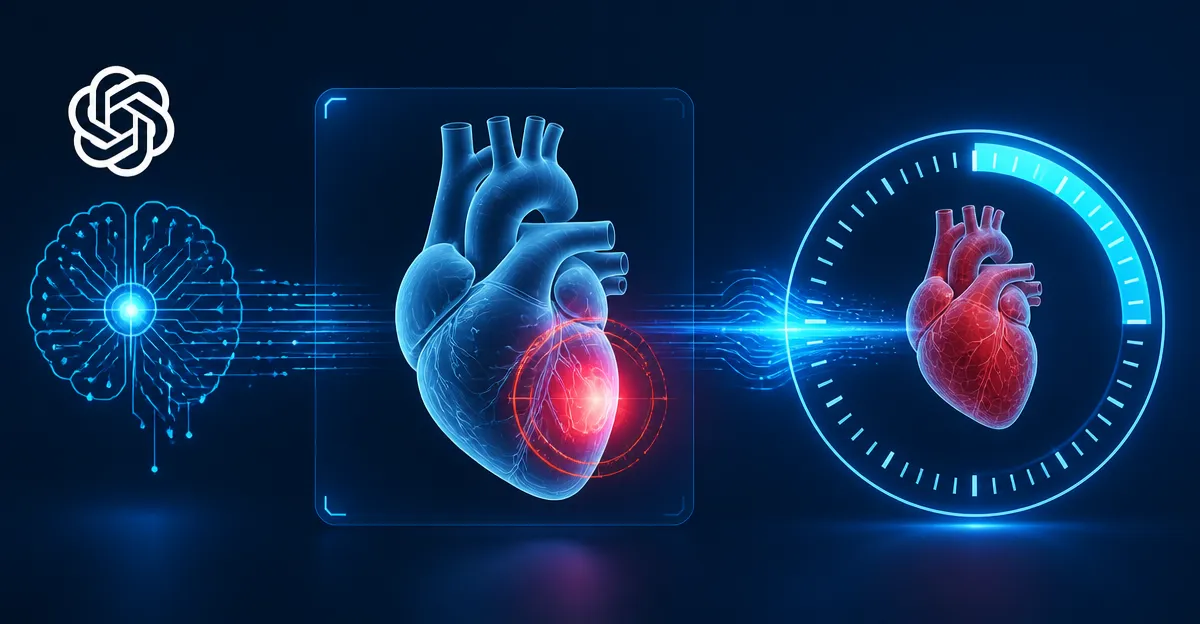
August 31, 2026, (Inside AI) — A new artificial intelligence system can detect signs of heart failure and heart valve disease from a routine electrocardiogram in under two seconds. The technology was trained on millions of patient records and extracts subtle patterns from ECG signals that human clinicians typically cannot see.
The tool was presented at the European Society of Cardiology congress in Munich. In a trial involving 67,000 patients in the United States, it identified up to 81% of those with heart failure and up to 90% of those with heart valve disease.
The standard ECG has been used for a century to diagnose heart attacks and abnormal rhythms. But it cannot directly detect structural heart disease. That usually requires an echocardiogram, an ultrasound scan that patients often wait months to receive.
The new AI model changes that workflow. It does not replace the echocardiogram, but it can flag high-risk patients quickly. Those flagged can then be prioritized for confirmatory scans, potentially cutting months off the diagnostic pathway.
Read: AI Can Detect Heart Disease in Women Using Mammograms, Study Suggests
Dr Sonya Babu-Narayan, a consultant cardiologist and clinical director of the British Heart Foundation, which funded the trial, said:
“It is exciting to see that AI can now deliver a read-out from an ECG in what feels like the blink of an eye.
“Technology like the AI ECG in this research, which has the potential to identify high-risk patients early, will not detect everyone with a heart condition. But it could be a solution to help fast-track the patients who are most likely to have a heart abnormality. When it comes to the heart, earlier diagnosis and treatment saves and improves lives.”
Dr Sonya Babu-Narayan, consultant cardiologist and clinical director, British Heart Foundation
The model was developed by researchers at Imperial College London. Prof Fu Siong Ng, a professor of cardiology at Imperial, noted that patients often wait several months for a heart ultrasound after referral.
Prof Ng said:
“Patients can often wait several months for a heart ultrasound scan after being referred for one by their doctor.
“This makes it exciting that our technology could identify patients most at risk of heart failure and heart valve disease, so they could be prioritised for scans faster and more urgently.”
Read: Can an AI-Powered Scribe Curb Physician Burnout?
Prof Fu Siong Ng, professor of cardiology, Imperial College London
The tool also has a secondary use. Ng said it could be run on all ECGs performed in a hospital to opportunistically flag unsuspected disease. That could catch heart failure or valve disease in patients who had an ECG for unrelated reasons.
Dr Ahmed El-Medany, a British Heart Foundation clinical research fellow who led the analysis, called the system a “superhuman AI.” He said the next challenge is designing handheld AI-led ECG readers for healthcare professionals.
The broader context matters. About one billion ECGs are performed worldwide each year. Even a modest improvement in triage could affect millions of patients. The technology does not diagnose disease on its own, but it provides a strong indication that further testing is needed.
At the same conference, researchers from the University of Tokyo and the Institute of Science Tokyo presented separate work. Their AI analysis of five-second facial videos could detect undiagnosed high blood pressure and type 2 diabetes. Millions of people have these conditions without knowing it.
The heart disease tool is not yet approved for clinical use. Researchers must validate it across diverse populations and healthcare systems. But the trial results suggest that AI-based ECG analysis could become a standard triage step in cardiology.
The potential impact is significant. Early diagnosis of heart failure and valve disease enables earlier treatment, which can prevent hospitalization and death. If the tool can be integrated into existing hospital workflows, it could reduce waiting lists for echocardiograms and improve outcomes.