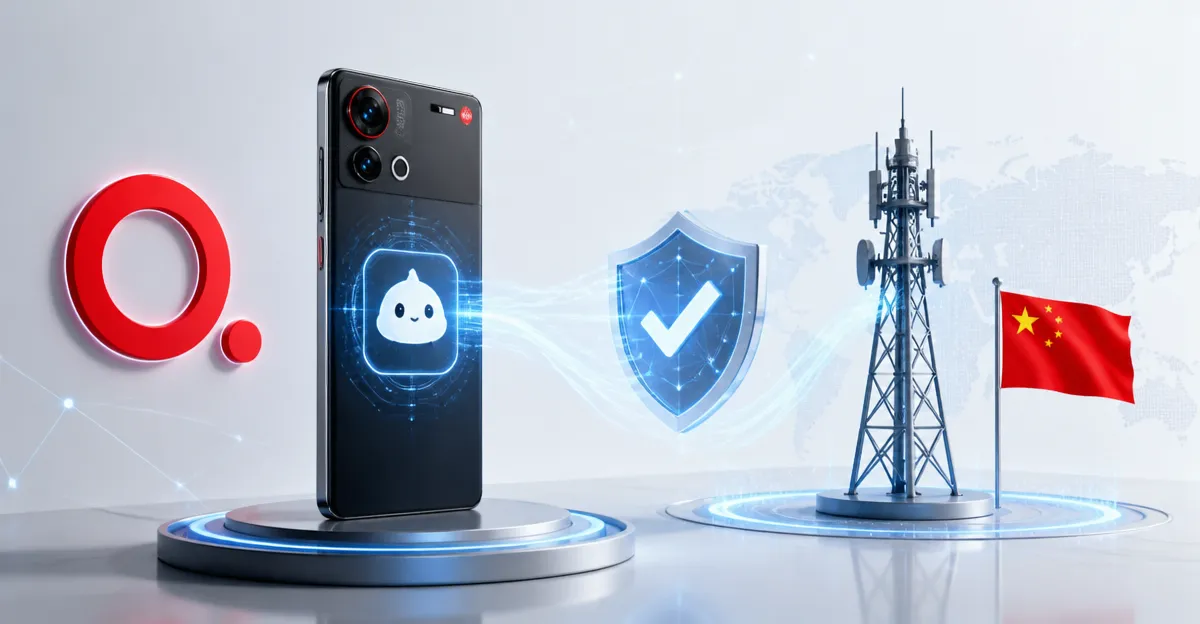
September 3, 2026, (Inside AI) — Nubia’s NaviX Ultra smartphone has cleared network access approval in China, setting the stage for a commercial launch this month. The device, developed with ByteDance’s Doubao team, will ship with the Doubao Phone Assistant, an AI agent designed to execute tasks across apps.
The approval, granted on September 1, moves the phone from technical preview to market readiness. It marks a concrete step in the race to put autonomous AI agents directly into consumers’ hands, not just as chatbots but as task-completing assistants.
Nubia, a brand under ZTE, has positioned the NaviX Ultra as a hardware vehicle for Doubao’s agentic capabilities. The phone’s core promise is to understand natural-language requests and act on them across multiple applications, from booking travel to managing messages, without requiring users to switch between apps manually.
This approach differs sharply from earlier AI phone features. Most current smartphones offer AI assistants that answer questions or generate text. The NaviX Ultra aims to cross the boundary from passive response to active execution, a shift that raises both technical and regulatory questions.
ByteDance’s Doubao team has been aggressive in deploying large language models across its ecosystem. Doubao, the company’s flagship AI assistant, has gained traction in China through aggressive pricing and integration with ByteDance products. Embedding Doubao into a phone’s operating layer represents a deeper push into consumer hardware.
Industry analysts note that network access approval in China involves testing for compatibility, security, and compliance with telecommunications standards. Clearing this hurdle suggests the device meets baseline regulatory requirements, but it does not guarantee smooth sailing for agentic features that may interact with third-party apps in ways those developers did not anticipate.
One open question is how app developers will respond. An AI agent that operates across applications could disrupt existing user flows and advertising models. If Doubao Phone Assistant automates tasks inside apps, it might reduce the time users spend engaging with those apps directly, potentially affecting revenue streams for developers.
Competing phone makers are watching closely. Huawei, Xiaomi, and Honor have all invested in on-device AI assistants, but none has yet launched a phone explicitly branded around an AI agent that completes tasks across apps. Nubia’s move could pressure rivals to accelerate their own agent strategies.
ByteDance’s involvement also signals a broader trend: AI model providers seeking hardware distribution channels. Just as Google and Samsung partnered on Galaxy AI, ByteDance appears to be using Nubia as a vehicle to extend Doubao’s reach beyond its own apps and into the device layer.
The NaviX Ultra’s technical specifications have not been fully disclosed. However, the emphasis on cross-app task execution suggests the phone likely includes a customized system-level integration layer, possibly with privileged access to app intents and user data. Such access raises privacy concerns that regulators may scrutinize after launch.
China’s AI governance framework has tightened over the past year. New rules require security assessments for generative AI services and mandate transparency about how user data is processed. An AI agent that acts on behalf of users across apps could face additional scrutiny under personal information protection laws.
Despite these challenges, the commercial launch signals confidence from both Nubia and ByteDance. If the NaviX Ultra succeeds, it could validate a new product category: the agent phone, where the primary differentiator is not camera quality or chip speed but the intelligence and autonomy of the software layer.
Sales are expected to begin this month, though pricing and availability details remain under wraps. The device will likely target tech-savvy early adopters in China’s competitive smartphone market, where differentiation is increasingly difficult.
The NaviX Ultra’s approval comes as AI agents gain momentum globally. OpenAI, Google, and Anthropic have all announced agentic features for their assistants, but few have shipped on dedicated consumer hardware. Nubia’s phone could offer an early glimpse of how agentic AI performs in everyday use.
For ByteDance, the partnership extends Doubao’s footprint into a new domain. The company has already integrated Doubao into its short-video platform, e-commerce, and office tools. A phone partnership creates another touchpoint for users to interact with ByteDance’s AI, potentially deepening data collection and personalization.
Whether the NaviX Ultra delivers on its promise remains to be seen. Network approval is a necessary step, but real-world performance, app compatibility, and user trust will determine whether agent phones become a lasting category or a short-lived experiment.