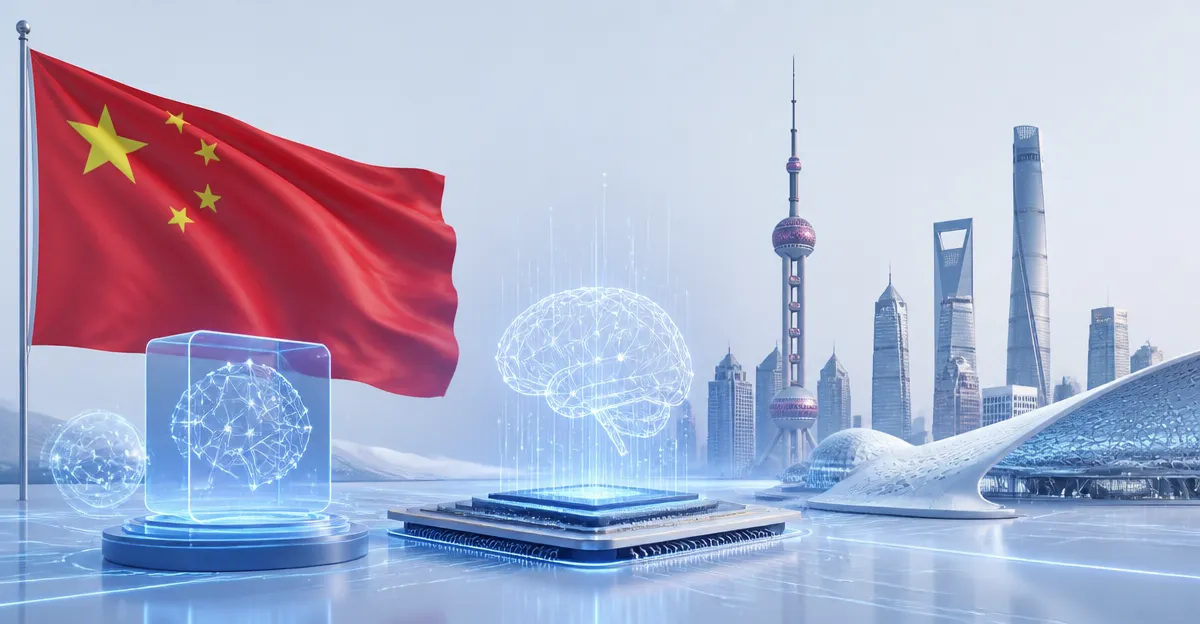
July 7, 2026, (Inside AI) — China is set to showcase a wave of new artificial intelligence technologies at the upcoming World Artificial Intelligence Conference (WAIC) in Shanghai, signaling an aggressive push in the global AI race. The ninth annual event, running from July 17 to 20, will feature the first physical display of Huawei Technologies’ Atlas 950 SuperPoD computing cluster. Officials also teased what they call “the world’s first AI agent phone,” though the developer remains unnamed.
The conference, a flagship gathering since 2018, comes as China’s shipments of AI-powered phones and computers surge. According to Wang Ruomeng, an official from the National Development and Reform Commission, shipments exceeded 100 million units in 2025 and are projected to overtake non-AI gadgets this year. The preview was detailed by Tang Wenkan, director of the Shanghai Municipal Commission of Economy and Informatisation, at a press briefing on Tuesday.
The Atlas 950 SuperPoD, originally unveiled last year, packs 8,192 Ascend neural processing unit (NPU) cards optimized for neural networks and machine learning workloads. Its physical debut underscores Huawei’s ambition to rival global AI infrastructure giants like Nvidia, which currently dominates the data center GPU market. However, U.S. export controls on advanced chips have forced Chinese firms to accelerate domestic alternatives, making the Atlas 950 a critical piece of the country’s self-reliance strategy.
Beyond hardware, the conference will spotlight a range of software and robotics innovations. MiniMax will introduce its M3 multimodal model, while StepFun plans to unveil an agent operating system. A near-memory computing 3D chip from Dongfang Suanxin also aims to push computing efficiency. Tang highlighted these alongside new humanoid robots and dexterous robotic hands, reflecting China’s focus on embodied AI. The mysterious AI agent phone, if truly agentic, could mark a shift from voice assistants to autonomous task execution—a leap that even Apple and Google have yet to fully realize.
Read: Nubia’s Doubao-Powered AI Agent Phone Clears Network Access Approval
Tang noted that WAIC will cover frontier topics like world models, open-source agents, AI coding, the token economy, and “one-person companies” that replace staff with AI. This aligns with a global trend toward agentic systems, but China’s state-backed ecosystem may accelerate adoption. For context, Beijing has poured billions into AI development, aiming to become the world leader by 2030. Yet, some analysts caution that hardware gaps and software maturity could slow progress compared to U.S. counterparts.
The Hardware Hurdle and the Agentic Bet
Huawei’s Ascend NPUs have made strides, but independent benchmarks suggest they still lag behind Nvidia’s H100 GPUs in training large models. The Atlas 950’s 8,192-card configuration is massive, yet raw scale doesn’t guarantee efficiency. Dylan Patel, chief analyst at SemiAnalysis, recently noted that China’s AI chip ecosystem remains fragmented, with interconnect and software stack issues persisting. “The hardware is improving, but the software ecosystem is where the real battle is,” he said in a June report. This makes the agent phone and operating system announcements particularly strategic—they signal a move toward application-layer dominance where hardware constraints matter less.
The agent phone concept, if executed well, could leapfrog current smartphone AI. Unlike simple chatbots, an AI agent phone would proactively manage tasks across apps, requiring deep OS integration. StepFun’s agent OS might be the underlying platform, but without details, skepticism is warranted. Satya Nadella, CEO of Microsoft, recently described AI agents as the next interface, but he also warned that reliability remains a challenge. China’s ability to deliver a seamless experience will be tested.
Market Momentum and Global Stakes
The shipment data from Wang Ruomeng provides concrete evidence of AI’s consumer penetration in China. Overtaking non-AI devices would be a tipping point, mirroring how smartphones eclipsed feature phones. This is fueled by domestic brands like Xiaomi, Oppo, and Vivo embedding on-device AI for photography, translation, and system optimization. Globally, IDC forecasts that AI PCs will make up 60% of all PC shipments by 2027, but China appears to be on a faster track.
However, the conference’s timing is politically charged. The U.S. recently tightened export rules on chipmaking equipment, and the European Union is advancing its own AI Act. China’s showcase is as much about projecting technological sovereignty as it is about product launches. The inclusion of one-person companies also hints at a labor market transformation that could have profound social implications—a topic that WAIC will likely explore in closed-door sessions.
Read: China’s DeepSeek Developing Its Own AI Inference Chip, Sources Say
As the conference approaches, the industry will watch whether these announcements translate into viable products or remain trade-show vaporware. The Atlas 950’s real-world performance, the agent phone’s capabilities, and the multimodal model’s benchmarks will be key indicators of China’s AI trajectory.