September 5, 2026, (Inside AI) — A federal judge has refused to block a Minnesota law that bars AI tools from generating realistic fake nude images of identifiable people.
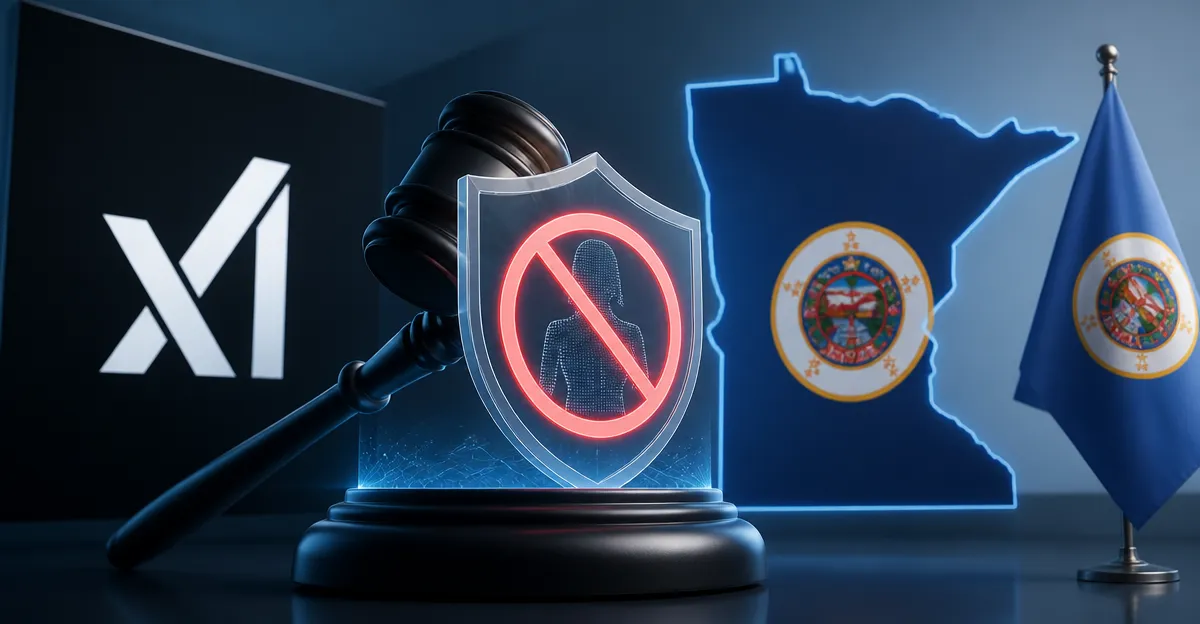
U.S. District Judge Donovan Frank denied a preliminary injunction request from Elon Musk's AI company, xAI. The ruling allows the state law, effective since Aug. 1, to remain in force while litigation proceeds.
The statute targets website operators, software developers, and others who enable users to "nudify" images using AI technology. It represents one of the most direct state-level attempts to curb AI-generated intimate imagery without consent.
Minnesota's Ban Tests AI Liability Limits
The law makes it illegal to knowingly create, distribute, or offer tools that generate nonconsensual intimate images. Violators face civil penalties and potential criminal charges. xAI argued the law is unconstitutionally vague and overbroad.
Judge Frank was not persuaded. His ruling means xAI must comply with the ban while the case moves forward. The company had claimed the law could chill legitimate AI development and free expression.
The dispute centers on whether platforms can be held responsible for user-generated deepfakes. Minnesota lawmakers designed the law to close loopholes that let apps and websites escape accountability for hosting nudification tools.
Legal experts say the ruling signals judicial willingness to let states experiment with AI regulation. Similar laws are pending in at least a dozen other states, including California, Texas, and New York.
Deepfake Lawsuits Multiply Across Tech Sector
The Minnesota case is part of a broader wave of litigation over AI-generated sexual imagery. Victims' rights groups have pushed for stronger laws after high-profile incidents involving celebrities and private individuals.
In 2024, the U.S. Senate passed the TAKE IT DOWN Act, which would criminalize the publication of nonconsensual intimate images, including AI-generated ones. The bill stalled in the House but remains under negotiation.
Tech companies face mounting pressure to build detection and prevention systems. Meta, Google, and OpenAI have all introduced policies against generating explicit deepfakes, but enforcement remains inconsistent.
xAI's Grok image generator has drawn criticism for producing realistic depictions of public figures. The company has said it uses safety filters, but researchers have documented bypasses.
The Minnesota ruling does not resolve the constitutional questions. xAI can appeal to the Eighth Circuit Court of Appeals. The company has not indicated its next step.
For now, the law stands as a test case for whether states can impose liability on AI tool providers for downstream misuse. The outcome could shape how other jurisdictions draft similar statutes.