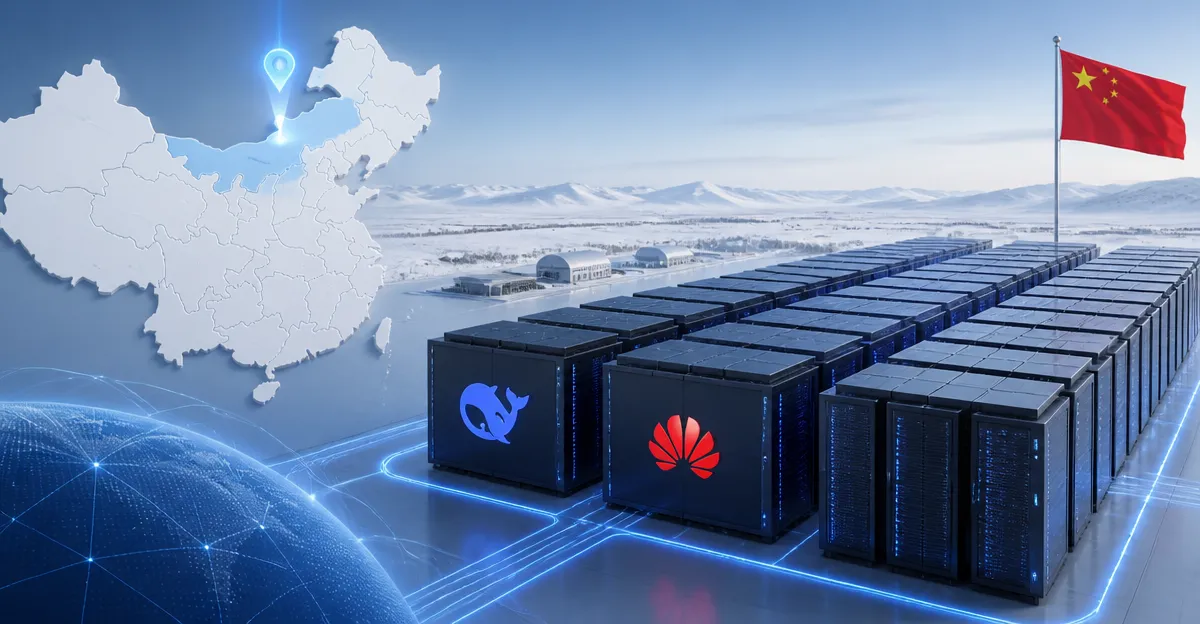
September 7, 2026, (Inside AI) — DeepSeek is preparing to deploy at least 160,000 Huawei Ascend 950DT accelerators at a new data center in Inner Mongolia, according to sources familiar with the matter. The cluster would rank among the largest known installations of Huawei AI silicon, though its completion depends on the chipmaker's production capacity.
The chips are earmarked for inference workloads, running DeepSeek's models to answer user queries. No training use is currently planned. The facility's broader design targets gigawatt-scale power consumption, with the 160,000 accelerators representing only a portion of eventual capacity.
The reported plan signals a major shift in China's AI supply chain. Huawei's Ascend line has faced yield and software ecosystem challenges. A cluster of this size would test whether Huawei can deliver at scale and whether DeepSeek can optimize its models for non-Nvidia hardware.
Huawei Ascend's Capacity Test
Huawei has positioned the Ascend 950DT as a domestic alternative to Nvidia's restricted GPUs. However, industry analysts note that Huawei's advanced packaging capacity, particularly for high-bandwidth memory, remains a bottleneck. A 160,000-chip order would consume a significant share of Huawei's annual output.
DeepSeek's choice of inference-only deployment reduces some risk. Inference workloads are less sensitive to interconnect performance than training, making them more forgiving of Huawei's software stack. Still, serving millions of users on Ascend chips requires substantial engineering effort.
Chinese cloud providers have been quietly testing Ascend clusters for inference. Alibaba Cloud and Tencent Cloud have both announced Ascend-based services. DeepSeek's plan, if realized, would dwarf those early deployments.
Inner Mongolia's Power Advantage
Inner Mongolia offers cheap, abundant electricity from wind and solar, plus cool temperatures that cut cooling costs. The region hosts several hyperscale data centers, including facilities for China Mobile and Alibaba. A gigawatt-scale project would make DeepSeek one of the region's largest tenants.
The timing remains uncertain. Sources describe the plan as reported intentions, not a completed deployment. Huawei's production capacity will determine how quickly chips arrive. DeepSeek has not publicly commented on the project.
China's push for AI self-reliance has accelerated since US export controls tightened. Domestic chip demand now exceeds supply by a wide margin. DeepSeek's order would deepen Huawei's role as the primary alternative to Nvidia in China.
The broader facility's power target suggests DeepSeek is preparing for sustained growth in inference demand. Its models have gained traction among developers and enterprises seeking low-cost AI services. Running those models on domestic silicon would insulate DeepSeek from future export restrictions.