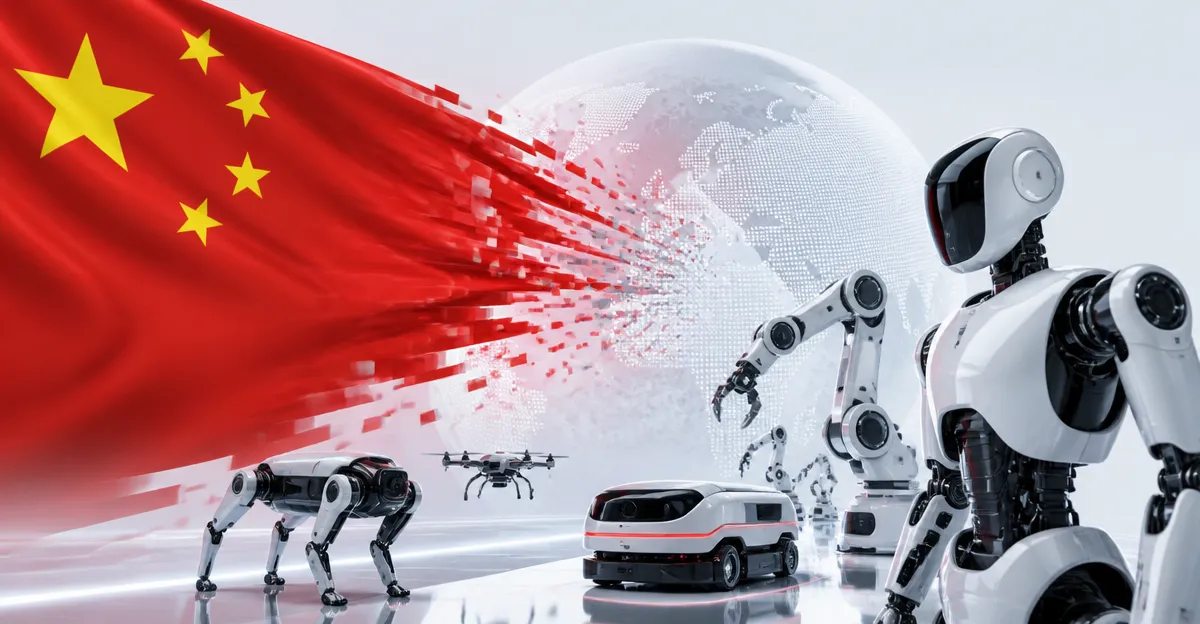
July 5, 2026, (Inside AI) — China is quietly building an army of AI-powered robots that could soon flood global markets, reshaping industries from logistics to manufacturing. This emerging wave, dubbed ‘China shock 3.0’ by some analysts, follows the country’s earlier disruptions in low-cost goods and electric vehicles.
The world’s fixation on frontier AI models misses a more tangible threat: China’s robot-making factories. While U.S. labs battle over language models, Chinese firms are embedding AI into physical machines designed for export.
Chinese e-commerce giant JD.com has predicted robots will ultimately replace its 700,000 delivery workers. Meanwhile, at South Korean carmaker Hyundai, workers are threatening strikes over robot roll-outs. These are not isolated incidents but signals of a systemic shift.
At home, robots offset a demographic crisis. China’s working-age population is projected to plummet from 1 billion at its peak to just 300 million by century’s end. Abroad, they become the next export machine.
Read: India Sits Out the US-China Embodied AI Robot Race
Many see AI models as the next battleground for economic leadership. But that’s only half the picture. AI models alone don’t create sufficient economic value. Value emerges only when models are turned into products, deployed at scale, and woven into the economy.
The Real AI Race Is Physical
China’s strategy leverages its manufacturing dominance to embed AI into hardware. The country already produces over half the world’s industrial robots. Now it’s adding intelligence, creating machines that learn and adapt.
This isn’t about chatbots. It’s about autonomous forklifts, AI-driven assembly arms, and delivery bots navigating city streets. The economic impact could dwarf that of software-only AI.
China’s robot density in manufacturing has surged, surpassing the United States in 2023 with 392 robots per 10,000 workers, according to the International Federation of Robotics. That number is climbing fast.
Export data reveals the ambition. China’s industrial robot exports grew 86% year-on-year in early 2026, per customs data. Destinations include Vietnam, Mexico, and Germany—markets critical to global supply chains.
Critics argue that Chinese robots still lag in precision and software. But the gap is closing. Companies like Siasun and Estun are investing heavily in AI integration, often using open-source models adapted from Western research.
Read: Can China’s AI Agribots Replicate Its EV Success Story?
When Labor Shortages Meet Export Ambition
China’s demographic decline is a well-documented catalyst. With fewer young workers, automation isn’t a choice but a necessity. The government’s “Made in China 2025” plan explicitly targets robotics as a pillar.
Yet the export push raises uncomfortable questions. If robots displace workers in South Korea or Germany, will protectionist walls rise? The European Union already probes Chinese EVs; robots could be next.
History offers parallels. The first China shock hit low-end manufacturing. The second, electric vehicles. Now, AI-powered robots could trigger a third, potentially more disruptive wave.
Economist Daron Acemoglu has warned that AI-driven automation risks hollowing out middle-class jobs without creating replacements. China’s robot exports could accelerate that trend globally.
But not everyone agrees on the threat level. Some analysts note that robots remain costly and niche. Adoption in small factories is slow. The real shock may take a decade to materialize.
Still, the trajectory is clear. China is betting that physical AI will define the next era of economic competition. The question is whether the world is paying attention.