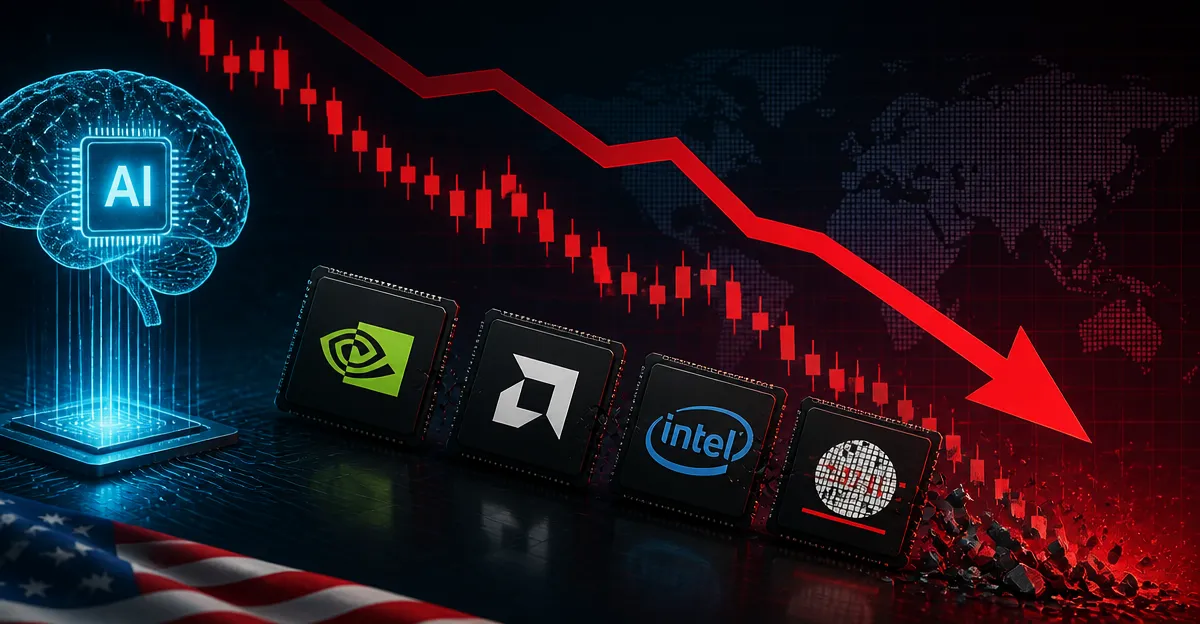
July 28, 2026, (Inside AI) — A sharp sell-off in artificial intelligence stocks pushed South Korea's benchmark Kospi index to a three-month low on Tuesday, as semiconductor giants Samsung Electronics and SK Hynix each plunged more than 10%. The rout reflected deepening investor anxiety over massive AI-related borrowing, intensifying Chinese competition, and the fragile financial engineering underpinning the industry's expansion.
The declines were triggered by a report from The Information that China has begun mass production of homegrown deep ultraviolet (DUV) chip-making tools, a development that threatens the dominance of established global equipment leaders. Simultaneously, Chinese memory chip maker CXMT saw its shares surge 466% upon its Shanghai stock exchange debut on Monday, underscoring Beijing's aggressive push to build an independent AI supply chain.
"We believe the market was likely spooked by the progress of China's chip-making equipment capabilities, and was worried that this progress would threaten the competitive position of global chip making and chip equipment leaders," said Jing Jie Yu, an equity analyst at Morningstar, adding that the sell-off was "largely a kneejerk reaction and overdone".
The rout extended beyond Asia. Nvidia shares closed 5% lower on Monday after the Wall Street Journal reported the company is in talks with OpenAI to provide $250 billion for a massive datacenter project in Ohio. The news sent Nvidia below the $200-per-share mark and spiked the cost of insuring its debt against default using credit default swaps (CDS).
"The market reaction to the Nvidia news was swift. Nvidia fell 5% and closed the session below the $200-per-share mark. More importantly, Nvidia's five-year CDS spiked, suggesting that it may not yet be the right time to buy the dip," said Ipek Ozkardeskaya, a senior analyst at Swissquote.
Circular Funding Fuels Anxiety
Investor unease is increasingly focused on the "circular funding" model in AI, where companies finance each other's growth, creating a web of interdependency. Nvidia's potential backing of OpenAI's datacenter project exemplifies this trend. While Nvidia's investment-grade credit rating could lower borrowing costs for the project, the arrangement also concentrates risk and raises questions about the sustainability of such capital-intensive expansion.
The sell-off reflects broader concerns about the return on massive AI investments. A recent Goldman Sachs report questioned whether the expected productivity gains from AI will justify the estimated $1 trillion in capital spending over the coming years. Similarly, academic research has highlighted the risk of diminishing returns as models scale, potentially undermining the economic case for ever-larger datacenters.
China's Chip Ambitions Reshape Landscape
China's progress in DUV lithography tools, while still trailing leading-edge extreme ultraviolet (EUV) technology, could enable it to produce advanced chips domestically and reduce reliance on foreign suppliers. This shift arrives as U.S. export controls have sought to limit China's access to cutting-edge semiconductor equipment. The CXMT listing, which raised billions, signals that Chinese firms are attracting significant capital to challenge incumbents like Samsung and SK Hynix in memory markets.
The Kospi's decline to mid-April levels wiped out months of gains, with the sell-off concentrated in stocks most exposed to AI hardware demand. Analysts warn that if AI spending slows, the ripple effects could hit not just chipmakers but also equipment suppliers and construction firms tied to datacenter builds. For now, the market is pricing in a reality check on an industry that has been fueled by hype and unprecedented capital flows.