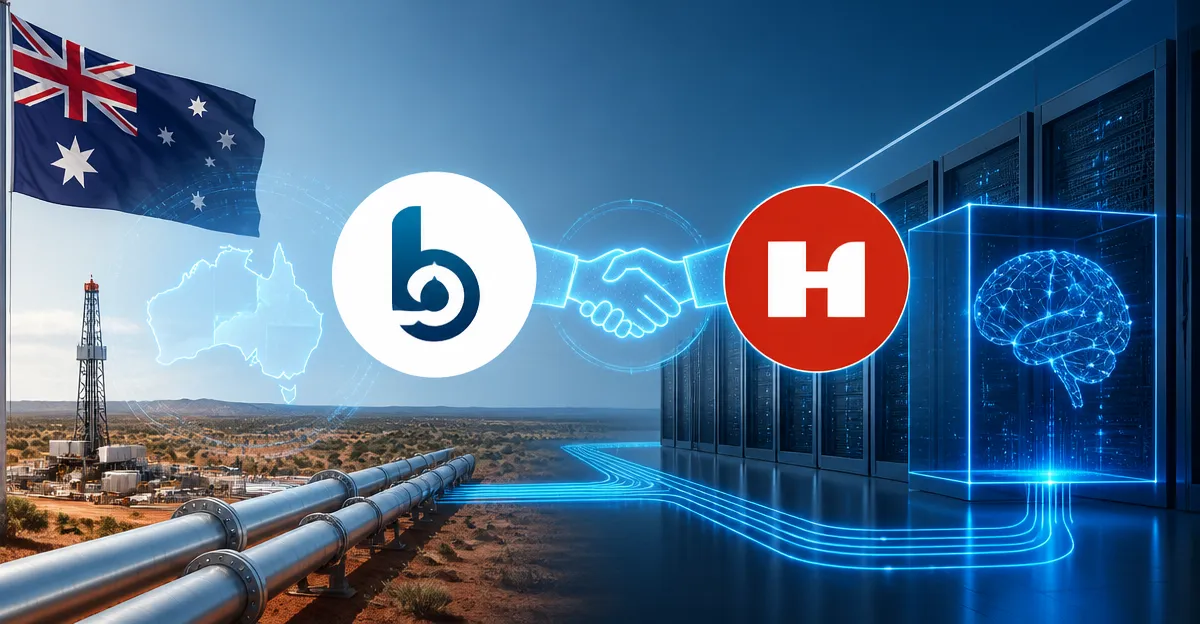
July 30, 2026, (Inside AI) — Beetaloo Energy Australia has signed a non-binding agreement with oilfield services giant Halliburton to advance a proposed gas-to-power and data centre development in Australia’s Northern Territory, the company announced Thursday. The partnership aims to supply power to hyperscale data centres and AI infrastructure from a 185-hectare site at Weddell near Darwin, tapping gas resources in the Beetaloo Basin.
The agreement positions Halliburton to provide technical expertise across field development, drilling, project execution, and scalable gas-fired power generation. This collaboration marks a significant step in Beetaloo Energy’s strategy to assemble a consortium of specialist partners spanning gas supply, power generation, pipelines, and data centre development.
Beetaloo Energy Chief Executive Alex Underwood described the deal as “another step in building a group of specialist partners across gas supply, power generation, pipelines and data-centre development.” The project, dubbed Beetaloo Digital, remains subject to concept studies, partner agreements, financing, and regulatory approvals, the company said.
The Beetaloo Basin, one of Australia’s most significant onshore shale gas resources, has long been eyed for its potential to supply domestic and international energy markets. However, this project pivots toward a more immediate, high-demand application: powering the AI revolution. Hyperscale data centres, the massive facilities that underpin cloud computing and AI model training, require enormous, uninterrupted power. A single large data centre can consume as much electricity as a small city, and AI workloads are dramatically accelerating that demand.
Read: Nvidia Teams Up With Australian Partners to Build 2 GW AI Factory Capacity
Global electricity consumption from data centres could double by 2030, reaching over 1,000 terawatt-hours, according to the International Energy Agency. In Australia, data centre capacity is projected to grow by 150% by 2030, driven by hyperscalers like AWS, Microsoft, and Google expanding their Asia-Pacific footprints. The Northern Territory’s abundant gas reserves and available land make it a logical candidate for such energy-intensive infrastructure.
Halliburton’s involvement brings critical oilfield expertise to a sector increasingly intertwined with tech. The company has been expanding its digital and low-carbon solutions, but this partnership underscores a more traditional role: extracting and delivering natural gas efficiently. Halliburton’s experience in unconventional resource plays could mitigate some of those hurdles.
Yet, the project faces significant headwinds. The Beetaloo Basin has been a flashpoint for environmental and Indigenous land rights disputes. Fracking in the region has drawn opposition from traditional owners and climate groups, who warn of water contamination and greenhouse gas emissions. The Northern Territory government has supported development, but regulatory approvals remain uncertain. Additionally, the project’s reliance on gas-fired power raises questions about its alignment with Australia’s net-zero targets, even as AI’s energy appetite grows.
Gas as a Bridge Fuel Faces Scrutiny
Proponents argue that natural gas is a necessary bridge fuel for reliable, on-demand power that renewables cannot yet fully provide for 24/7 data centre operations. Critics counter that locking in new gas infrastructure risks stranded assets and undermines climate goals. The tension is acute in Australia, where the government has simultaneously approved new gas projects and strengthened emissions reduction commitments.
For Beetaloo Energy, the Halliburton deal is a calculated bet that AI’s insatiable power needs will accelerate development timelines and attract investment. The company’s share price rose modestly on the news, reflecting cautious optimism. However, the non-binding nature of the agreement means significant milestones, including final investment decisions and regulatory greenlights, lie ahead.
The broader trend of tech firms securing dedicated energy sources is accelerating. Microsoft recently signed a deal to power data centres with fusion energy by 2028, while Google has invested in geothermal and nuclear startups. In this context, Beetaloo Digital represents a more conventional approach: leveraging existing fossil fuel resources to meet immediate demand, with the promise of eventual carbon capture or offsets.
Read: Finland Risks Strained Power Supply After Google AI Deal, Opposition Warns
As the project advances, its success will depend not only on technical execution but also on navigating complex social and political landscapes. For now, the agreement signals that the marriage of Big Oil and Big Tech is deepening, with Australia’s remote frontiers becoming a new battleground for the AI energy race.