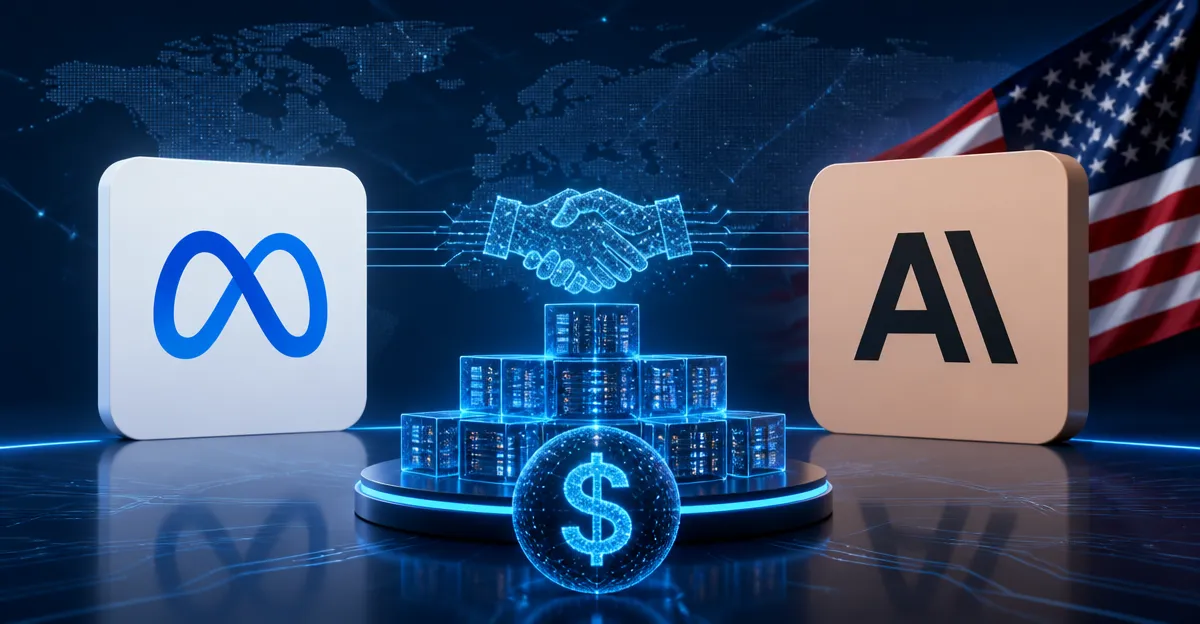
July 18, 2026, (Inside AI) — Meta Platforms is in advanced talks to lease substantial computing power to Anthropic, the artificial intelligence startup behind the Claude family of large language models, in a deal that could be worth $10 billion, according to a report by the New York Times on Friday. The discussions, confirmed by three people with knowledge of the matter, would position Meta as a critical infrastructure provider in the accelerating AI arms race.
The potential deal underscores a tectonic shift in how AI compute is sourced and monetized. Rather than building or renting from traditional cloud providers, Anthropic would tap directly into Meta’s sprawling, custom-built infrastructure. Meta has invested billions in data centers packed with NVIDIA H100 GPUs and its own MTIA (Meta Training and Inference Accelerator) chips, originally designed to power its social media algorithms and the Llama open-source models. Now, that capacity is becoming a for-sale commodity.
Anthropic’s hunger for compute is well documented. The company, co-founded by former OpenAI employees Dario Amodei and Daniela Amodei, has raised over $7 billion from backers including Amazon and Google. Its Claude models compete directly with OpenAI’s GPT-4o and Google’s Gemini. Training frontier models demands clusters of tens of thousands of GPUs running for months. Leasing from Meta could give Anthropic a dedicated, predictable supply outside the congested public cloud, where wait times for large GPU reservations stretch into quarters.
The Economics of a $10 Billion Handshake
A $10 billion commitment would be one of the largest pure compute leases in history. For context, Microsoft’s multi-year investment in OpenAI, including cloud credits, is estimated at over $13 billion. Meta’s deal, if consummated, would likely span several years and involve not just raw GPU hours but also networking, storage, and software optimization. It could also include access to Meta’s Grand Teton platform, its latest GPU server design.
For Meta, the deal is a masterstroke in capital efficiency. The company spent $28.1 billion on capital expenditures in 2024, mostly on AI infrastructure. Leasing idle or excess capacity to a well-funded partner like Anthropic turns a cost center into a revenue stream. CEO Mark Zuckerberg has repeatedly said Meta needs massive compute to train Llama and power AI-driven recommendation systems. But not all that capacity runs at 100% utilization year-round. A long-term lease with Anthropic smooths out those dips.
Yet the arrangement raises eyebrows among antitrust observers. Meta, already under scrutiny for its dominance in social media, would become a gatekeeper of AI compute. If the deal includes preferential access or technical integration with Meta’s own AI efforts, competitors could cry foul. The Federal Trade Commission under Lina Khan has shown keen interest in AI partnerships, having opened inquiries into deals between cloud giants and AI startups.
Anthropic’s Compute Independence Gambit
Anthropic’s move can be read as a bid for independence from its own investors. Both Amazon and Google provide cloud credits to Anthropic, but relying on them creates strategic vulnerability. Amazon’s Bedrock service hosts Claude, but Amazon is also developing its own Titan models. Google has DeepMind. A direct pipeline to Meta’s hardware gives Anthropic a neutral third-party option, reducing its dependence on investor-controlled infrastructure.
The deal also reflects the sheer scale of next-generation AI training. Claude 4, expected to train on over 100,000 GPUs, would strain even the largest cloud regions. Meta’s data centers, many located in the U.S. Midwest and Ireland, offer abundant power and cooling. Anthropic could effectively rent an entire AI supercomputer, preconfigured for large-scale distributed training, without the 18-24 month lead time to build its own.
Neither Meta nor Anthropic has publicly commented on the talks. The New York Times report, citing anonymous sources, notes that negotiations are ongoing and terms could change. A Meta spokesperson declined to comment when reached by Inside AI. Anthropic did not immediately respond to a request for comment.
This isn’t the first time a tech giant has monetized its internal infrastructure. Amazon Web Services itself was born from Amazon’s need to sell excess server capacity. But the AI compute market is different—more concentrated, more capital-intensive, and more geopolitically sensitive. The Biden administration’s executive order on AI and subsequent CHIPS Act funding have prioritized domestic AI infrastructure. A Meta-Anthropic deal would keep critical compute on U.S. soil, aligning with national security goals.
For the broader industry, the deal signals that AI compute is becoming a tradable asset class. Startups with deep pockets can now bypass cloud providers entirely, negotiating directly with hyperscalers for raw capacity. This could squeeze margins at Microsoft Azure, Google Cloud, and AWS, which have built their AI strategies around bundled services—compute plus proprietary models plus developer tools. If the best models can run on anyone’s hardware, the cloud’s lock-in weakens.
The talks come as Meta prepares to release Llama 4, its most advanced open-source model yet. Zuckerberg has framed open-source AI as a counterweight to proprietary systems. Leasing compute to a company like Anthropic, which operates on a safety-first, closed-source philosophy, creates an interesting tension. It suggests Meta is agnostic about how the compute is used, as long as it pays.
Financial analysts view the potential deal as a positive for Meta’s stock, which has rallied on AI optimism. Morgan Stanley analyst Brian Nowak wrote in a note to clients that “monetizing excess AI capacity could add $3-4 billion in high-margin annual revenue, accelerating Meta’s return on its infrastructure bets.” However, he cautioned that execution risks remain, including the complexity of supporting an external customer with stringent uptime and security requirements.
For Anthropic, the compute lease would be its largest infrastructure commitment to date, surpassing its $4 billion deal with Amazon announced in 2023. It also raises questions about its long-term cloud strategy. Will Anthropic eventually build its own data centers? CEO Dario Amodei has hinted at vertical integration, stating in a 2025 interview that “control over the full stack, from silicon to safety, is the endgame for frontier AI.” A $10 billion lease with Meta buys time to develop that capability.
The AI infrastructure gold rush shows no signs of slowing. NVIDIA’s data center revenue hit $47.5 billion in fiscal 2025, and demand still outstrips supply. Deals like this one validate the thesis that AI compute is the new oil—and those who control the refineries will shape the next decade of technology. Whether Meta becomes a kingmaker or merely a landlord depends on how it structures the fine print.