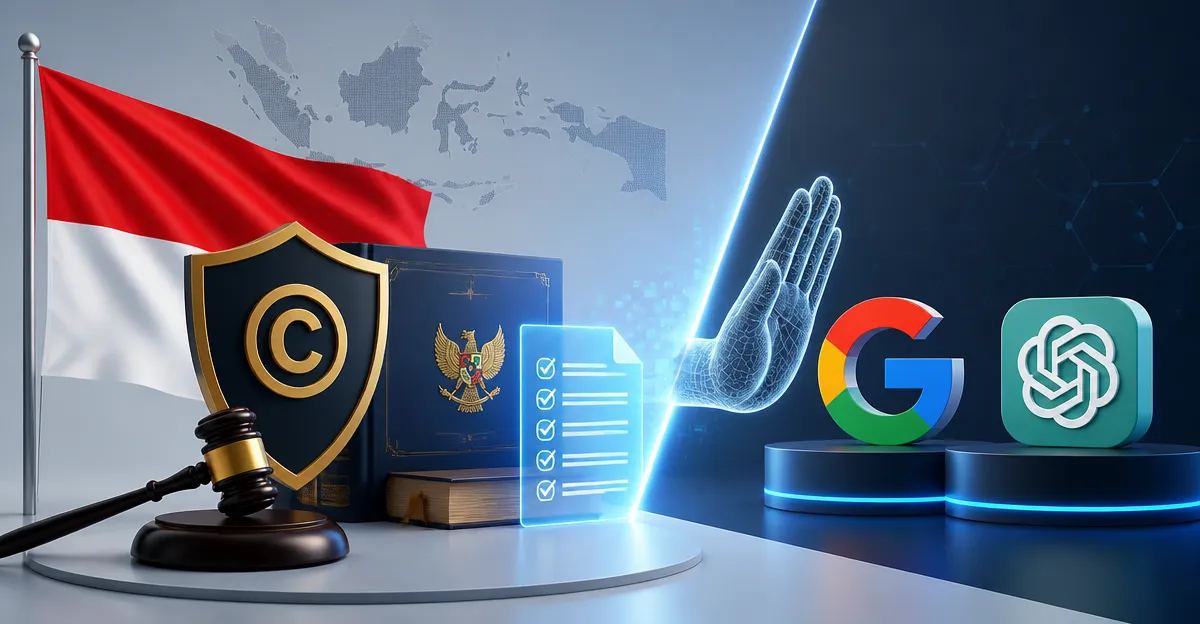
July 17, 2026, (Inside AI) — Indonesia is drafting sweeping amendments to its copyright law that would, for the first time in Southeast Asia, explicitly regulate artificial intelligence. A bill reviewed by Reuters shows the government plans to grant copyright privileges to human creators who use AI as a tool, while excluding fully machine-generated works from protection.
The legislation also mandates that tech platforms pay compensation for using news content in AI training or link previews, with funds channeled through state-supervised collective management organizations. The move puts Google, Meta, TikTok, and other platforms on notice, potentially reshaping the region’s digital economy.
Hermansyah Siregar, an official at Indonesia’s law ministry overseeing intellectual property, confirmed the draft’s authenticity. He framed the bill as a necessary response to generative AI’s disruption of creative industries.
“The development of generative AI has disrupted the copyright framework,” Siregar said. “If unregulated, it could kill human creation.”
The draft introduces several AI-specific clauses. It would ban using AI to imitate a creator’s “distinctive style” and require disclosure when AI is used in content. Copyright protection would apply only to AI-assisted works with sufficient human involvement, though the bill does not define that threshold. Fully AI-generated works would be ineligible.
Fair-use provisions or licensing agreements would govern the use of copyrighted material for AI training. Ari Juliano Gema, an IP and entertainment lawyer, warned that the bill conflates commercial and research AI uses, a distinction that could alarm global tech firms.
Google, which criticized the overhaul last month, could face sanctions including revoked business permits if it fails to comply. The company argued the bill’s rigidity would backfire.
“Rigid, overbroad mandates, however, would harm local creators, slow innovation, and leave Indonesia as an international outlier, ultimately discouraging the investment needed to drive its digital future,” Google said in a statement, adding it would engage with the government.
Meta and TikTok did not respond to requests for comment. Their platforms remain deeply embedded in Indonesia’s social media landscape.
The bill’s timing aligns with Indonesia’s broader AI ambitions. On Thursday, the nation joined 28 other countries in Shanghai to establish an intergovernmental body for AI cooperation and governance. China’s President Xi Jinping later called for human-controlled AI systems and global early-warning mechanisms.
Indonesia’s disclosure rules mirror transparency mandates elsewhere. The EU AI Act requires labeling of deepfakes, while U.S. and Singapore copyright offices insist on human authorship for protection. Yet Indonesia’s approach goes further by directly linking news content compensation to AI training—a provision absent in most jurisdictions.
Siregar noted the draft is not final and the government seeks further input. He cited the New York Times lawsuit against AI developers as evidence of a global reckoning. The bill’s fate remains uncertain, but its provisions signal a willingness to challenge Silicon Valley’s data practices head-on.
If enacted, the law could force platforms to renegotiate content deals or risk losing access to Indonesia’s 270 million consumers. For now, the draft stands as a test case for how emerging economies might wield copyright to extract value from AI supply chains.