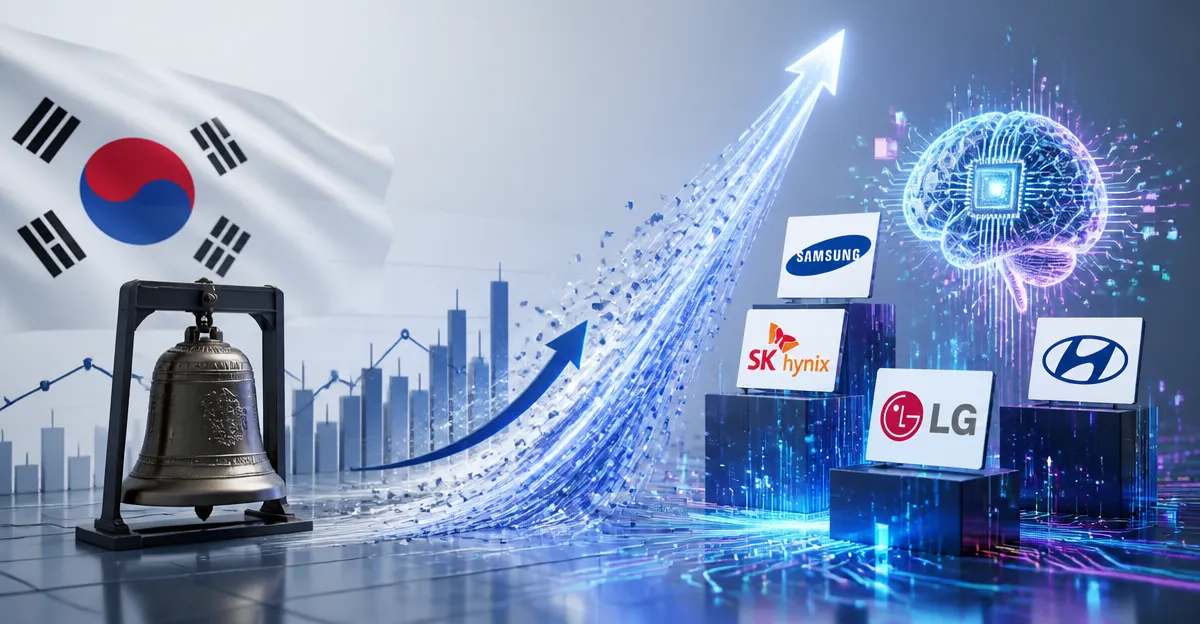
July 17, 2026, (Inside AI) — South Korea’s stock market, once a trusted bellwether for global economic health, has been transformed into an AI-fueled casino. An unprecedented surge in leveraged bets on semiconductor giants like Samsung Electronics and SK Hynix has decoupled the benchmark KOSPI from traditional fundamentals, triggering extreme volatility and regulatory alarm.
More than half of all circuit breakers in the KOSPI’s history have been triggered in the past six months alone. These trading halts, activated when the index drops over 8% for at least a minute, underscore a market now driven by speculative capital flows rather than earnings or economic data.
“The index has decoupled from all of Korea’s historical drivers,” said Alexander Redman, chief equity strategist at CLSA. “Korea had been an easy market for strategists, with long-term faithful relationships … to (help) pick entry and exit points,” he added. Those relationships have broken down.
The primary culprits are single-stock leveraged exchange-traded funds (ETFs), which promise magnified returns but amplify volatility. Retail investors have piled in, with margin loans hitting 34.37 trillion won ($23 billion) this week, down slightly from a June record of 38.6 trillion won. Much of this cash is funneled into leveraged plays on Samsung and SK Hynix, which now account for over half of the KOSPI’s market capitalization.
Assets in a Hong Kong-listed twice-levered SK Hynix fund have skyrocketed more than 20 times since the start of the year to $7.78 billion, making it the largest such fund globally. Its daily rebalancing flows are now large enough to sway the entire market. “Some of the single-name leveraged ETFs have four times the average volume of the underlying stock,” noted Florian Neto, head of investment for Asia at Amundi. “When the assets under management are ballooning, we see the limits of the exercise of giving leverage on single names—this is sending some warning signals for us.”
This dynamic has inverted traditional market relationships. The KOSPI, which once tracked U.S. benchmarks, now influences Wall Street. A rally that doubled the index’s market value in six months has sharply reversed, losing 20% this month alone. Price-to-earnings ratios for Samsung and SK Hynix have fallen below 5, signaling a market that is neither pricing future earnings nor responding to economic correlations.
Regulators are walking a tightrope. This week, South Korea moved to block new launches of single-stock leveraged funds. From August 5, the minimum cash balance to trade such ETFs—including those listed abroad—will triple to 30 million won ($20,300). The goal is to curb excess without sparking a panic that could trigger the very volatility they seek to tame.
“The volatility in the Korean equity market has been insane recently,” said Mike Sell, head of global emerging market equities at Alquity. “So measures to restore a focus on fundamentals can only be welcomed… a return to rationality will be positive for long-term investors, in our view.”
Yet the frenzy has winners. Insatiable investor appetite enabled SK Hynix to execute the largest U.S. capital raise by a foreign company on record last week, securing $26.5 billion. “Speculative capital is actually making permanent changes to companies,” observed Michael Green, chief strategist at Simplify Asset Management.
For global investors, who rank an AI bubble as the top tail risk in Bank of America’s fund manager survey, Korea’s market gyrations are a critical signal. “I actually think it’s right for pretty much every investor around the world to be paying very close attention to what’s happening in Korea,” said Damien Boey, portfolio strategist at Wilson Asset Management in Sydney. “The bull case is that earnings growth continues, the leverage wins out, and Korean equities fly. I don’t think that the market action is telling you that the story is that simple.”