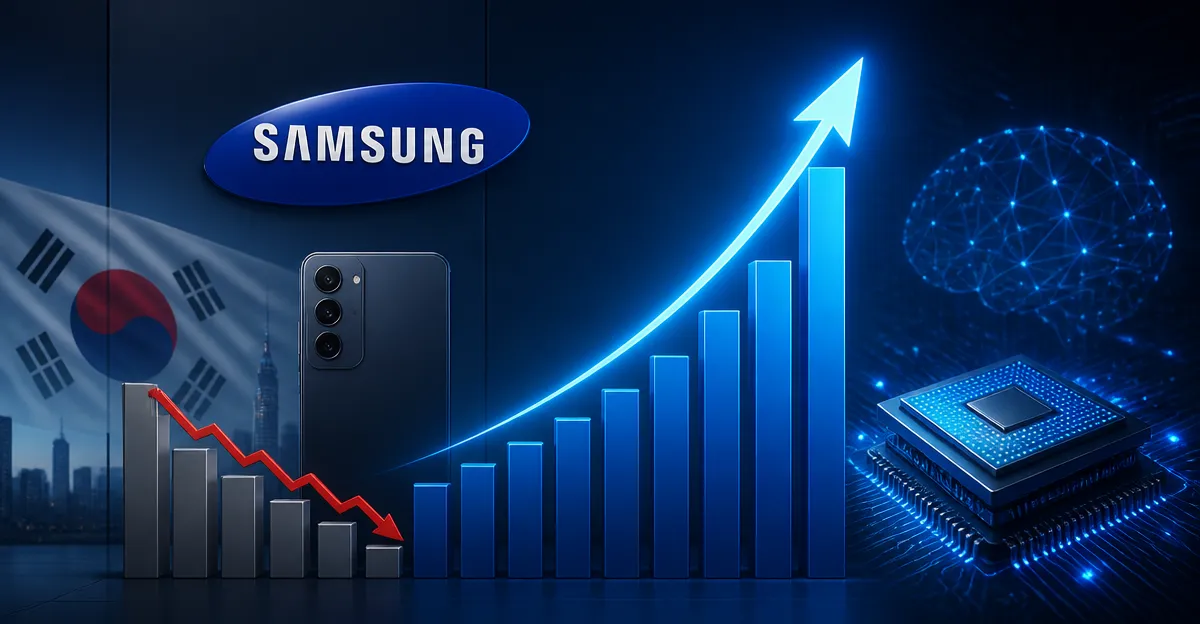
July 30, 2026, (Inside AI) — Samsung Electronics reported a record-breaking second quarter, with operating profit surging 19-fold to 89.5 trillion won ($61.98 billion). The jump was fueled by explosive demand for AI memory chips, which overshadowed weaker earnings in its mobile division.
The world's largest memory chipmaker said revenue climbed 130% to 171.5 trillion won for the April-to-June period, compared to a year earlier. The profit figure nearly matched Samsung's earlier guidance of 89.4 trillion won, confirming the company's dominant position in the AI semiconductor supply chain.
While Samsung did not break out detailed divisional results in its preliminary release, the numbers underscore how high-bandwidth memory (HBM) and other advanced DRAM products are reshaping the company's financial profile. Demand for HBM3E, the latest iteration used in Nvidia's H200 and Blackwell GPU platforms, has been particularly intense. Samsung began mass production of its 12-stack HBM3E chips in early 2026, targeting a market that research firm TrendForce estimates will grow to $50 billion by 2027.
The mobile business, once Samsung's cash cow, continued to face headwinds from sluggish smartphone sales and component cost pressures. But the chip division's performance was so strong that it completely offset those losses, a stark reversal from the 4.68 trillion won operating profit posted in the same quarter last year, when memory prices were in freefall.
The HBM Bottleneck Is Real
Samsung's results arrive amid a persistent global shortage of advanced packaging capacity for AI chips. The company's ability to ramp HBM output depends on its advanced 2.5D and 3D packaging lines, which are running at near-full utilization. Analysts at Counterpoint Research note that Samsung's investment in its Cheonan campus, where it is building dedicated HBM packaging lines, will be critical to maintaining its lead over rivals SK Hynix and Micron.
"The entire semiconductor industry is going through a structural shift driven by AI, and memory is at the center of it," said Neil Shah, Vice President of Research at Counterpoint. "Samsung's scale gives it an advantage, but the real battle is in advanced packaging and thermal management."
Samsung's foundry business, which manufactures logic chips for clients like AMD and Qualcomm, also benefits from the AI wave. The company's 3-nanometer gate-all-around (GAA) process is being used for some AI accelerator chips, though yields have been a concern.
Memory Prices Defy Gravity
The profit explosion reflects a dramatic recovery in memory chip prices. After plunging in late 2025, contract prices for DRAM and NAND flash have more than doubled in the past year, according to data from TrendForce. The premium for HBM chips is even steeper, with some reports indicating that HBM3E sells for five to seven times the price of standard DDR5 memory.
Samsung's capital expenditure is expected to reach a record 65 trillion won this year, with most of it directed toward memory and advanced packaging. The company is also expanding its Pyeongtaek campus, which will house new EUV lithography lines for next-generation DRAM. A recent technical blog post from Samsung detailed its progress on 1c-nm DRAM, which promises a 30% reduction in power consumption compared to current 1b-nm technology.
Despite the stellar results, Samsung faces geopolitical risks. U.S. export controls on advanced semiconductor equipment to China could limit its ability to operate its Xi'an NAND flash plant at full capacity. The company is navigating these restrictions while trying to capture demand from Chinese AI firms, which are stockpiling legacy memory chips ahead of potential further sanctions.
Looking ahead, Samsung expects AI-driven demand to remain strong through 2026, with the next catalyst being the mass adoption of HBM4 in 2027. The company is already sampling HBM4 to key customers and aims to integrate it with custom logic dies, a technology known as memory-semantic computing. This could open new markets in edge AI and autonomous vehicles, though commercial viability remains years away.