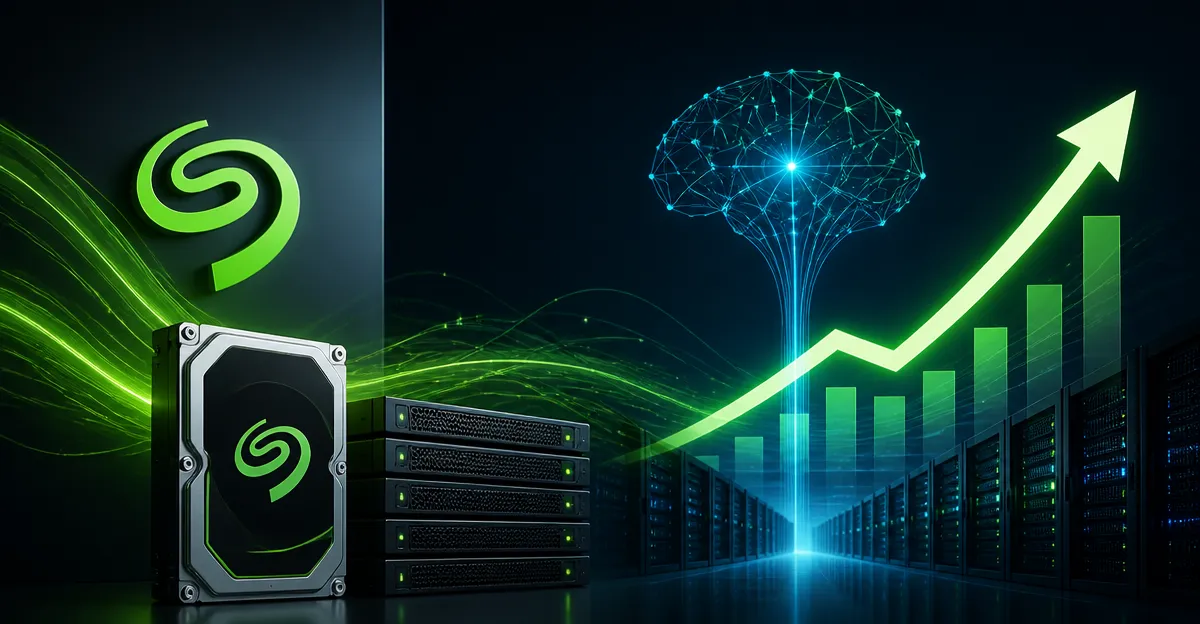
July 29, 2026, (Inside AI) — Seagate Technology projected fiscal first-quarter revenue and profit that handily beat Wall Street targets, propelled by surging orders for high-capacity hard disk drives used in AI infrastructure.
Shares of the Singapore-based company jumped more than 8% in extended trading on Tuesday, adding to a rally that has more than doubled the stock’s value this year.
The upbeat forecast underscores a dramatic shift in storage economics: as hyperscalers race to deploy AI training and inference clusters, demand for dense, cost-effective nearline HDDs is outstripping supply. Seagate’s 30TB+ heat-assisted magnetic recording (HAMR) drives, now shipping in volume, are becoming the de facto standard for AI data lakes where petabytes of unstructured data must be stored cheaply and accessed reliably.
This contrasts sharply with the narrative that flash storage would cannibalize spinning disks. In AI workloads, the bulk of training data is written once and read infrequently, making HDDs’ $0.02 per gigabyte economics irreplaceable against SSDs’ $0.20 per gigabyte. Seagate’s results validate that hybrid storage architectures are not transitional but permanent fixtures in AI infrastructure.
The HDD Renaissance Nobody Predicted
For years, hard drives were dismissed as legacy technology destined for obsolescence. But the AI boom has inverted that thesis. A single GPT-scale training run can consume hundreds of petabytes of text, image, and video data. Storing that on all-flash arrays would bankrupt most AI labs.
Seagate’s HAMR technology, which uses a laser to briefly heat the disk surface for higher density writes, has allowed areal densities to scale beyond 2 terabits per square inch. This capacity leap, combined with the company’s Mach.2 dual-actuator design that doubles IOPS, makes HDDs viable for AI data staging and checkpointing, not just cold archives.
Competitor Western Digital recently reported similar trends, but Seagate’s pure-play HDD focus gives it outsized leverage. Its 30TB+ drives are ramping at a time when NAND flash prices remain elevated due to fabrication cuts, further tilting the cost equation toward HDDs.
Supply Constraints and Geopolitical Tailwinds
Seagate’s forecast also reflects tightening supply. The company’s factories in Thailand and China are running near full utilization, and lead times for high-capacity drives have stretched to 12-16 weeks, according to channel checks. This scarcity gives Seagate pricing power it hasn’t enjoyed since the Chia cryptocurrency bubble of 2021.
Geopolitics may be amplifying demand. As nations erect AI sovereignty barriers, domestic data centers are stockpiling storage. India’s recent mandate that AI training data remain within borders has triggered a rush for on-premise HDD clusters. Seagate, with a significant manufacturing footprint in Southeast Asia, is well-positioned to serve these regional buildouts without crossing U.S.-China export controls.
Analysts caution that the cycle could turn if AI capital spending slows. But for now, the storage industry is riding a wave that shows no sign of cresting. Seagate’s next earnings call, expected in October, will reveal whether this momentum is sustainable or a spike driven by panic buying.