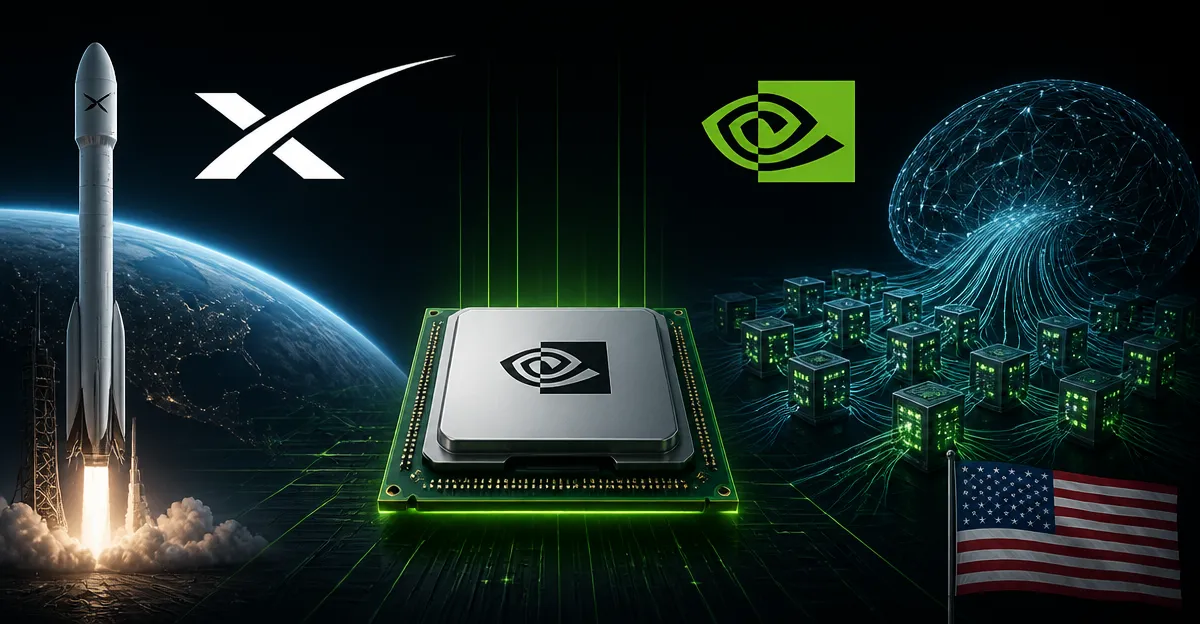
August 24, 2026, (Inside AI) — SpaceXAI will deploy NVIDIA Vera CPUs to accelerate its next generation of agentic AI workloads, the companies announced today. The move brings the first CPU built specifically for AI agents to one of the world’s most ambitious AI deployments.
Agentic AI applications increasingly depend on CPUs to orchestrate tools, execute code, process data, and run simulations between model calls. SpaceXAI will use Vera to accelerate these application workloads, helping AI agents act faster while keeping GPUs fed and fully utilized.
SpaceXAI is expanding its AI infrastructure behind Grok with the NVIDIA Vera Rubin platform as it scales toward gigawatts of computing capacity. The company also plans to extend its use of NVIDIA accelerated computing into space, with the first-generation Starmind AI satellite based on an optimized NVIDIA Vera Rubin NVL72 system.
The announcement signals a shift in how hyperscale AI operators think about CPU architecture. For years, GPUs have dominated AI infrastructure conversations. But as agentic systems move from generating text to executing multi-step workflows, the CPU’s role in orchestration, tool use, and data processing has become a bottleneck.
NVIDIA’s Vera CPU targets precisely that gap. It features 88 NVIDIA-designed Olympus cores, NVIDIA Spatial Multithreading technology, and high-bandwidth LPDDR5X memory, delivering up to 1.2TB/s of bandwidth. NVIDIA claims Vera enables up to 1.8x faster task completion compared with x86 CPUs across workloads including agentic AI, reinforcement learning, and data processing.
“Agentic AI requires a new kind of computing system — one built not only to generate answers, but to take action,” said Ian Buck, vice president of hyperscale and high-performance computing at NVIDIA. “Vera gives AI agents the CPU performance to act in real time — executing code, processing data and coordinating complex tasks. SpaceXAI is taking this architecture from massive AI factories to the next frontier of computing in orbit.”
SpaceXAI president Mike Nicolls framed the decision in operational terms. “Vera gives us the CPU performance and memory bandwidth to run enormous amounts of orchestration, code and data processing while keeping GPUs doing what they do best,” he said. “That means higher-performance AI agents and more useful work from every watt of compute.”
Why CPUs Became the Agentic AI Bottleneck
The industry’s pivot toward agentic AI has exposed a fundamental mismatch in data center architecture. Large language models generate tokens on GPUs, but the work between model calls, tool invocation, API orchestration, code execution, and state management, runs on CPUs. Traditional x86 server processors were never optimized for this pattern.
NVIDIA’s bet with Vera is that purpose-built CPU cores, combined with high memory bandwidth and spatial multithreading, can reduce latency in agentic pipelines. The 1.2TB/s memory bandwidth figure is notable. It exceeds what most x86 server CPUs offer today, and it matters because agent orchestration involves frequent, irregular memory access patterns.
SpaceXAI’s adoption is a significant validation for NVIDIA’s full-stack strategy. The company is not just buying GPUs. It is standardizing on the Vera Rubin platform, which integrates NVIDIA accelerated computing, NVLink interconnect, Spectrum-X Ethernet networking, BlueField data processing units, and NVIDIA software into a single architecture.
That integration is designed to drive down cost per token while maximizing performance and energy efficiency. For a company scaling toward gigawatts of computing capacity, those economics are decisive.
Orbital Computing Constraints Reshape Hardware Choices
SpaceXAI’s plan to put a Vera Rubin NVL72 system into orbit aboard the Starmind satellite introduces constraints that terrestrial data centers never face. Power availability, thermal management, bandwidth, reliability, and physical integration all change dramatically in space.
NVIDIA and SpaceXAI are working to adapt the Vera Rubin foundation to orbital requirements while preserving a common architecture and software ecosystem. That commonality is the strategic point. If the same software stack runs on Earth and in orbit, SpaceXAI can move workloads between environments without rewriting its AI infrastructure.
The Starmind satellite represents an early test of whether rack-scale AI systems designed for data centers can function in space. The optimized NVL72 configuration suggests significant engineering work on power delivery and thermal dissipation, two areas where space environments are unforgiving.
SpaceXAI’s broader roadmap now spans three tiers: Vera CPUs accelerating increasingly sophisticated AI agents, Vera Rubin powering the AI infrastructure behind Grok and gigawatt-scale AI factories on Earth, and NVIDIA accelerated computing extending into orbital AI infrastructure. The company is betting that a single computing foundation can span all three.
NVIDIA’s push into CPU territory also intensifies its competition with AMD and Intel in the data center. Both incumbents have launched AI-focused server processors, but neither has a platform that integrates CPU, GPU, networking, and software as tightly as Vera Rubin. SpaceXAI’s decision suggests that integration is winning over hyperscale customers who prioritize total system efficiency over component-level benchmarks.
For the broader AI industry, the announcement marks a milestone in the transition from generative AI to agentic AI. The infrastructure requirements are different. CPUs are no longer an afterthought. They are a critical part of the agent execution stack, and vendors that ignore that shift risk being left behind.