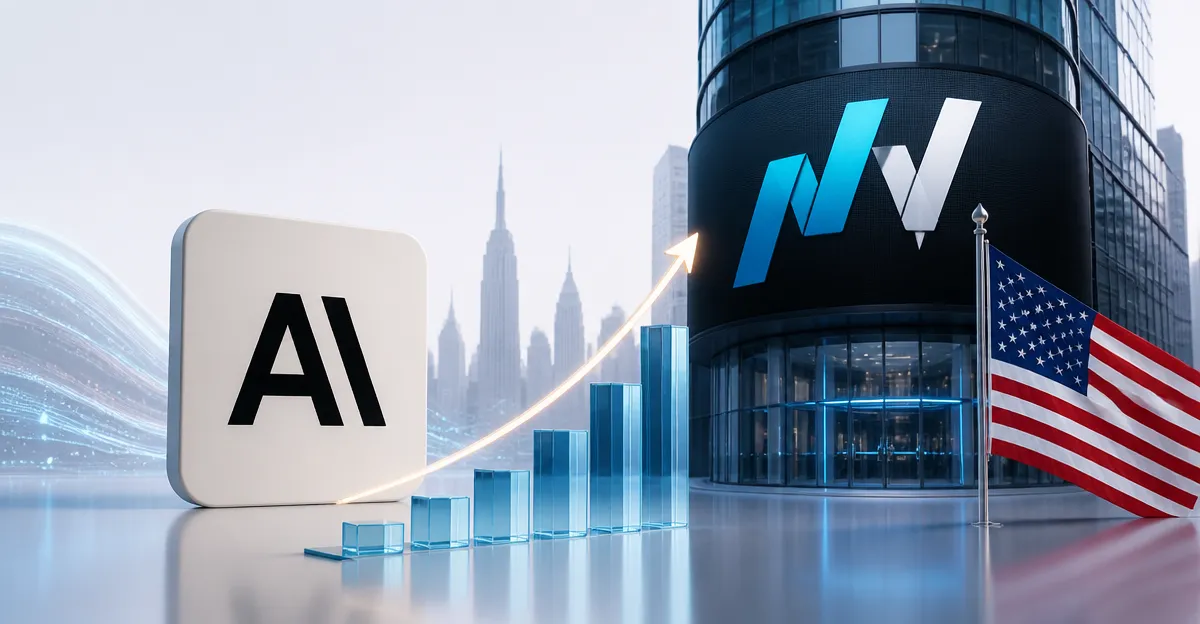
November 19, 2026, (Inside AI) — Anthropic, the San Francisco-based maker of the Claude AI assistant, began trading on the Nasdaq on Thursday after completing the largest share offering ever by an artificial intelligence company. The listing caps a five-year run from a small research outfit founded by former OpenAI employees to a public company with a valuation that rivals some of the largest technology firms in the world.
The company, founded in 2021 by siblings Dario Amodei, its chief executive, and Daniela Amodei, its president, has become one of the most closely watched names in enterprise AI. Its flagship product, Claude, powers consumer and business tools including Claude Code for software development and Claude Cowork for workplace tasks. The majority of its revenue comes from businesses paying for model access per use, measured in tokens of information processed, alongside paid subscription tiers.
The financial trajectory behind the listing is striking. Anthropic reported revenue of $4.59 billion in 2025, up from $386 million a year earlier. For the six months ended June 2026, revenue reached $16.29 billion, a leap from $1.16 billion in the same period of 2025. That growth rate is among the fastest ever recorded by a software company at this scale, and it explains why public market investors were willing to absorb a record offering.
But the numbers also carry a warning. Computing power is Anthropic's largest expense, and its compute and infrastructure costs have dwarfed revenue over the past three years. The company has spent heavily to secure access to graphics processors and data center capacity, a cost structure that mirrors the rest of the frontier AI industry. Public shareholders will now scrutinize that spending in quarterly filings for the first time.
Amazon And Google Sit On Both Sides Of The Ledger
Anthropic's corporate relationships add a layer of complexity that public investors have rarely encountered. Amazon and Google are both computing partners and among Anthropic's top shareholders, a circular financing structure that has dominated capital flows across the AI industry. The arrangement means two of the largest cloud providers are simultaneously suppliers, investors, and competitors in the generative AI race.
The company's most direct competitor is OpenAI, the creator of ChatGPT. But Anthropic is also locked in a race with Elon Musk's SpaceX, Alphabet's Google, and Meta for dominance in generative AI. Each of those rivals has deep pockets and its own infrastructure strategy, and several are expected to pursue public listings or major capital raises of their own.
The competitive pressure extends to talent and compute. Anthropic has positioned itself around safety research and enterprise reliability, a contrast to OpenAI's consumer-first approach. That positioning has won it large corporate customers, but it has not insulated the company from the capital intensity of training frontier models. Every new model generation requires billions of dollars in compute, and the company has acknowledged that its infrastructure spending will remain elevated.
The decision to list on Nasdaq rather than the New York Stock Exchange follows a pattern among technology issuers seeking a market with a strong concentration of institutional growth investors. Nasdaq has hosted several of the largest technology IPOs of the past decade, and Anthropic's choice signals that it expects to be valued as a growth company rather than a mature enterprise software firm.
For the broader AI industry, the listing marks a turning point. Until now, the largest AI companies have been private, funded by venture capital and corporate strategic investors. Anthropic's public debut gives retail and institutional investors direct exposure to the sector, and it creates a public benchmark against which rivals can be measured. It also introduces quarterly earnings pressure to a company that has prioritized long-term research over short-term profitability.
The offering's record size also raises questions about market appetite. Public investors have shown willingness to absorb large AI listings, but the sector has yet to prove that it can generate sustainable profits at scale. Anthropic's prospectus, which disclosed the heavy compute costs, will be read closely by analysts looking for a path to profitability. The company has not provided a timeline for reaching positive earnings.
Anthropic's public market debut also has implications for the circular financing structures that have drawn scrutiny from regulators and economists. With Amazon and Google as both shareholders and suppliers, the company's cost of compute is tied to the performance of its own investors. That relationship will now be visible in public filings, and it may invite questions about transfer pricing and arm's length dealings.
The listing is expected to value Anthropic at a level that places it among the most valuable companies to go public in U.S. history. Trading began under the ticker symbol ANTH, according to sources familiar with the offering. The company has not disclosed the exact amount raised, but the offering was described as the largest ever by an AI firm.
For Dario and Daniela Amodei, the listing completes a transformation from OpenAI alumni to public company executives. The siblings founded Anthropic after leaving OpenAI in 2021, citing differences over safety and commercial direction. Their company now stands as a direct challenge to their former employer, and the public markets will judge which approach delivers better returns.
As trading began, the focus shifts to Anthropic's first earnings report as a public company. That report will reveal whether the revenue growth of the past two years can continue, and whether the company can bring its compute costs under control. For now, the record offering has answered one question: public investors are willing to bet on the AI frontier.

Shamil has a low tolerance for AI that only works in controlled demos. He covers agentic systems and generative AI with the skepticism of someone who has seen too many “revolutionary” tools quietly disappear six months after launch.