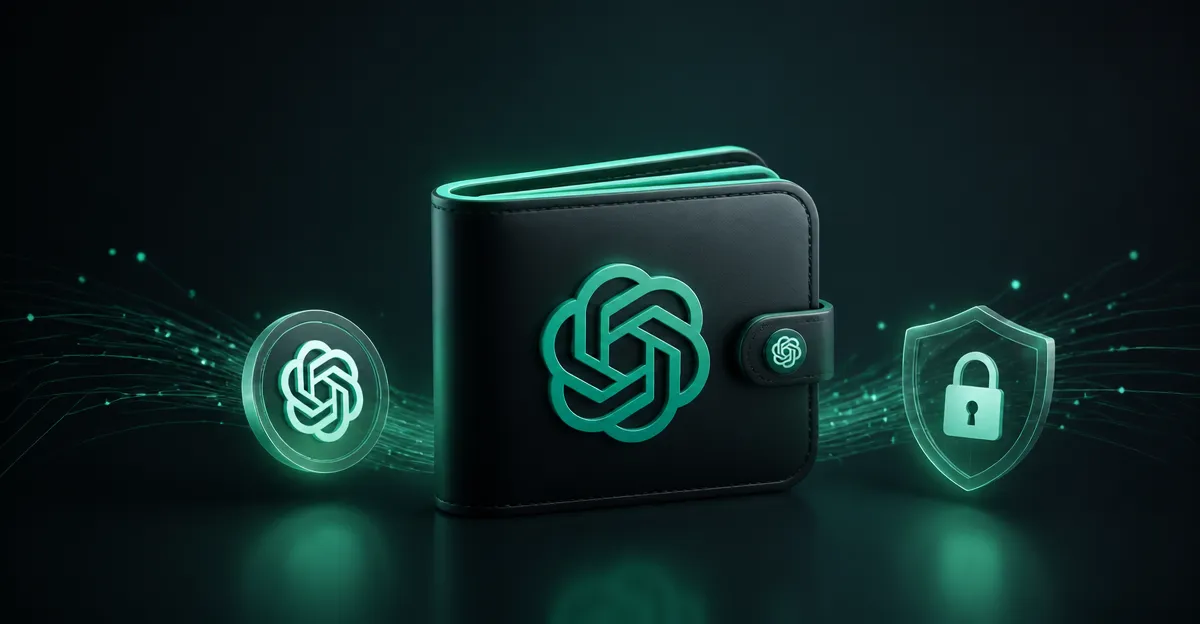
November 13, 2026, (Inside AI) — OpenAI on Thursday introduced ChatGPT Wallet, a payment system that lets AI agents complete purchases without ever accessing a user's actual card details. The wallet, built with American Express, Mastercard, and Visa, launches first through dots for ChatGPT Pro subscribers in the United States. It requires a biometric security check for every transaction.
The move marks OpenAI's most direct entry into commerce, turning a platform used by 1.2 billion people weekly from a product research tool into a checkout layer. ChatGPT Wallet is the first wallet that lets agents pay without seeing card numbers and mandates user approval for each purchase, while preserving existing card rewards and dispute protections.
Users add a card once. Before each purchase, they review items, total, and selected card, then approve with Face ID or a fingerprint scan. Each approval creates a record of authorized purchases. The payment network then issues a token, a substitute card number with its own security code and expiration date, which is charged to the user's card. Neither the business nor the agent sees the real card details.
The wallet is available only to Pro subscribers aged 18 and older with eligible US-issued cards. OpenAI said it will learn from early use and expand availability with banks and networks.
Read: Nasdaq Futures Dip
Why OpenAI Is Betting on Agentic Checkout
The launch addresses a structural problem in agentic commerce: websites and payment risk systems often block automated purchases. OpenAI is publishing a Commerce Partner Playbook with guidance on making product information available, ensuring agent access, and reducing unnecessary declines. It is also urging businesses to adjust risk systems to recognize legitimate agent purchases.
The company's approach keeps existing rails intact. Users transact directly with businesses, which retain customer relationships, pricing, fulfillment, returns, and service. Banks and networks evaluate transactions. Card rewards and eligible dispute protections remain with the user's card.
OpenAI said it expects users to eventually delegate purchases entirely by setting spending limits, categories, or time periods, with pre-approval backed by enhanced safeguards. That shift would move the wallet from per-purchase approval to parameter-based autonomy, a change with significant implications for fraud liability and consumer protection.
The partnership with all three major US card networks gives the wallet broad acceptance potential. But agentic payment standards remain unsettled. Rival efforts include Google's agent payments protocol and independent agent commerce frameworks, each competing to define how agents authenticate and transact. OpenAI's early lead in consumer AI usage gives it distribution, but merchant adoption will depend on whether its playbook reduces declines without opening fraud channels.
"We're building agent-led commerce to fit reliably into existing systems," OpenAI said in its announcement, adding that users keep their card's existing rewards and protections for eligible disputes with businesses, for example when an item is defective.
The limited rollout suggests OpenAI is prioritizing reliability over speed. Agentic commerce remains nascent, and premature scaling could expose merchants and networks to chargebacks and fraud. Starting with Pro subscribers gives OpenAI a technically sophisticated user base likely to tolerate early friction.
Read: Nebius Tops Q3 Revenue
OpenAI's commerce push follows its broader strategy of embedding transactions into ChatGPT. The company has tested shopping features and merchant integrations, but a native wallet with network backing is a deeper commitment. It also positions OpenAI against Apple Pay and Google Pay, though those systems authenticate humans, not agents.
The Commerce Partner Playbook signals that OpenAI wants merchants to adapt rather than rebuild. Businesses that fail to update bot-blocking and risk rules may lose sales to competitors that do. That dynamic could accelerate agent-friendly infrastructure across e-commerce platforms.
For now, ChatGPT Wallet is a US-only, Pro-only experiment. Its success will hinge on merchant acceptance, fraud rates, and whether users trust an AI agent with purchase authority. OpenAI has not disclosed fee structures or whether it will earn revenue from transactions. The company said it will expand availability as it learns from early use.

Shamil has a low tolerance for AI that only works in controlled demos. He covers agentic systems and generative AI with the skepticism of someone who has seen too many “revolutionary” tools quietly disappear six months after launch.