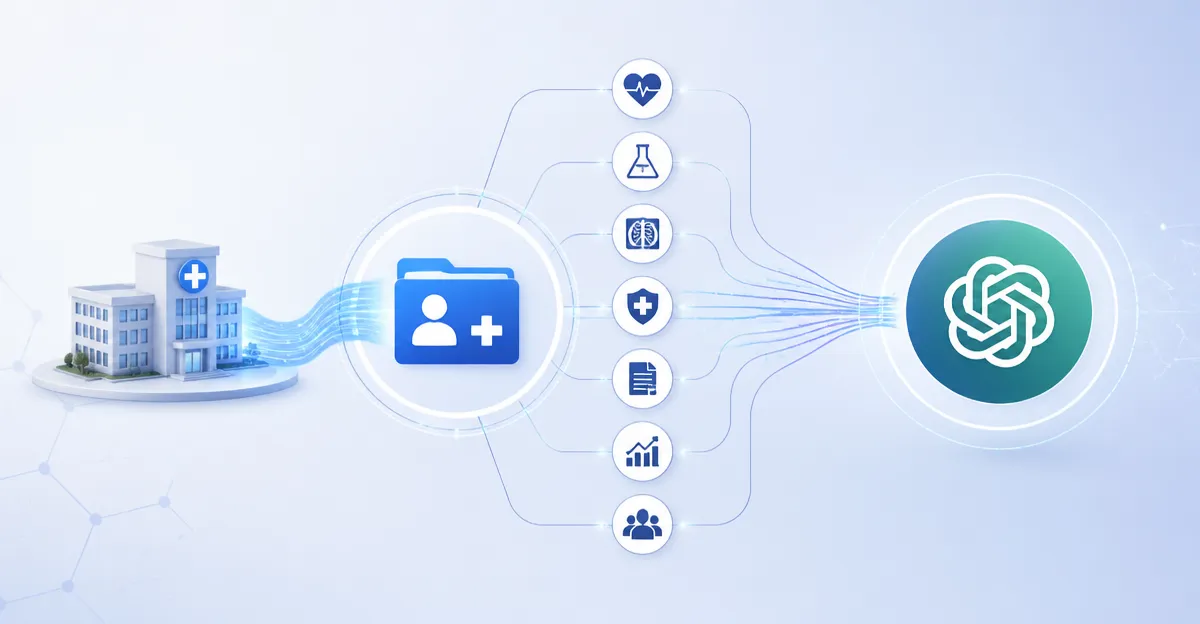
September 2, 2026, (Inside AI) — OpenAI has launched a new electronic health record integration that connects Epic environments directly to ChatGPT for Healthcare. The move lets clinicians pull authorized patient context, including appointment notes, lab results, medications, and specialist documentation, into a governed AI workspace.
The company also introduced the Healthcare Public Data plugin, which links ChatGPT to nine official public healthcare sources such as PubMed, DailyMed, ClinicalTrials.gov, and CMS Coverage. Together, these tools aim to reduce the time clinical teams spend searching across disconnected systems.
OpenAI said the integration supports two complementary experiences. One surfaces relevant patient information within ChatGPT. The other points back to supporting chart information in Epic. Both are designed to complement existing EHR workflows rather than replace them.
Read: AI Tool Spots Heart Disease in Under 2 Seconds from ECG
Clinical Accuracy Claims Face Independent Scrutiny
OpenAI reported that physicians across 60 countries, 49 languages, and 26 medical specialties have reviewed more than 700,000 model responses to date. In a targeted evaluation, physicians assessed 27 clinical use cases using connected EHR context, including pre-visit review, clinical timelines, medication review, and handoff summaries.
Across 4,363 ratings, clinicians rated 99.1% of responses safe. In a separate two-round evaluation covering five connected data sources, more than 93% of responses were rated as having good or better accuracy.
These figures are internal evaluations. They have not been published in a peer-reviewed journal. Independent researchers have previously raised concerns about AI models generating plausible but incorrect clinical information, a risk known as hallucination. Without external validation, the safety and accuracy claims remain difficult to verify.
Read: Can an AI-Powered Scribe Curb Physician Burnout?
Governance and Compliance Shape Enterprise Adoption
ChatGPT for Healthcare includes role-based access, single sign-on, and audit logs. With an applicable Business Associate Agreement, customers can use ChatGPT Work, Codex, apps, and plugins in the same workspace to support HIPAA-compliant workflows.
The Healthcare Public Data plugin provides dedicated connectors to nine official sources, including RxNorm and provider records. Teams can work with specific records, fields, identifiers, and versions while focusing tasks on authoritative sources. This makes it easier to compare trial eligibility criteria, medication identifiers, coverage policy versions, and provider records without searching each source separately.
OpenAI also highlighted enterprise integrations with Microsoft SharePoint, Google Drive, Salesforce, and Slack. These plugins expand approved business context in ChatGPT while preserving existing permissions.
Healthcare organizations can start with the capabilities that fit their needs and expand over time. OpenAI directs interested customers to contact its sales team for the right solution.