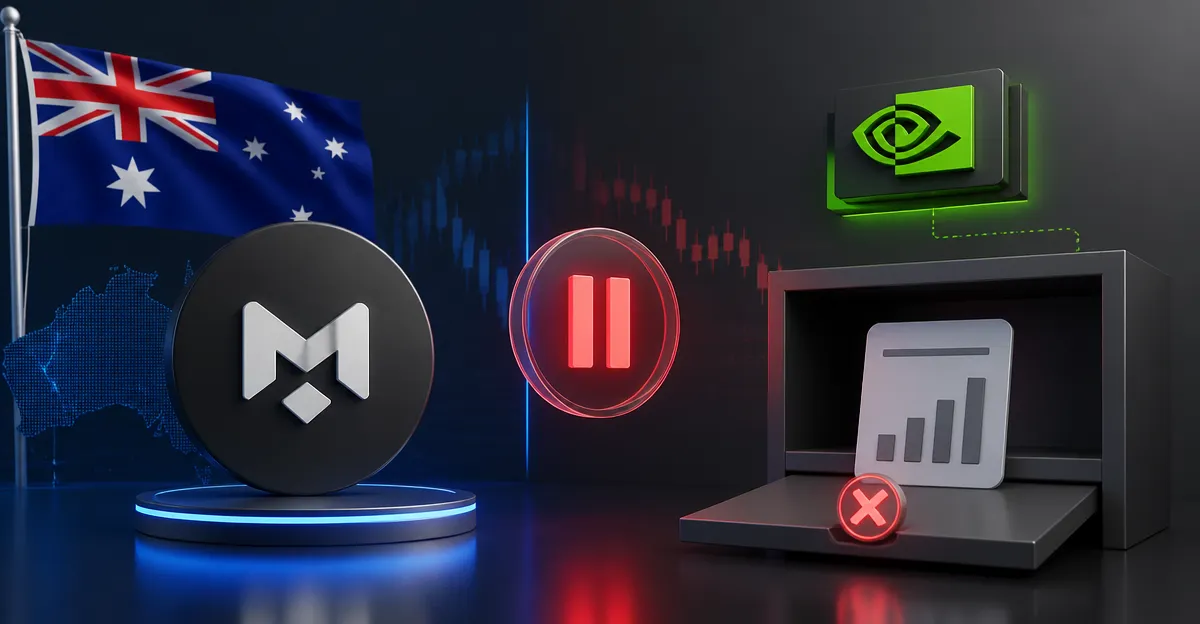
October 9, 2026, (Inside AI) — Shares of Australian construction services provider Maas Group entered a trading halt on Friday, pending a material announcement tied to Nvidia-backed data centre operator Firmus, which abruptly shelved its A$5 billion initial public offering. The halt came one day after Maas stock plunged more than 20%, erasing roughly A$517 million in market value.
Maas said it requested the halt while it prepares an update on its contractual arrangements with Firmus. The company expects the suspension to lift once it releases that update, or by the start of trading on Monday.
The sequence of events exposes a widening gap between the hype surrounding AI infrastructure and the discipline of public market investors. Firmus, which counts OpenAI as its anchor customer, designs and operates modular AI factories using proprietary energy and cooling technology. Its listing would have ranked as Australia's second-largest on record.
Instead, the company scrapped the IPO on Friday and said it would pursue a private fundraising round. The decision followed lukewarm demand from institutional investors, according to sources familiar with the matter, despite a term sheet circulated at launch claiming indicative orders were already sufficient to cover the offering size.
Valuation Doubts Sink A Record Listing
Prospective investors who reviewed the deal told Inside AI they were concerned about Firmus's rapidly rising valuation, its ability to deliver on ambitious expansion plans, and its hefty debt load. Those concerns outweighed the company's high-profile backing and its anchor customer relationship.
Read: AI's Debt-Fueled Boom Faces a 24-Year High in Borrowing Costs
The pullback signals that investors remain selective toward AI-linked listings even as the artificial intelligence boom fuels global equity markets. The episode echoes earlier caution seen in other AI-adjacent public offerings, where revenue projections have often outpaced near-term commercial traction.
Maas's exposure to Firmus is direct. In early August, Maas pledged an additional A$300 million ($208.74 million) to Firmus through ordinary and preference shares priced at A$230 apiece. That investment increased Maas's stake in the data centre operator to 3.2%.
The trading halt marks a sharp reversal for Maas, whose shares had reached a record high earlier this month. The stock is now down more than 30% from that peak. The selloff on Thursday alone was the company's steepest single-day decline in recent memory, according to exchange data.
Firmus had positioned itself as a critical piece of AI infrastructure in the Asia-Pacific region, leveraging Nvidia's backing to attract attention from sovereign wealth funds and technology-focused institutional investors. Its modular AI factories are designed to be deployed quickly, addressing power and cooling constraints that have slowed data centre construction globally.
Yet the company's debt-financed expansion strategy raised red flags. Investors questioned whether Firmus could service its obligations if AI infrastructure spending slowed or if competition from larger cloud providers intensified. The shelved IPO leaves those questions unresolved.
For Maas, the immediate priority is clarifying the status of its contractual arrangements with Firmus. The company has not disclosed whether the private fundraising round will alter the terms of its existing investment or its role as a construction partner.
The broader implication for Australia's capital markets is significant. The Firmus IPO was viewed as a test of investor appetite for large-scale AI infrastructure deals in the region. Its failure may prompt other AI-linked companies to reconsider listing timelines or seek private capital instead.
Nvidia's involvement had been a key selling point for the offering. The chipmaker's backing lent credibility to Firmus's technology and its access to GPU supply, which remains constrained globally. But even that endorsement could not overcome concerns about valuation and leverage.
Maas said it would update the market as soon as possible. The trading halt will remain in place until that announcement is released or until Monday's open, whichever comes first. Investors will be watching closely for details on how the Firmus setback affects Maas's balance sheet and forward guidance.
The episode underscores a broader shift in AI investment sentiment. Public market investors are demanding clearer paths to profitability and more conservative capital structures, even as private venture funding for AI continues to flow. For data centre operators and their construction partners, the message is clear: access to capital is no longer guaranteed by association with the AI boom alone.