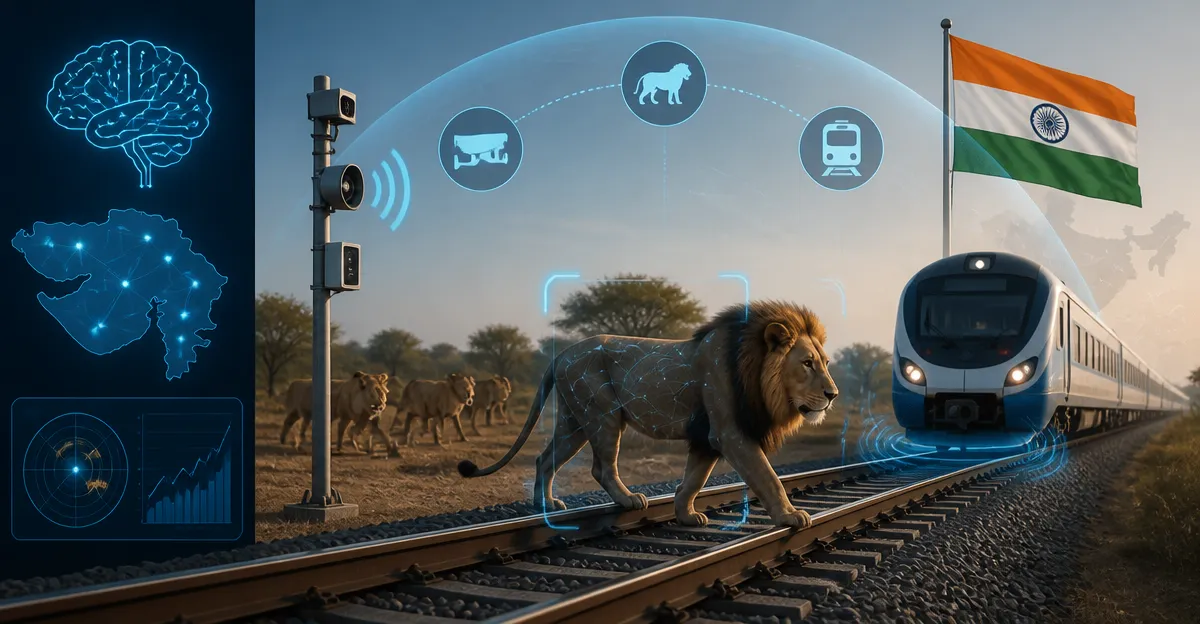
August 19, 2026, (Inside AI) — A railway track in Saurashtra once meant a race against time for Asiatic lions. A tracker would raise an alarm, a train would slow, and the animal would be coaxed away. After 19 lions were fatally hit by trains between 2014 and 2024, the Gujarat government deployed technology alongside traditional safeguards and diverted 6,682 lions from railway tracks across Junagadh, Gir-Somnath, Amreli, and Porbandar districts.
The experiment achieved a striking result: no lion was killed by a train between August 2024 and May 2026. The detail appears in an affidavit by Conservator of Forest, Junagadh, Ram Ratan Nala before the Gujarat High Court as part of a suo motu Public Interest Litigation.
For years, railway tracks cutting through Saurashtra’s lion country were a deadly collision point between India’s fastest-growing lion population and its expanding transport network. The court-monitored safety system is producing a reversal as Asiatic lions expand beyond the traditional confines of the Gir landscape.
The compliance report shows a mix of human and technical measures. The government deployed 70 railway trackers, cleared 14.23 hectares of vegetation, installed watch towers, underpasses, and speed restrictions. It also put in place an Intrusion Detection System that includes AI-based monitoring, CCTV surveillance, LED lights on trains, and optic fibre cables to detect lion movement along tracks.
The fibre optic sensing cables were laid along the Liliya-Savarkundla section in Amreli district. A more specific deployment involved a 6-core OFC cable laid in a zigzag pattern in that section, an area identified for frequent lion movement.
In an order dated July 31, 2026 (uploaded August 10), a Bench of Chief Justice Sunita Agarwal and Justice D N Ray perused the affidavit dated July 30 filed by Nala, through Additional Advocate General Manisha Luvkumar, in compliance with the June 12 HC order. Nala is a member of the High-Level Committee directed by the HC to examine the incidents and prevent them.
The state government’s submission notes an incident on November 14, 2025, when a train hit a year-old cub between the Vadiya-Haveli and Vavdi stations. It suffered fractures and was taken to Sakkarbaug zoo where it recovered.
The latest operational figures between April and July 2026 show 33.4 km of vegetation cleared, 1,104 lion-diversion operations undertaken, 1,356 caution orders issued, and around 100 wildlife-movement hotspots identified. Fourteen railway underpasses required retrofitting, 13 new underpasses were proposed, and 62 underpasses were assessed to be in good condition.
The broader compliance report records 6,682 lions diverted and 1,148 other animals diverted under the safety regime. It lists nine permanent hotspots, 66 signages, 26 watchtowers, and 5,909 caution orders. Three loco-pilot training sessions trained 136 loco pilots, while five joint inspections were conducted between 2024 and 2026.
AI accuracy still needs improvement
The affidavit states that the latest, eighth meeting reviewed mitigation measures, including improving wildlife underpasses, expediting railway safety measures, installing twin LED headlights in locomotives, and trials of the Intrusion Detection System. The committee directed the adoption of AI-based monitoring, early warning systems, and CCTV surveillance to enhance detection of lion movement.
The AI component is still evolving. The SOP provides for AI-powered cameras with software and hardware at hotspot areas for early detection of lions near railway tracks and for raising alarms to loco pilots. Earlier committee deliberations recorded that the process of generating an AI “signature” for lions was underway.
The committee recorded that “the current software accuracy requires improvement”, while the feasibility of laying additional fibre cables in forest areas was to be examined with the Forest Department. The SOP states that IDS technology will be “implemented in phased manner after proof of concept by Western Railway”, subject to railway sanction.
The affidavit describes this as trackside AI and surveillance technology, not an AI system installed inside locomotives. Trains have a separate upgrade: locomotives operating in hotspot areas have twin-beam headlights. Western Railway reported conversion of 559 of 917 locomotives to LED headlights, with the remaining 358 under conversion.
Court pushes for measurable impact
The High Court has posted the matter on September 11 to bring before it the status of retrofitting underpasses, the impact of twin LED headlights, and trials of the Intrusion Detection Device System. The progress in adoption of AI-based monitoring will also be placed on record.
The court’s focus on measurable impact reflects a broader shift in conservation technology. AI-based wildlife detection systems are increasingly used globally, from elephant corridors in India to bear detection in North America. The Gujarat experiment shows how court oversight can accelerate deployment of unproven technology while demanding evidence of results.