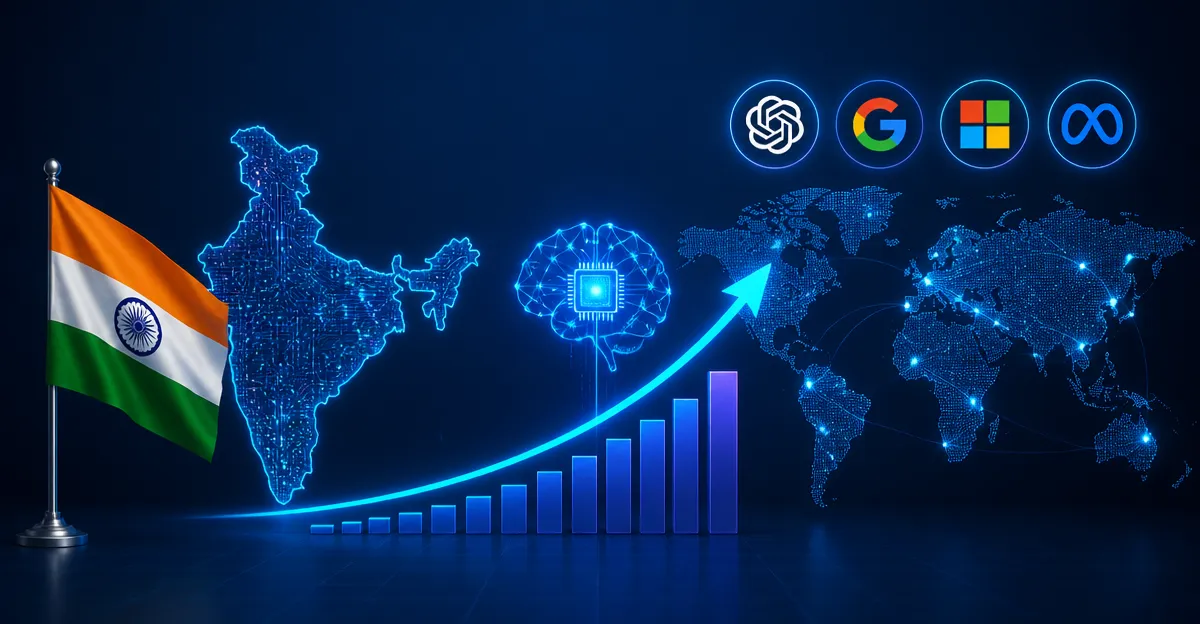
November 27, 2026, (Inside AI) — India's AI learning market is expanding quickly, but a new global skills report shows the country still lags in pairing technical AI training with the human skills needed to apply it. According to the Coursera Global Skills Report 2025-26, AI course enrollments in India grew 57 per cent year over year, trailing the global rate of 67 per cent. However, in shorter, focused AI micro-credentials, India's enrollments surged 181 per cent, well above the global 122 per cent.
The report ranks India 40th among 98 countries on its AI-Human Skills Synergy Index, which measures how well learners combine AI skills with complementary human capabilities. The index draws 60 per cent of its weight from Coursera learning behavior and 40 per cent from the Oxford Insights Government AI Readiness Index 2025. India's government readiness score outpaces its learner signal, suggesting policy efforts are ahead of grassroots skill integration.
The findings matter for a workforce that must adapt to AI-driven changes. For job seekers, the report recommends learning AI alongside communication and critical thinking. For India, the impact of national programs will depend on how consistently employers link training to specific roles and workflows.
Micro-Credentials Outpace Global Growth
India's 181 per cent growth in AI micro-credentials exceeds the global rate by 59 percentage points. The report notes that India already had high enrollment volumes in these short certifications, so the rise represents substantial additional learning. In other areas, India trails the global figure. AI security enrollments rose 296 per cent in India versus 665 per cent globally. Agentic workflows grew 238 per cent in India against 546 per cent worldwide. Generative AI was closer, at 125 per cent in India and 132 per cent globally.
Read: AI Can Add $490-685 Billion for MSMEs, Says RBI Governor Sanjay Malhotra
Trending AI themes include generative AI and prompting, AI agents that plan and execute multistep tasks, machine learning basics, and large language model applications. On the human side, learners are exploring ethics, communication, critical thinking, influencing stakeholders, and leading people. Popular courses include DeepLearning.AI's AI For Everyone and Generative AI for Everyone.
The report identifies skill pairs that Indians learn together more strongly than the global average. Prompting is often paired with communication for refining AI drafts. Generative AI pairs with communication for adapting content with human accuracy checks. AI workflows and integration pair with innovation for testing practical AI uses.
This pattern suggests Indian learners are gravitating toward applied, job-ready AI skills rather than deep technical specialization. The emphasis on communication and innovation alongside AI tools could help bridge the gap between adoption and effective deployment. However, the lag in AI security and agentic workflows signals potential vulnerabilities as enterprises scale AI systems.
Employers Favor Industry-Aligned Credentials
According to the report, 95 per cent of surveyed Indian employers value industry-partnered micro-credentials over institution-only ones, 13 points above the global sample. Further, 81 per cent say candidates with micro-credentials move faster through hiring. AI is also entering workplaces. Nearly 60 per cent of surveyed companies reported active AI deployment, while 88 per cent of surveyed employees used AI at work. However, AI is often added to existing jobs without matching changes to roles.
The Indian government's IndiaAI Mission has seven pillars covering computing power, datasets, startup financing, and safe AI. Its FutureSkills pillar supports fellowships and Data and AI Labs to widen practical training beyond major technology centers. YUVA AI for ALL, an IndiaAI course on Coursera, teaches basic, practical, and responsible AI use, with a national goal to reach 10 million people.
Globally, Europe stands out for consistency. Of its 31 countries analyzed, 25 are in the top half and none in the bottom 25. Japan, South Korea, Hong Kong, and Singapore are Asia-Pacific's entries in the top 10. The report points to European investment and adoption as context. EU members' 2025 digital roadmaps had 1,910 measures worth €288.6 billion. Enterprise AI use rose from 13.5 per cent in 2024 to 20 per cent in 2025, ranging from 42 per cent in Denmark to 5.2 per cent in Romania.
Read: Bolt and Microsoft Launch Free AI Skills Training for Drivers in South Africa
For students and job seekers, the findings point to learning AI alongside skills such as communication and critical thinking. For India, the report says the workforce impact of its national programs will depend on how consistently employers connect them to specific roles, workflows, and decisions.

Shamil has a low tolerance for AI that only works in controlled demos. He covers agentic systems and generative AI with the skepticism of someone who has seen too many “revolutionary” tools quietly disappear six months after launch.